How to Manage Multiple Businesses or Branches in One System
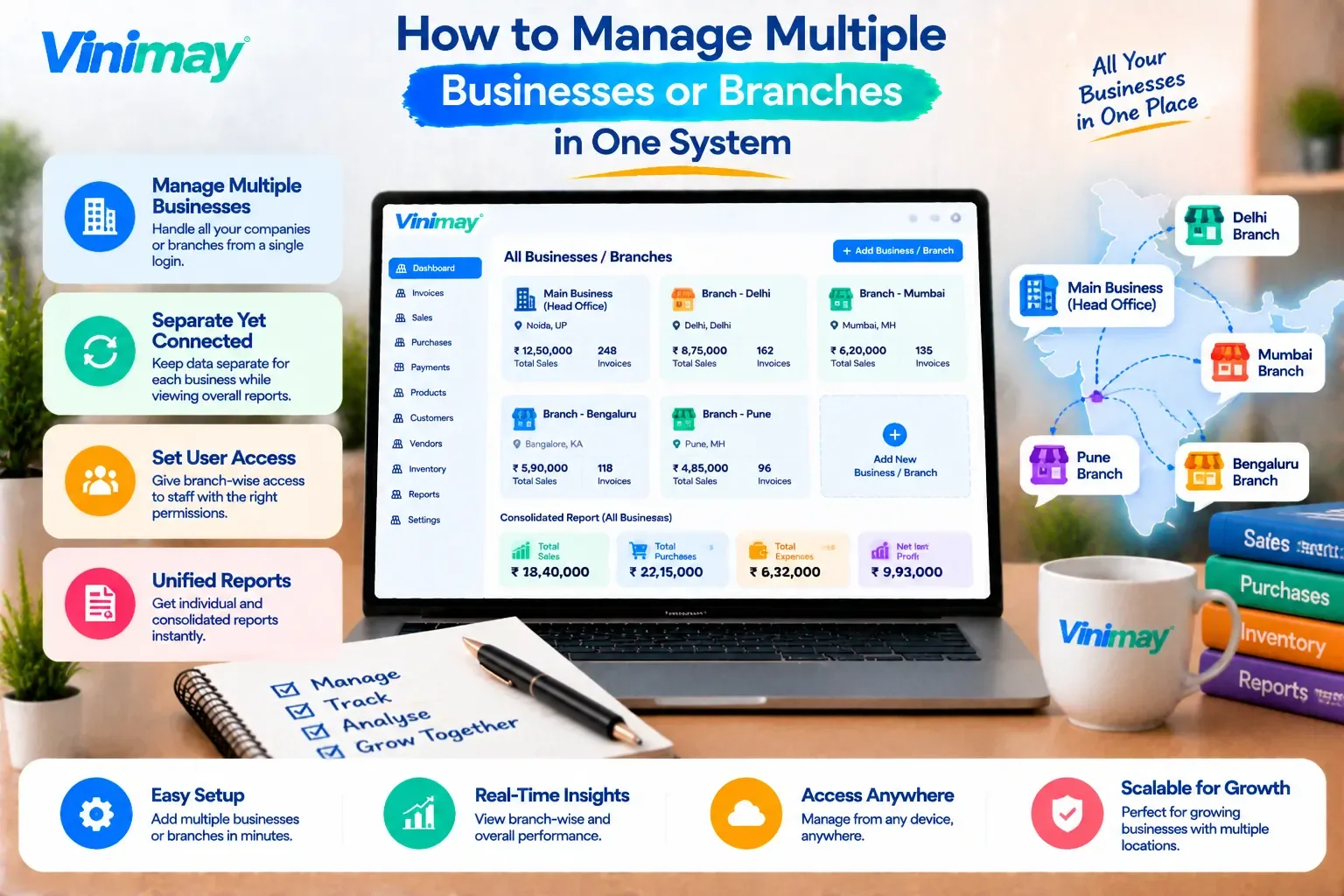
Running more than one business—a second shop location, a separate entity, or distinct branches under one owner — multiplies the usual bookkeeping challenges rather than simply adding to them. Every invoice, payment, and stock record needs to stay attached to the correct business, and a single mixed-up entry can throw off GST filings, receivables, or reports for both.Multiple Businesses
The instinct to just use separate spreadsheets or separate software subscriptions for each business often makes this worse, not better — it recreates the same manual reconciliation problem, just duplicated across multiple disconnected systems instead of one. What actually solves this is keeping each business's records distinct within a single connected system, so nothing crosses over by mistake, but everything remains accessible without switching tools.
This guide covers what genuinely matters when managing multiple businesses or branches, and the practical steps to keep everything accurate and separate.
What Does "Managing Multiple Businesses" Actually Require?
Direct answer: Managing multiple businesses accurately requires keeping each entity's invoices, GST details, customers, stock, and reports completely separate from one another, while still being accessible from a single account — rather than merging records together or maintaining entirely disconnected systems for each.
Each business likely has its own GSTIN, and invoices must reflect the correct one
Stock, customers, and vendors typically shouldn't cross between entities
Reports need to be generated per business, not blended together
Why Mixed Records Are the Biggest Risk of Running More Than One Business
The most common and costly mistake when managing multiple businesses isn't a lack of software—it's an invoice, a customer record, or a stock entry accidentally attached to the wrong business entity. This tends to happen quietly: an invoice created under the wrong company's GSTIN, a customer's outstanding balance recorded against branch A when the sale actually happened at branch B, or a stock count that gets combined across locations when it should have stayed separate. These errors are especially damaging because they don't just cost time to fix — they can affectGST filings for the wrong entity,understate or overstate receivables for a specific business, and make it genuinely difficult to know how each business is actually performing on its own. Preventing this isn't about extra vigilance; it's about having a system that structurally keeps each business's records apart by default.
What to Look For in Multi-Business Management
Practical Steps to Keep Records Separate and Accurate
Set up each business as a distinct entity within the system, with its own GSTIN and details from the start
Avoid sharing customer or vendor records across entities unless the relationship is genuinely the same for both
Confirm which entity you're working in before creating any invoice — a quick habit that prevents most cross-attribution errors
Review reports separately for each business, rather than relying on a combined view that can hide entity-specific issues
Reconcile stock per location or entity regularly, especially if goods occasionally move between branches
Keep a consistent invoice numbering approach per entity, so records stay traceable and audit-ready for each one individually
How Vinimay Manages Multiple Companies
Supports multiple company management, keeping each business's records structurally separate within one account
Applies the correct GSTIN and GST-compliant invoicing per company, avoiding cross-entity billing errors
Keeps customer and vendor management, sales records, and purchase records distinct per business
Tracks inventory and product management separately for each entity, avoiding combined or mismatched stock counts
Provides reports and ledger management per company, giving an accurate, individual view of each business's performance
Conclusion
Managing multiple businesses accurately means keeping records structurally separate, not just organised in theory
The biggest risk is a record accidentally crossing between entities — an invoice, customer, or stock count attached to the wrong business
A single connected system with clear entity separation avoids both the mixed-record risk and the hassle of disconnected, duplicated tools
Vinimay's multiple company management keeps each business distinct while staying accessible from one account
FAQs
How can I manage multiple businesses in one system?
By using software that keeps each business's invoices, customers, and stock structurally separate, while still allowing access to all of them from a single account.
Should I use separate software subscriptions for each business I run?
Not necessarily — this often recreates the same reconciliation problems in multiple disconnected places rather than solving them.
What's the biggest risk of managing multiple businesses without a proper system?
Records accidentally crossing between entities—an invoice, customer balance, or stock count attributed to the wrong business.
Do I need a separate GSTIN for each business or branch?
This depends on how each entity is legally registered — separate legal entities typically have distinct GSTINs, which the software should apply correctly per business.
Can customers and vendors be shared across multiple businesses I manage?
It's usually more accurate to keep them separate, unless the relationship genuinely applies to more than one entity in the same way.
How do I avoid entering data under the wrong business by mistake?
Confirming which entity you're working in before creating any invoice is a simple habit that prevents most cross-attribution errors.
Should stock be tracked separately for each branch or business?
Yes, unless goods regularly and intentionally move between locations, stock should be tracked independently to keep counts accurate.
Can reports be generated separately for each business I manage?
Yes, reliable multi-business software should allow reports to be reviewed per entity, not just as a combined, blended view.
Is it difficult to switch between managing multiple businesses in one system?
Not with software built for it — a clear entity-switching structure makes it straightforward, without the confusion of separate logins.
What's the advantage of one system over separate tools for each business?
It reduces duplicated manual reconciliation and keeps a single, connected view of all businesses, while still keeping their records distinct.
Related Topics
Published by Team Vinimay
Our editorial and compliance specialists create practical guides, tax calculation rules, and operational strategies to empower Indian small business owners and accountants.