Streamline Accounting Software: Save Time and Money
Software Almost every article on this topic opens with a specific-sounding statistic — a percentage saved, a number of hours reclaimed weekly. Look closely at where these numbers come from, and most trace back to unverifiable vendor claims or anecdotes from a single client, presented as if they apply universally. None of them tell you anything reliable about what your specific business will experience, so this article deliberately skips that approach.
What can actually be said honestly is this: accounting software saves time and money by removing specific, repeated tasks that only exist because records are disconnected—not through some fixed percentage that applies to every business regardless of size or complexity. The value comes from which manual tasks disappear, not from a number attached to them.
Where GST Calculation Eats Up Time Manually
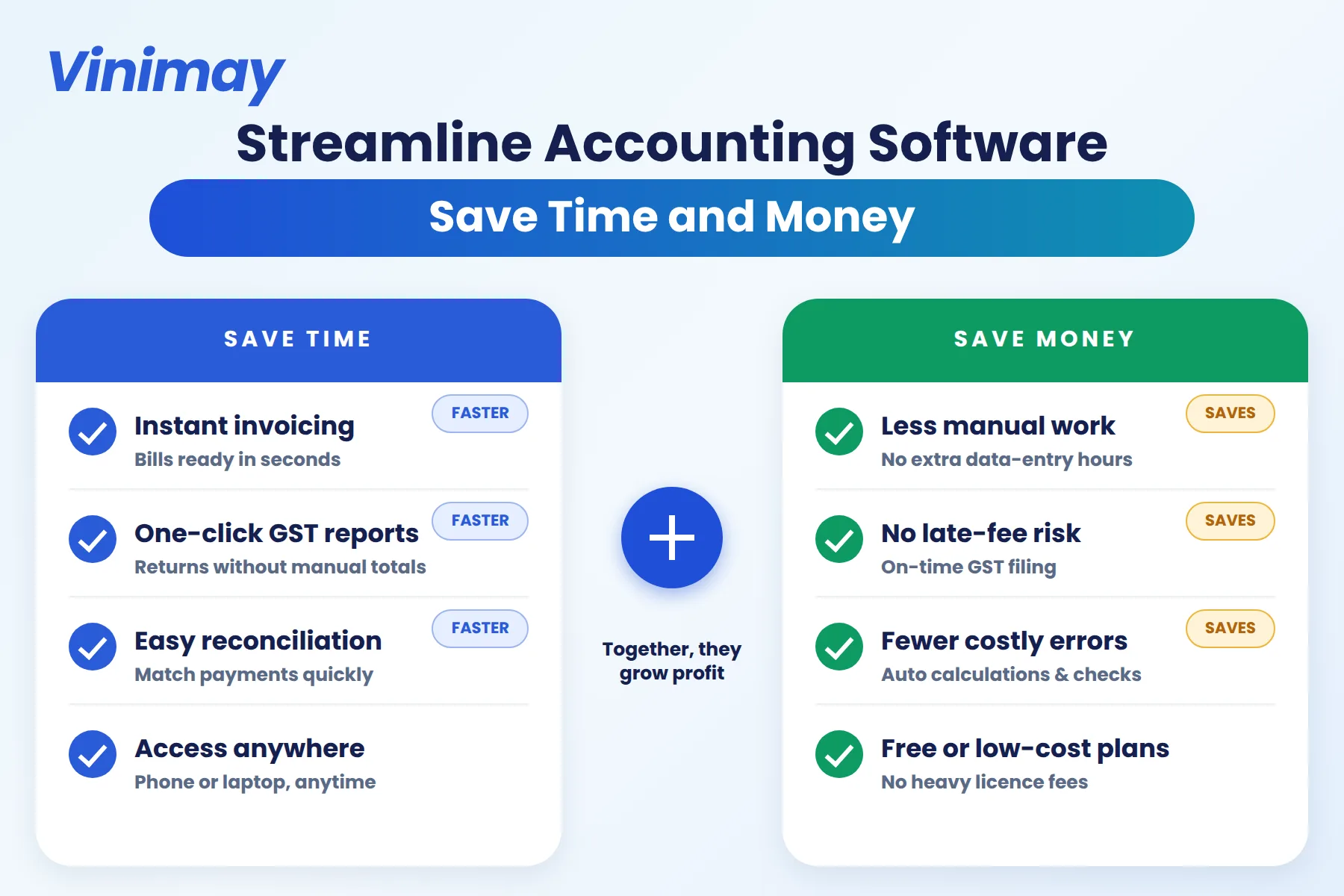
Manually checking whether a sale needs CGST+SGST or IGST, invoice after invoice, is repetitive and easy to get wrong under pressure. The mistake usually isn't a lack of understanding—it's the sheer repetition of the same decision, dozens of times a month, that eventually produces an error. Correcting that error later, once it's already fed into a GST return,takes far longer than getting it right the first time would have.
Where Payment Reconciliation Quietly Costs You
When invoices and payments live in separate places — an invoice book here, a payment diary or a different spreadsheet there — knowing a customer's real outstanding balance means manually checking both records every time you need the answer. This isn't a one-time cost; it's a recurring task that repeats every time you or a customer needs to know where things stand, and it gets slower and less reliable as your customer base grows.
Where Stock Counting Becomes a Repeated Task
If billing and inventoryaren't connected, someone has to physically recount stock periodically just to catch the drift that's built up since the last count. This recount isn't optional maintenance — it exists specifically because the sale and the stock reduction were never recorded as the same event, so a gap opens up naturally over time even with careful staff.
Where Scattered Records Slow Down Simple Questions
A mix of paper invoices, an Excel sheet, and a payment diary means finding a specific transaction later requires checking multiple places, not one. A question as simple as "did this customer pay last month's invoice" can turn into a ten-minute search across formats, purely because the answer was never stored in one connected place to begin with.
What "Streamlined" Actually Means in Practice
Where the Money Actually Comes From
The cost savings from accounting software aren't a fixed percentage — they come from two specific places: fewer costly mistakes (a GST error corrected before it becomes a filing problem, a missed customer payment caught before it's forgotten entirely), and less time spent on tasks that generate no value beyond re-entering data that should have been connected already. Neither of these produces a number that applies the same way to every business — a business processing 500 invoices a month saves differently than one processing 20.
Why the Savings Scale Differently for Different Businesses
A high-volume retail shop billing dozens of customers daily saves more from automated GST calculation than a consultant billing five clients a month, simply because the manual task was being repeated far more often in the first place. Similarly, a wholesaler juggling credit across many buyers saves more from connected outstanding tracking than a cash-only business would. This is exactly why fixed percentage claims don't hold up — the same software streamlines different amounts of work depending on how disconnected your starting point was.
How This Applies to Vinimay
Vinimay streamlines the specific tasks described above, within its confirmed scope. GST is applied correctly — CGST, SGST, or IGST based on the transaction — removing manual tax-split calculation. Payments are recorded against the same customer and vendor accounts as the invoices they settle, so outstanding balances stay accurate without separate reconciliation. Inventory adjusts as invoices are created, reducing the gap between recorded and actual stock.
What Vinimay doesn't currently confirm, and what several generic articles on this topic attribute to "accounting software" broadly: automated bank reconciliation, payroll processing, and automated tax return filing. If any of these specifically matter to your business, they're not part of what's verified here, and worth checking directly rather than assuming.
If you want to see the GST calculation and transaction recording directly, Vinimay's free tool lets you generate up to 5 GST-compliant invoices without needing to sign up.
[Create Your First Invoice Free with Vinimay]
Conclusion
"Save time and money" is true of good accounting software, but not because of some universal percentage you'll find repeated across marketing pages.
It's true because specific, repeated manual tasks—GST calculation, payment reconciliation, stock counting—stop needing to happen the way they used to. Judge any software, including this one, by which of these specific tasks it actually removes, not by a statistic that can't be traced back to your own business.
FAQs
Are the "hours saved" statistics quoted in most accounting software articles accurate?
Many are unverifiable or based on single anecdotes presented as universal figures—treat specific percentage or hour claims with skepticism unless the source and methodology are clear.
What specifically gets streamlined when switching to accounting software?
GST calculation, payment-to-invoice reconciliation, stock tracking against sales, and having transaction records in one retrievable place instead of scattered across formats.
Does accounting software save the same amount of time for every business?
No — the time saved depends on your transaction volume and how disconnected your current manual process is; a business with high volume and scattered records saves more than one with low volume and simple records.
Where does the "money saved" from accounting software actually come from?
Primarily from avoiding costly mistakes — like GST errors that cause filing problems, or missed customer payments — and from reducing time spent on tasks that add no value beyond re-entering disconnected data.
Does Vinimay handle bank reconciliation as part of streamlining accounting?
Not currently confirmed. Vinimay's confirmed scope covers GST-compliant invoicing, transaction recording, customer/vendor management, and inventory.
Does automating GST calculation actually reduce costs, or just save time?
Both — it saves the time spent recalculating manually, and reduces the cost of correcting mismatches that surface later during GST return filing.
Is it worth switching to accounting software if my invoice volume is low?
The value scales with volume and complexity — at very low volume, the time and cost savings are smaller, though GST accuracy still matters regardless of volume.
Does Vinimay automate payroll or tax filing as part of its accounting features?
Not currently confirmed. If either is a requirement for your business, confirm directly rather than assuming it's included under general "accounting software" functionality
Related Topics
Published by Team Vinimay
Our editorial and compliance specialists create practical guides, tax calculation rules, and operational strategies to empower Indian small business owners and accountants.