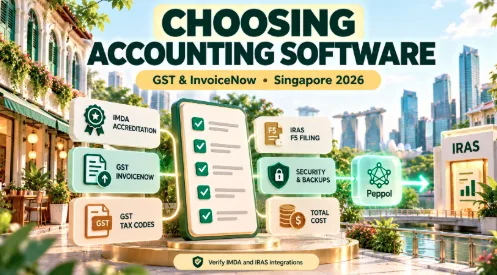
What Should I Check Before Choosing Accounting Software for GST and InvoiceNow?
Quick Answer: Before choosing accounting software in Singapore, verify IMDA InvoiceNow accreditation, Peppol connectivity, direct GST invoice data submission to IRAS, GST F5 reporting, supported tax codes and reliable accounting records. Also compare subscription costs, security, integrations and your business's mandatory InvoiceNow implementation date.
Choosing accounting software is no longer just about creating invoices or recording expenses. Singapore businesses must also consider Goods and Services Tax (GST) reporting and the phased GST InvoiceNow Requirement.
A low-cost platform may handle everyday bookkeeping but lack the functions needed for statutory reporting. Conversely, a compliant solution may be unnecessarily expensive or complicated for a small business.
1. Is the Software Officially InvoiceNow-Ready?
Start by checking whether the exact product is listed in IMDA's accredited InvoiceNow-Ready Solutions directory.
An InvoiceNow-Ready Solution should support Singapore's Peppol-based electronic invoicing network.
Confirm that it can:
Send and receive structured electronic invoices.
Register or connect your business's Peppol ID.
Process relevant invoices and credit notes.
Support the applicable Singapore invoice specifications.
Activate the required GST InvoiceNow submission feature.
Businesses using customised ERP systems may connect through an IMDA-accredited Access Point Provider.
Do not assume that PDF invoicing or basic Peppol connectivity proves full GST InvoiceNow compliance.
2. Can the Software Submit GST Invoice Data to IRAS?
This is a separate and essential check.
Under GST InvoiceNow, covered businesses must transmit prescribed sales and purchase invoice data to IRAS.
The software should support relevant transaction information, including supplier and customer identifiers, invoice numbers, taxable values and GST amounts.
Ask the provider whether the system can generate submission acknowledgements and identify failed transmissions.
IRAS confirms that successful transmissions receive acknowledgement IDs through the InvoiceNow-Ready Solution.
Without reliable error handling, businesses may struggle to identify transactions that were not successfully submitted.
3. Does It Support Singapore GST Tax Codes?
Accounting software should classify transactions correctly before calculating GST.
GST Treatment | What to Verify |
|---|---|
Standard-rated supplies | Correct 9% GST calculations |
Zero-rated supplies | Proper 0% treatment |
Exempt supplies | Correct exemption classification |
Purchases | Eligible input GST identification |
Imports | Appropriate import GST records |
Reverse charge | Support where applicable |
Credit notes | Accurate GST adjustments |
Businesses should also confirm support for discounts, foreign currencies and GST-inclusive prices.
Incorrect tax classifications can affect both GST F5 reporting and InvoiceNow data submissions.
4. Can It Prepare and File GST F5 Returns?
GST InvoiceNow does not replace periodic GST return filing.
Some accounting systems prepare GST reports but cannot submit GST F5 directly to IRAS.
Software Capability | What It Means |
|---|---|
GST calculation | Calculates tax on transactions |
GST F5 report | Prepares return figures |
Direct GST F5 filing | Submits returns through supported IRAS integration |
GST F7 support | Helps correct previous GST returns |
GST InvoiceNow | Submits prescribed invoice data separately |
Singapore's former IRAS Accounting Software Register Plus (ASR+) ceased on 30 June 2026.
It has been replaced by the #SFFS Solution Partners framework, which identifies verified integrations for specified IRAS filing functions.
Businesses should check the current #SFFS listing rather than relying on outdated ASR+ tier claims.
5. Does the Software Match Your InvoiceNow Deadline?
Singapore's GST InvoiceNow Requirement is being introduced progressively.
Implementation Date | Business Category |
|---|---|
1 November 2025 | Qualifying newly incorporated voluntary registrants |
1 April 2026 | New voluntary GST registration applicants |
1 April 2028 | New compulsory registrants and existing businesses with annual supplies up to S$200,000 |
1 April 2029 | Existing registrants with annual supplies up to S$1 million |
1 April 2030 | Existing registrants with annual supplies up to S$4 million |
1 April 2031 | Remaining existing GST registrants |
Specified exclusions apply.
Businesses should check their IRAS notification or official implementation date calculator.
Allow time for software configuration, Peppol registration, employee training and testing before the mandatory date.
6. Does It Fit Your Business's Daily Operations?
Compliance is essential, but accounting software must also be practical.
A freelancer may primarily need invoices, expenses and customer payment reminders. A retailer may need point-of-sale integration and stock management.
A trading company may require purchase orders, inventory, multi-currency transactions and supplier reconciliation.
Useful features to compare include:
Automated bank reconciliation.
Customer and supplier ledgers.
Inventory management.
Accountant access.
Payroll and CPF integrations.
Financial reporting.
Data export and backups.
Businesses should test actual workflows using sample transactions rather than relying only on feature descriptions.
7. Are Pricing, Security and Support Suitable?
Compare the complete cost of ownership, not just the advertised monthly subscription.
Ask about setup charges, Peppol integration, additional users, transaction limits, data migration and technical support.
Review access permissions, multi-factor authentication, audit trails and backup procedures.
Singapore businesses should also consider how the provider handles personal data and its responsibilities under the Personal Data Protection Act.
For government funding, note that the former PSG, EDG and MRA schemes closed to new applications on 29 September 2026.
From 30 September 2026, businesses can explore qualifying support through Enterprise Singapore's EDGE Grant, subject to current eligibility and approved activities.
8. What Should You Ask Before Buying Accounting Software?
Before subscribing, request a demonstration showing a complete transaction from invoice creation through GST reporting.
Use this checklist:
Is the exact product IMDA-accredited?
Can it submit GST InvoiceNow data to IRAS?
Can it retrieve submission acknowledgement IDs?
Does it support Singapore GST tax codes?
Can it prepare or directly file GST F5?
Can it handle foreign currencies and credit notes?
Does it provide secure backups and data exports?
Are support and integration costs clearly stated?
Accounting software such as Vinimay provides general invoicing, customer management, purchases, inventory and accounting records.
However, Vinimay's Singapore GST F5 integration, IMDA accreditation and InvoiceNow reporting capabilities have not been independently verified. Businesses should confirm these capabilities before using it for mandatory compliance.
The key takeaway: Choose accounting software that combines verified Singapore compliance with the features your business actually uses.
Frequently Asked Questions
Related Topics
Published by Satyam mahajan
Our editorial and compliance specialists create practical guides, tax calculation rules, and operational strategies to empower Indian small business owners and accountants.