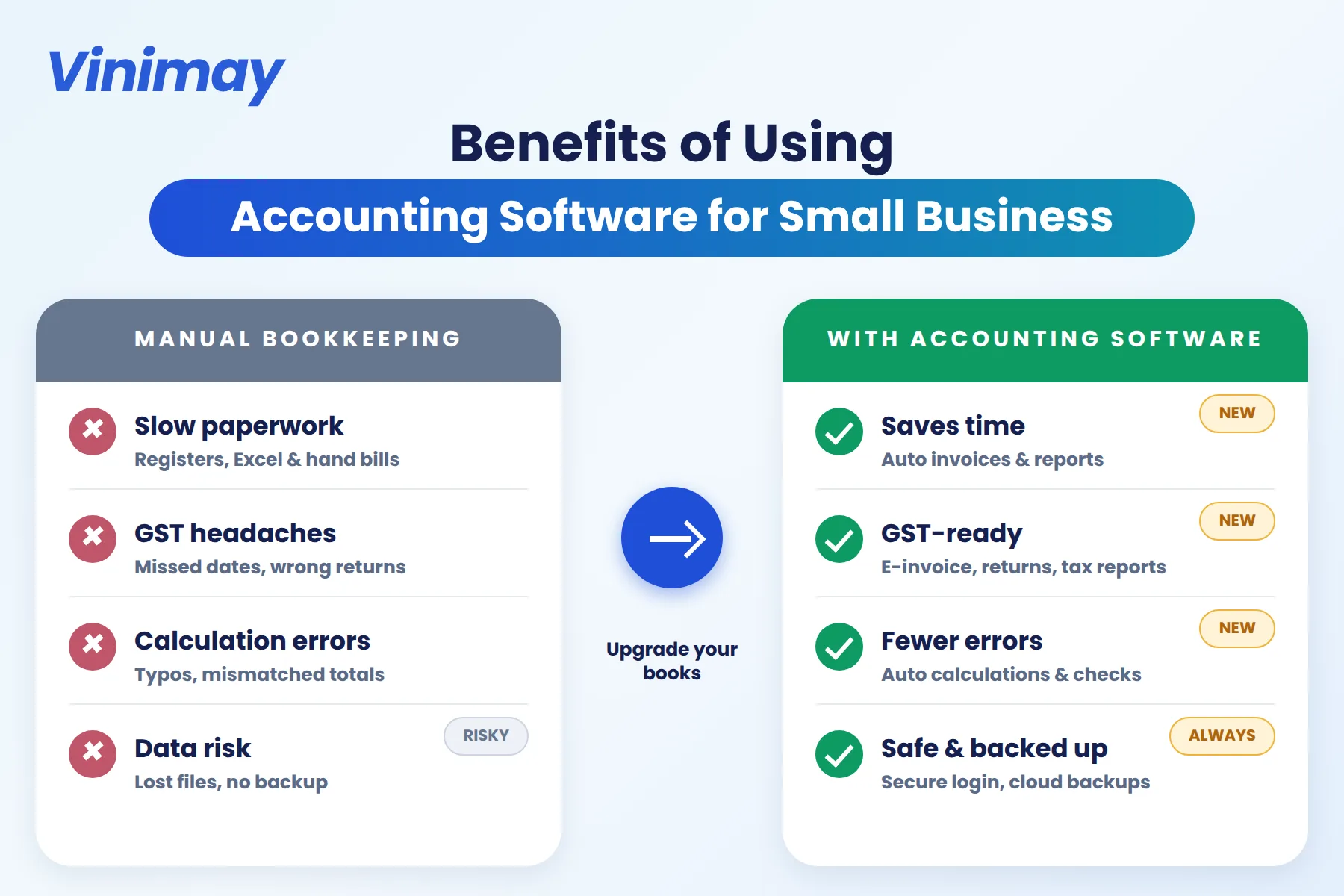
9 Must-Have Features of Accounting Software for Small Businesses in India (2026)
Generic "accounting software features" lists, written for a global audience, routinely miss the specific requirements that make software genuinely usable for an Indian small business. GST isn't an optional add-on feature here — it's the backbone of nearly every invoice issued, and that changes which features actually count as "must-have."
This list focuses specifically on what Indian small businesses need in 2026, given the current GST frameworkand how compliance requirements have evolved — rather than repeating a universal feature checklist that treats India as just another market.
Why India-Specific Requirements Shape This List Differently
Unlike many countries with a single, flat sales tax, India's GST structure involves multiple tax components (CGST, SGST, IGST), HSN/SAC classification, and specific invoice-level requirements tied to compliance. Software that works well for a business in a country with simpler tax rules may be entirely inadequate here — not because it's lower quality, but because it wasn't built around this specific regulatory structure.
1. Correct CGST, SGST and IGST Application
This is the foundation — software must correctly determine whether a transaction is intra-state (CGST + SGST) or inter-state (IGST), based on the place of supply, and apply the right rate consistently. Getting this wrong on even a fraction of invoices creates ongoing reconciliation headaches.
2. HSN/SAC Code Support
Products and services need to carry the correct HSN or SAC code, which in turn determines the applicable tax rate. Software should let you assign this once per product and apply it consistently, rather than requiring manual entry per invoice.
3. GSTIN Capture for B2B Invoices
For business-to-business transactions, capturing the buyer's GSTIN correctly is essential — it directly affects their ability to claim input tax credit. This should be a required field for B2B customers, not an optional one easily skipped under time pressure.
4. Sequential, Compliant Invoice Numbering
GST invoicing requires numbering that stays sequential without gaps, which becomes especially important during reconciliation or if a GST audit occurs. This should happen automatically, not depend on manual tracking across multiple books or counters.
5. Multi-State Business Support
Businesses operating or selling across more than one state need software that correctly handles the place-of-supply logic for each transaction, since a single business can have both intra-state and inter-state customers simultaneously.
6. GST-Ready Sales and Purchase Reports
Reports that already reflect correct tax breakdowns—not just raw totals — make it significantly easier to prepare for return filing or reconciliation, since the GST-relevant data is already organised rather than needing to be extracted separately.
7. Support for Proforma Invoices and Delivery Challans
Beyond the final tax invoice, Indian businesses frequently need proforma invoices (quotation-style estimates before supply) and delivery challans (documenting goods movement without a final sale). Software built for the Indian market should support both as standard document types.
8. Vendor and Customer GST Record-Keeping
Storing GSTIN and address details against vendor and customer records—not just entering them fresh each time — keeps this compliance-relevant information consistent and reduces the risk of transcription errors across repeated transactions.
9. Data Retention for Compliance Review
GST-related records may need to be referenced well after the transaction date, whether for reconciliation, audit preparation, or resolving a customer query. Software should retain this history accessibly, rather than archiving or purging it after a short window.
What This List Deliberately Leaves Out
Worth noting explicitly: this list doesn't include automated e-invoicing (IRP integration) or e-way bill generation, since these are distinct, more specialized capabilities that not all GST-compliant software includes by default — they depend on separate government portal integrations and apply based on specific turnover or transaction thresholds, which are worth checking separately for your business.
Where Vinimay Fits This List
Vinimaycovers the majority of this list directly: CGST, SGST and IGST are applied automatically based on customer and product setup, HSN/SAC codes attach to products, GSTIN is captured for customers and vendors, invoices are numbered sequentially, and proforma invoices and delivery challans are supported alongside standard GST invoicing. Reports draw from these same organised, GST-tagged records.
To see this in practice, Vinimay's free tool lets you generate up to 5 GST invoices free, with correct tax application from the first bill.
Conclusion
Accounting software features that matter for Indian small businesses in 2026 are shaped directly by GST's specific structure—CGST/SGST/IGST logic, HSN codes, GSTIN capture, and India-specific document types like proforma invoices and delivery challans.
A generic global feature list misses most of this. Vinimay is built around these exact requirements, applying GST correctly by default and supporting the document types Indian businesses actually use — while capabilities like e-invoicing and e-way bill generation remain separate, more specialised considerations worth checking independently.
Frequently Asked Questions
1. Why do Indian businesses need different accounting software features than global standards suggest?
Because India's GST structure — CGST, SGST, IGST, HSN codes — is more specific than the single sales-tax models common elsewhere.
2. Is HSN code support really necessary for a small business?
Yes, since the applicable GST rate is generally tied to it, making it central to correct invoicing.
3. What happens if GSTIN isn't captured for a B2B customer?
It can prevent the buyer from properly claiming input tax credit on that purchase.
4. Does Vinimay support proforma invoices and delivery challans?
Yes, both are part of Vinimay's confirmed feature set alongside standard GST invoicing.
5. Is e-invoicing part of this must-have list?
No, it's a separate, more specialised capability requiring government portal integration, worth checking independently based on your turnover.
6. Why does multi-state support matter for a single business?
Because a businesscan have both intra-state and inter-state customers, requiring different tax logic for each.
7. Does Vinimay apply GST automatically for Indian businesses?
Yes, Vinimay applies CGST, SGST and IGST automatically based on verified customer and product setup.
8. How many free invoices can I test with Vinimay's GST handling?
Vinimay's free invoice tool allows up to 5 GST invoices free.
9. Should data retention length matter when choosing software?
Yes, since GST-related records may need to be referenced well after the original transaction date.
10. Is this list different from a general "accounting software features" list?
Yes, it's specifically built around India's GST compliance structure, rather than universal features that apply anywhere.
Related Topics
Published by Team Vinimay
Our editorial and compliance specialists create practical guides, tax calculation rules, and operational strategies to empower Indian small business owners and accountants.