How Can I Make My Accounting Process More Efficient?
When people talk about making their accounting process "more efficient," they often imagine doing the same steps faster—typing invoices quicker, checking records more rapidly. Real efficiency usually comes from a different place: removing steps that shouldn't have needed to exist in the first place, like reconciling two separate records that never should have been separate, or manually recalculating something that follows a fixed, predictable rule.
This distinction matters because it changes what you're actually looking for. Instead of asking, "How can I do my current process faster?" a more useful question is, "Which of these steps exist only because my records are disconnected and would disappear entirely if they weren't?" That second question tends to point toward far bigger efficiency gains than simply speeding up the same manual routine.
The Cost of Checking Outstanding Balances Manually
Manually checking a customer's outstanding balance by cross-referencing an invoice book against a payment diary is a step that shouldn't need to exist at all.
It only exists because invoices and payments were recorded in two separate places to begin with.
The more customers you have, the more this cross-checking task grows, not shrinks.
Once both records live in the same place, this step disappears entirely rather than getting faster.
The Cost of Recalculating GST by Hand
Manually working out whether aninvoice needs CGST plus SGST or IGST is a repetitive decision that shouldn't require fresh thought every single time.
The rule itself is fixed—it depends only on where the buyer is located.
Doing this calculation by hand dozens of times a month is exactly where fatigue causes mistakes.
Automating it doesn't make the calculation faster—it removes the need to do it manually at all.
The Cost of Recounting Stock Physically
Frequent manual stock recounts exist specifically to catch the drift that builds up when billing and inventory aren't connected.
If a sale is billed but stock isn't reduced at the same time, the two slowly disagree.
Regular full recounts are a symptom of this disconnection, not a necessary part of running a business.
Once inventory updates with billing automatically, the need for frequent full recounts drops significantly.
The Cost of Searching Scattered Records
Finding a specific past transaction across a mix of paper invoices, spreadsheets, and notes turns a simple question into a real search.
A question as basic as "did this customer pay last month" can take far longer than it should.
This delay exists purely because the answer was never stored in one place to begin with.
Retrievable, connected records turn this into a lookup instead of a search.
Steps That Are Genuinely Necessary, Not Inefficiencies
It's worth being clear that not every manual step is a problem to solve — some are simply part of running an accurate process.
Entering each transaction as it happens will always need a human, regardless of software.
Periodically reviewing records for missed or incorrectly entered transactions is a genuine, ongoing task.
Decisions on pricing, credit terms, and customer relationships are business judgments, not record-keeping steps to automate away.
How Vinimay Removes the Unnecessary Steps
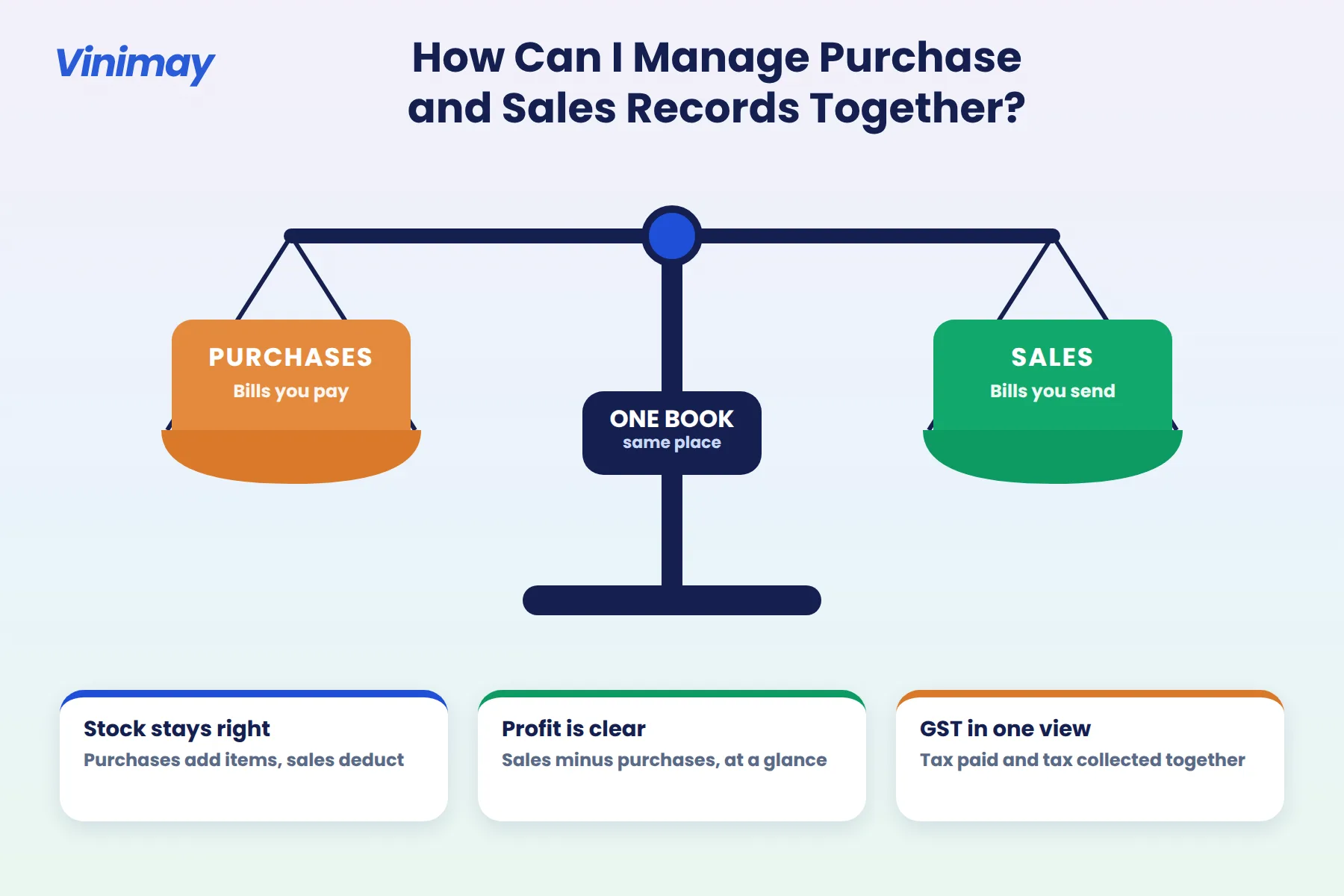
Vinimay specifically targets the steps that exist only due to disconnected records.
GST tax-split calculation is automated based on the transaction.
Payments are recorded against the same customer and vendor accounts as their invoices, removing manual cross-checking.
Inventory adjusts as invoices are created, reducing the frequency of manual stock recounts.
Records stay retrievable in one connected system rather than scattered across separate files.
What stays manual, appropriately, is entering each transaction as it happens and periodically reviewing your records — these aren't inefficiencies to remove, they're the genuine, necessary parts of running an accurate accounting process.
[Create Your First Invoice Free with Vinimay]
Conclusion
Real efficiency in accounting doesn't come from doing the same steps faster — it comes from identifying which steps only exist because your records were disconnected in the first place, and removing them entirely. Once GST calculation, payment reconciliation, and stock tracking are connected rather than separate, what's left is genuinely necessary work: recording transactions and periodically checking your own records.
FAQs
What does "efficient accounting" actually mean for a small business?
Removing unnecessary steps caused by disconnected records — like manual reconciliation or recalculating GST by hand — rather than just doing the same steps faster.
Which accounting steps can genuinely be removed with better software?
GST tax-split calculation, payment-to-invoice cross-checking, and frequent manual stock recounts are the most reducible, since they're rule-based or exist due to disconnection.
Which accounting steps will always require manual effort?
Entering each transaction as it happens, and periodically reviewing records for missed or incorrect entries — these need a human regardless of software.
Why does connecting sales and payments improve efficiency specifically?
Because it removes the need to manually check two separate records to determine a customer's outstanding balance.
Does making my accounting process more efficient reduce errors too?
Yes, for the automatable parts — removing manual GST calculation and reconciliation reduces the errors that come from repetitive manual work.
Is buying more software features the way to become more efficient?
Not necessarily — efficiency comes from removing genuinely unnecessary steps, not from adding more features you may not use.
How do I know if my current accounting process has unnecessary steps?
Ask whether a step exists only because two records are disconnected — if connecting them would remove the step entirely, it's a candidate for automation.
Does automating stock updates eliminate the need for physical stock checks?
Not entirely — it reduces how often manual recounts are needed, but occasional physical checks still make sense as a verification step.
Does Vinimay make invoice creation itself faster, or just more accurate?
Both — saved customer and item details speed up creation, while automatic GST calculation improves accuracy at the same time.
What's the first place to look for efficiency gains in my accounting process?
Identify which of your current manual steps exist only because two pieces of information (like invoices and payments) are kept separately — connecting them usually delivers the biggest gain.
Related Topics
Published by Team Vinimay
Our editorial and compliance specialists create practical guides, tax calculation rules, and operational strategies to empower Indian small business owners and accountants.