free software
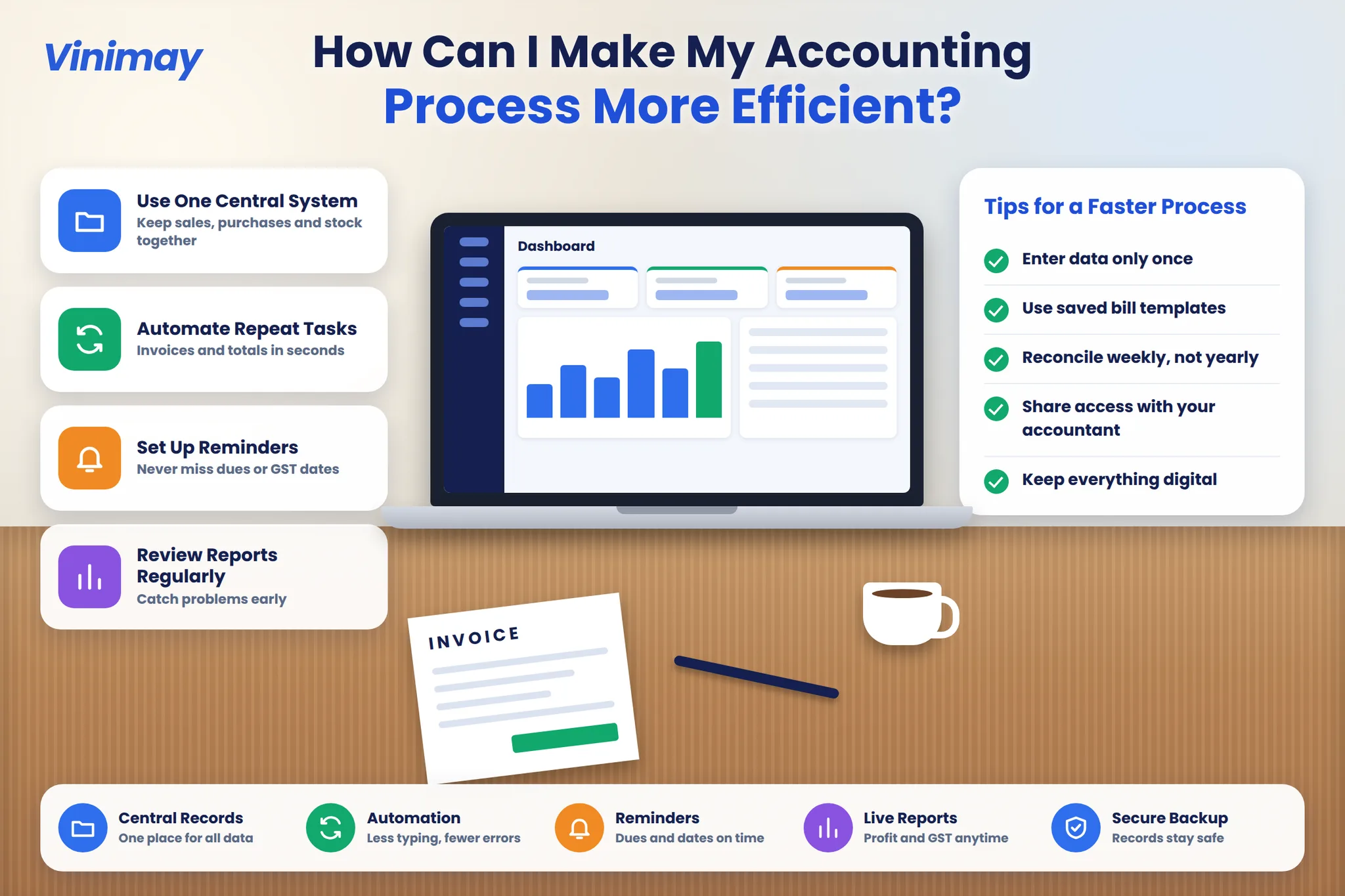
Read post How Can I Make My Accounting Process More Efficient?
Efficiency in accounting isn't about doing things faster — it's about removing steps that shouldn't exist in the first place. Here's how.
Efficiency in accounting isn't about doing things faster — it's about removing steps that shouldn't exist in the first place. Here's how.
Create professional GST-compliant invoices in under 30 seconds, send WhatsApp payment links, and track inventory effortlessly.
What Is a Tax Invoice in the UAE?
Quick Answer: A tax invoice in the UAE is an official document issued by a VAT-registered supplier to record a taxable sale of goods or services. It includes supplier details, transaction information and applicable VAT, supporting tax reporting, and eligible input VAT recovery.
Businesses operating in Dubai, Abu Dhabi, Sharjah, and other Emirates must maintain accurate invoices when making taxable supplies.
Under UAE VAT legislation, tax invoices help businesses calculate VAT collected from customers, maintain financial records and support input tax recovery where the applicable conditions are satisfied.
Whether you own a retail shop, trading company, restaurant, or consultancy, understanding the correct tax invoice format is important for day-to-day accounting and tax compliance.
A tax invoice is a document issued by a VAT-registered business showing the details of a taxable supply and the applicable Value Added Tax.
The UAE generally applies a standard VAT rate of 5% to taxable goods and services, although certain supplies may be zero-rated or exempt.
A tax invoice serves several purposes:
Records the sale of goods or services.
Identifies the supplier and relevant customer.
Shows the applicable VAT amount.
Supports VAT return preparation.
Provides evidence for eligible input tax recovery.
Helps maintain reliable accounting records.
For example, a Dubai trading company selling goods worth AED 2,000 before VAT at 5% would generally charge AED 100 VAT, making the invoice total AED 2,100.
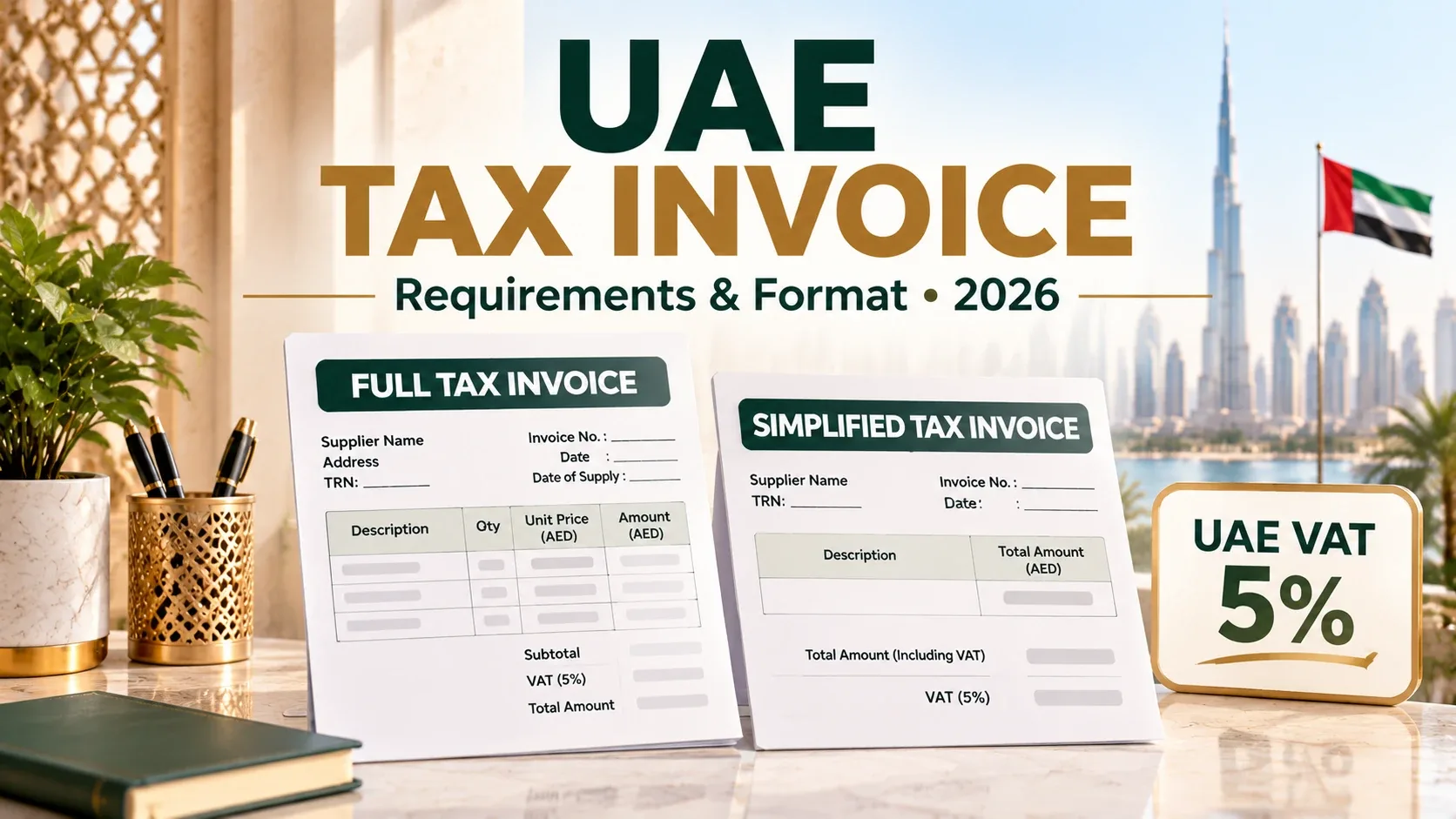
The UAE VAT framework distinguishes between full tax invoices and simplified tax invoices.
Under the traditional VAT rules, simplified invoices may be issued where the recipient is not VAT-registered or where a VAT-registered recipient receives a qualifying supply with consideration not exceeding AED 10,000.
However, the simplified invoice flexibility does not apply to electronic tax invoices issued under the new UAE Electronic Invoicing System.
Article 59 of the UAE VAT Executive Regulation sets out the required tax invoice particulars.
A full tax invoice generally includes:
The words Tax Invoice prominently displayed.
Supplier's name, address and Tax Registration Number (TRN).
Recipient's name, address and TRN where the recipient is registered.
Unique or sequential invoice number.
Invoice issue date.
Date of supply, if different.
Description of goods or services.
Unit price, quantity and applicable VAT rate.
Discounts, where applicable.
Total amount payable in AED.
VAT amount in AED and applicable exchange rate, where required.
Certain reverse-charge transactions also require an appropriate statement and legal reference.
Businesses should ensure invoices contain accurate information rather than relying only on visually attractive templates.
A simplified tax invoice contains fewer details than a full tax invoice.
For qualifying transactions outside the mandatory Electronic Invoicing System, the minimum details generally include:
The words Tax Invoice.
Supplier's name, address and TRN.
Invoice issue date.
Description of the supplied goods or services.
Total consideration and VAT amount charged.
For example, a VAT-registered retail shop selling products directly to an individual customer may issue a simplified tax invoice where the applicable conditions are met.
Businesses should distinguish ordinary retail invoicing from electronic invoicing obligations because covered B2B transactions will require structured electronic invoices when the mandate applies.
VAT should be calculated according to the tax treatment of the goods or services supplied.
Consider this simple example:
Where AED 1,050 is already VAT-inclusive at 5%, the VAT portion is calculated as:
VAT = VAT-inclusive amount × 5 ÷ 105
Therefore, AED 1,050 includes AED 50 VAT and AED 1,000 before VAT.
Businesses should apply the correct VAT treatment to discounts, zero-rated supplies, exempt supplies and reverse-charge transactions where relevant.
Under the general UAE VAT invoicing rules, a tax invoice must normally be issued within 14 days of the date of supply.
The actual date of supply depends on the nature of the transaction and applicable VAT provisions.
Certain summary invoicing arrangements and other specific rules may affect how this requirement is applied.
Businesses should avoid delaying invoices until payment is received without considering the relevant tax point.
For example, a consultancy should identify the applicable date of supply and ensure its invoice is issued within the prescribed period.
Timely invoicing supports proper accounting records and VAT reporting.
The UAE is introducing mandatory structured electronic invoicing in phases.
The framework generally covers qualifying B2B and B2G transactions, while B2C transactions are currently excluded.
Unlike an ordinary PDF invoice, a compliant UAE e-invoice must follow the prescribed structured electronic format and be exchanged through an Accredited Service Provider (ASP).
Businesses should not confuse a digitally created PDF tax invoice with a compliant structured electronic invoice.
Businesses should establish a consistent invoicing process and maintain accurate customer, product and tax information.
A practical checklist includes:
Verify the supplier's VAT registration details.
Record the correct customer information.
Generate a unique invoice number.
Include accurate descriptions and quantities.
Apply the correct VAT category and rate.
Calculate invoice totals correctly.
Retain supporting accounting records.
Review future UAE e-invoicing compatibility.
Accounting software can help reduce repetitive manual entry.
For example, Vinimay offers general invoicing, customer records, payment tracking and financial reporting features that can help organise business transactions.
However, its UAE-specific VAT compliance, PINT-AE support and ASP integration have not been independently verified. Businesses should confirm these capabilities before relying on it for UAE tax compliance.
The priority is ensuring every tax invoice contains accurate information and follows the requirements applicable to the transaction.
A UAE tax invoice is an essential document for recording taxable supplies and maintaining VAT compliance. Businesses should ensure that their invoices contain the required details, including the supplier's name, TRN, invoice number, date, description of goods or services, taxable amount, VAT rate, and VAT charged. Following the Federal Tax Authority's tax invoice requirements helps businesses maintain accurate records and avoid invoicing errors. Vinimay’s free bilingual billing software can help businesses create invoices in English and Hindi, manage sales bills, and organise transaction records. This supports everyday billing and bookkeeping, while UAE VAT-specific invoice compliance should be verified separately.
Our editorial and compliance specialists create practical guides, tax calculation rules, and operational strategies to empower Indian small business owners and accountants.
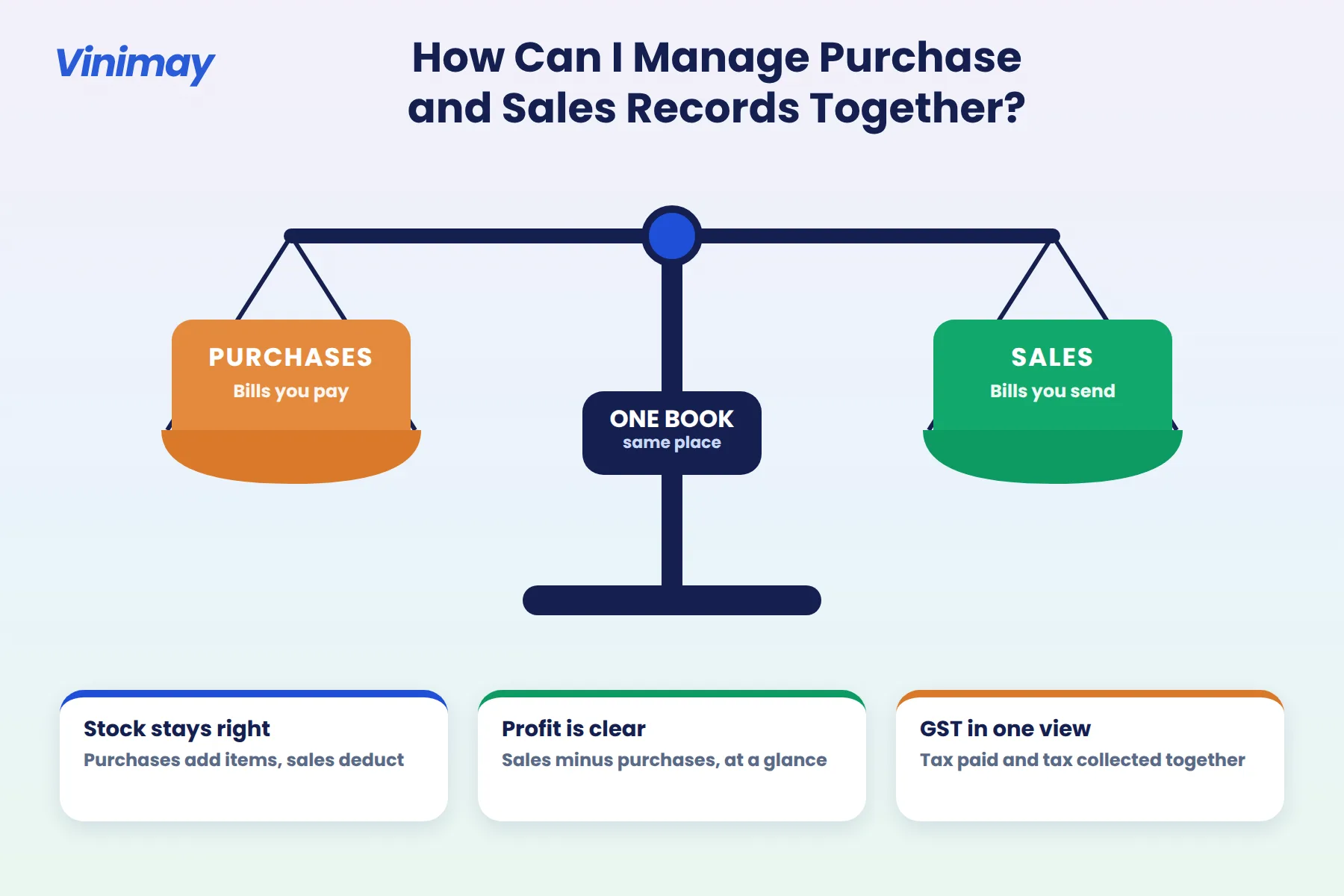
Tracking sales and purchases separately hides your real margin. Here's why they need to be connected, and how to actually do it.
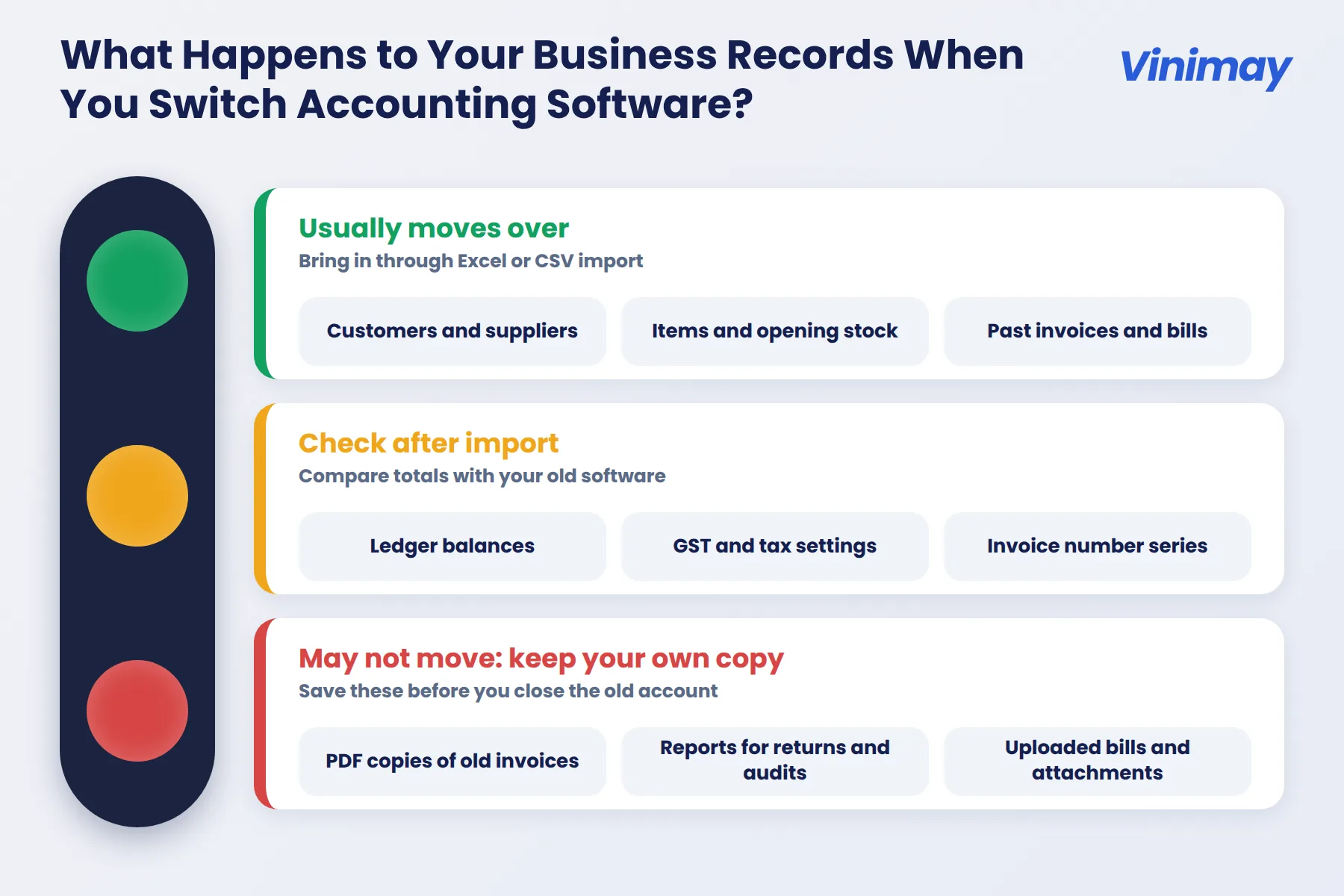
Switching accounting software doesn't have to mean losing your history. Here's exactly what to check and do before you make the move.