How Can I Manage Purchase and Sales Records Together?
Most small businesses track sales more carefully than purchases, simply because sales feel more directly tied to revenue and customer relationships. Purchases often get treated as a secondary concern — recorded loosely, sometimes only as cash paid to a supplier with no formal entry. The problem is that sales and purchases are two halves of the same picture, and looking at only one half hides something important: your actual margin. Records
When sales and purchases live in separate records, or purchases barely get recorded at all, you can be doing well on revenue while actually losing money on rising supplier costs, and not notice until it's a serious problem. Managing them together isn't just neater bookkeeping—it's the only way to see whether your business is genuinely profitable or just busy.
This article covers why keeping these two records separate causes real blind spots, what "managed together" should actually look like, and how Vinimay connects both sides for you.
Why Separate Tracking Hides Your Real Margin
A business can see rising sales month over month and feel confident, while supplier costs quietly rise even faster during the same period—and without both sides recorded in the same system, that shift is invisible until profit visibly shrinks. Sales-only tracking tells you revenue is growing; it says nothing about whether the cost of goods behind that revenue is growing faster.
What "Managed Together" Actually Means
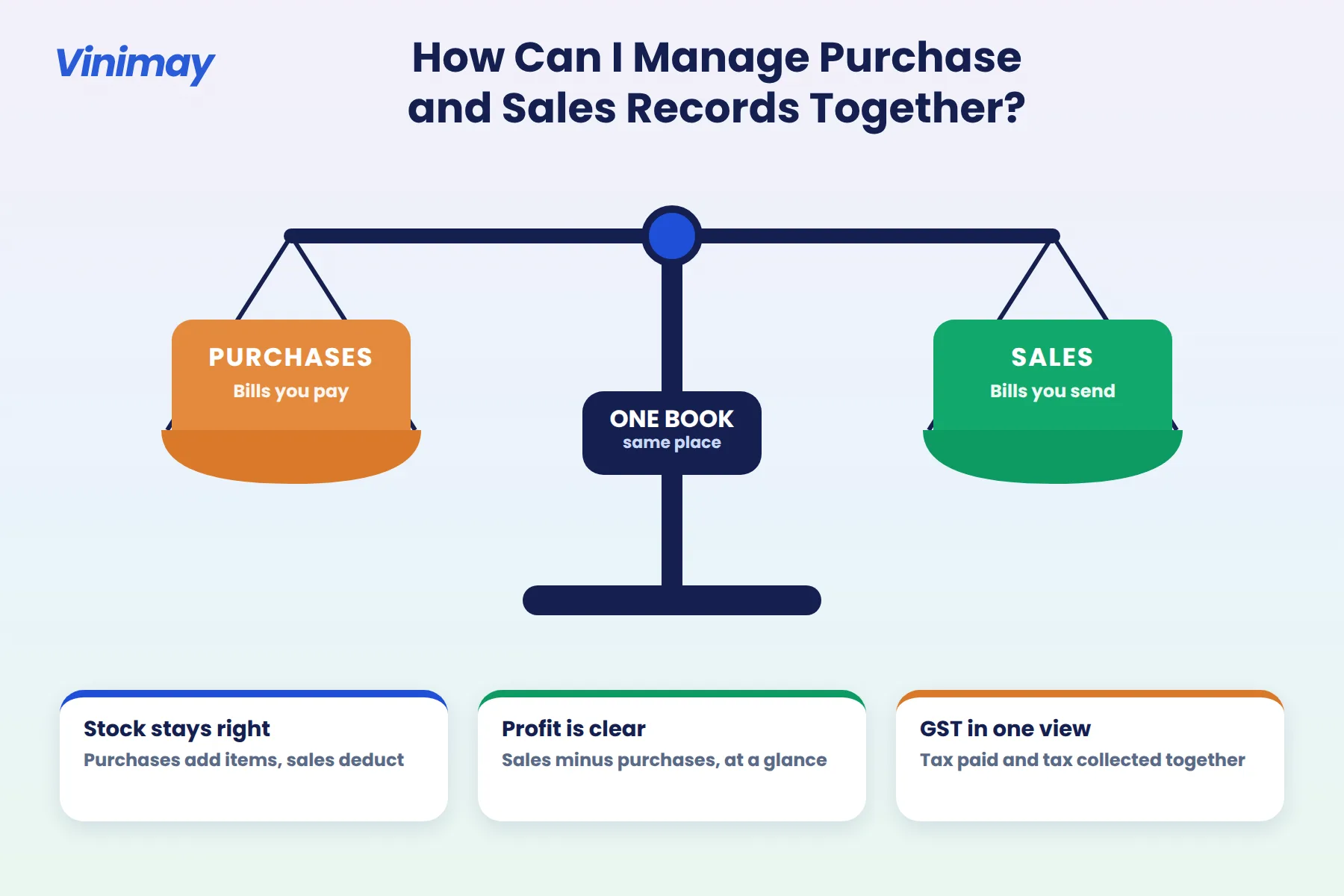
Every sale and every purchase recorded in the same system, not two separate files or habits.
Purchases tied to specific vendors, the same way sales are tied to specific customers.
The ability to see, for any period, total sales against total purchases without manually pulling two different records and adding them up yourself.
Stock movement reflecting both sides—what came in through purchases and what went out through sales.
How Vinimay Connects Both Sides
Vinimay records sales and purchases as transactions within the same system, tied to customer and vendor accounts respectively. Because both sides sit in one connected record rather than two separate habits, you're not manually merging a sales log and a purchase log to understand your actual position. Inventory adjusts based on both — reducing with sales, increasing with purchases — keeping stock figures aligned with what's actually happening on both ends of the business.
Formal margin or profitability reports comparing sales against purchases automatically aren't part of what's currently confirmed for Vinimay — while the underlying data (recorded sales and purchases) supports this kind of comparison, a dedicated report generating it directly should be confirmed rather than assumed.
[Create Your First Invoice Free with Vinimay]
Conclusion
Sales and purchases were never meant to be tracked as two separate stories — they're two sides of the same business, and looking at only one hides whether you're actually profitable or just busy.
Managing them together, in one connected system, is what lets you see your real position clearly instead of discovering a margin problem only after it's already serious.
FAQs
Why is it a problem to track sales and purchases separately?
Because it hides your real margin — sales can look strong even while rising purchase costs quietly erode profit, and you won't notice without both sides in view together.
What does "managing purchases and sales together" actually involve?
Recording both in the same system, tied to specific customers and vendors, so you can compare them directly without manually merging two separate records.
Does tracking purchases matter as much as tracking sales?
Yes — purchases represent your costs, and without tracking them as carefully as sales, you can't actually know whether your revenue is translating into real profit.
How does connecting sales and purchases affect inventory accuracy?
Stock levels reflect both sides automatically — reducing with sales and increasing with purchases — rather than needing separate manual updates for each.
Can I see my profit margin just from tracking sales and purchases together?
The underlying data supports this comparison, but whether a specific tool generates a formal margin report automatically depends on that tool's reporting features.
Why do businesses often neglect purchase records more than sales records?
Because purchases, especially cash ones, don't come with the same natural trail as a sales invoice, making them easier to record loosely or skip.
Does Vinimay track purchases the same way it tracks sales?
Yes — both are recorded as transactions tied to customer or vendor accounts within the same connected system.
Do I need separate software for purchases and sales, or can one tool handle both?
One connected tool handling both is generally better, since separate systems reintroduce the reconciliation problem that tracking them together is meant to solve.
Does Vinimay generate a margin or profitability report from sales and purchases?
Not currently confirmed as a dedicated report—the transaction data itself is recorded and connected, but confirm directly if an automatic margin report is a specific requirement.
What's the simplest first step to managing purchases and sales together?
Start recording every purchase with the same consistency as your sales, in the same system, rather than treating purchases as a secondary or occasional task.
Related Topics
Published by Team Vinimay
Our editorial and compliance specialists create practical guides, tax calculation rules, and operational strategies to empower Indian small business owners and accountants.