What Should Singapore Businesses Do When Suppliers Deliver Fewer Goods Than Invoiced?
Quick Answer: When a supplier delivers fewer goods than invoiced, Singapore businesses should count the items received, record the shortage, notify the supplier, and request replacement goods or an appropriate credit note. They should reconcile purchase orders, invoices, and delivery records, adjust inventory accurately and review any related GST input tax claims.
Short deliveries can create problems for Singapore retailers, wholesalers, restaurants, eCommerce sellers and manufacturing businesses.Paying for goods that never arrive can overstate inventory, increase expenses and reduce available cash.
A clear goods-receiving and supplier reconciliation process helps resolve shortages without disrupting business relationships.
What Is a Supplier Short Delivery?
A short delivery occurs when a supplier delivers fewer items than the quantity ordered or invoiced.
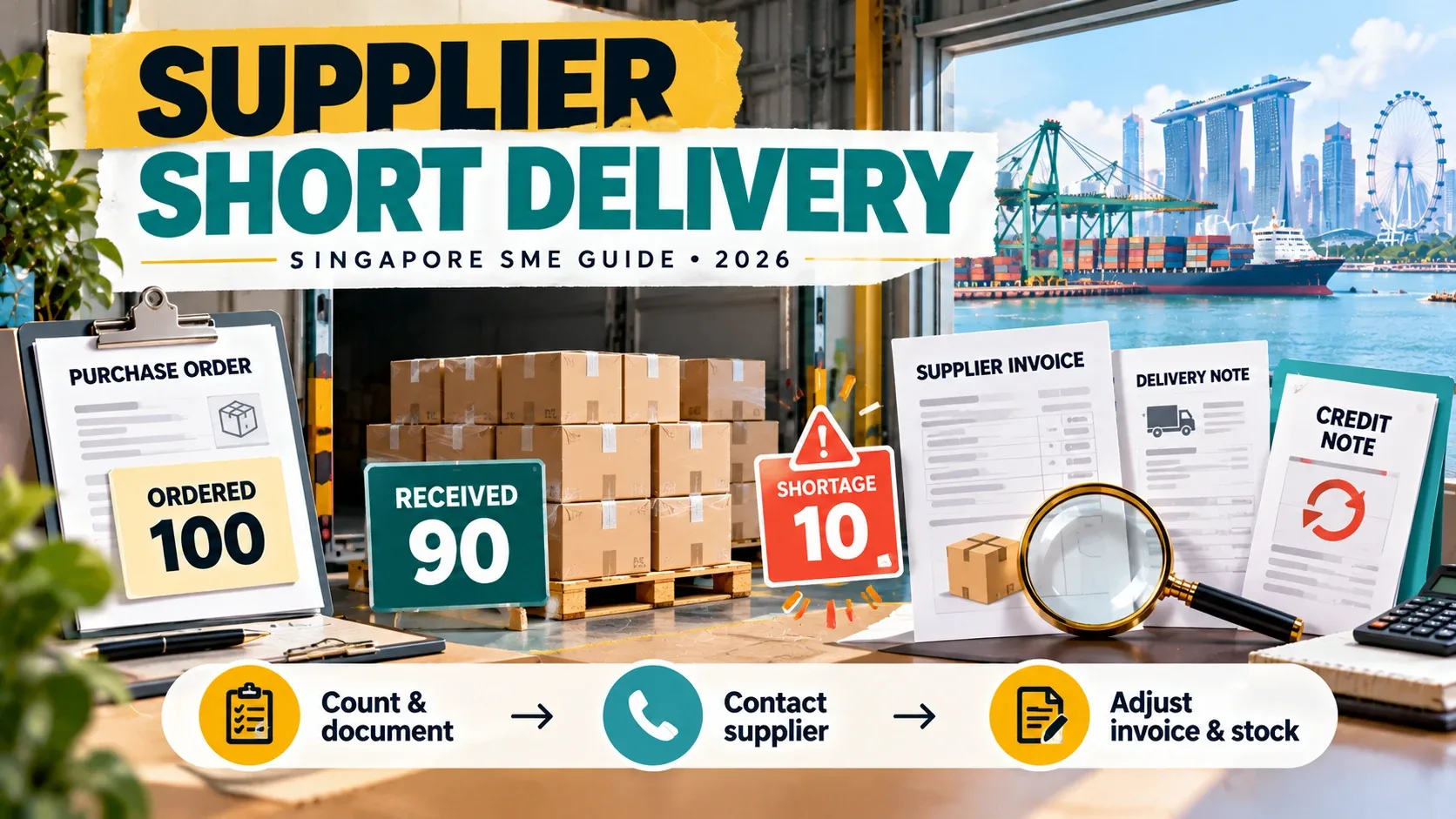
For example, a Singapore wholesaler orders 100 cartons but receives only 90, even though the supplier invoice charges for all 100.
The missing ten cartons represent a delivery discrepancy requiring investigation.
Businesses should check whether the remaining goods are delayed, missing or intentionally shipped separately before adjusting the supplier balance.
How Should Businesses Check the Goods Received?
Compare three important documents:
This is commonly called three-way matching.
For example, if the PO and invoice show 100 units but the receiving report confirms 90, the accounts team should investigate the difference before approving payment.
Record the actual quantity received, not merely the invoiced quantity.
What Should You Do Immediately After Finding a Shortage?
Businesses should document discrepancies as soon as possible.
A useful process is:
Recount the delivered goods.
Compare the quantity with the delivery order.
Photograph packaging or shipment discrepancies.
Record a goods-received discrepancy note.
Notify the supplier in writing.
Request replacement goods, a credit note, or another agreed resolution.
For example, an eCommerce business expecting 200 products but receiving 185 should record a shortage of 15 units.
Keep copies of supplier correspondence and agreed adjustments.
Should You Request a Credit Note or Replacement Goods?
The appropriate solution depends on the commercial agreement.
IRAS allows credit notes where goods were not supplied, charges are reduced or a genuine mistake needs correction.
A buyer should not ordinarily issue its own tax credit note on behalf of a supplier. The supplier should provide the appropriate document, subject to applicable self-billing arrangements.
How Should a Short Delivery Be Recorded in Accounting?
Consider this example:
For a credit purchase using a perpetual inventory system, the business may record only the received goods:
Debit: Inventory — S$4,500
Debit: Recoverable Input GST — S$405
Credit: Supplier Payables — S$4,905
If the original invoice was already recorded in full, the subsequent credit note may instead reduce inventory or the appropriate clearing account, input GST and supplier payables.
The actual entries depend on the transaction's accounting and GST treatment.
How Does Short Delivery Affect Singapore GST?
Singapore's standard GST rate is 9%.
GST-registered businesses must satisfy IRAS's input tax conditions, including valid supporting documents and a qualifying supply.
When the supplier issues a GST credit note reducing the original purchase, the buyer should make the corresponding input tax adjustment where required.
For example, a S500 reduction in a standard-rated purchase would ordinarily reduce the related input GST by S45.
IRAS's guidance covers adjusting taxable purchases and input tax following supplier credit notes.
Businesses should not claim input GST on an unsupported quantity merely because an invoice was issued.
How Can Businesses Prevent Future Short Deliveries?
Establish a goods-receiving procedure requiring staff to verify deliveries before approving supplier bills.
Use consistent purchase order numbers, item codes and receiving records.
For larger shipments, record batch numbers, quantities and warehouse locations where applicable.
Businesses should also review recurring shortages by supplier.
For example, if a supplier repeatedly delivers fewer items than invoiced, management may need to revise purchasing terms or strengthen delivery verification.
Keep relevant GST accounting records for at least five years under IRAS requirements.
How Can Vinimay Help With Supplier Shortages?
Vinimay provides general features for recording purchases, maintaining supplier ledgers, tracking inventory and managing payments and financial reports.
These functions can help Singapore trading businesses compare purchase quantities, supplier balances and recorded stock.
For example, a retailer can maintain product purchase records and review discrepancies before completing supplier payment reconciliation.
However, Vinimay's automated three-way matching, supplier shortage claims, Singapore GST credit-note adjustments, InvoiceNow accreditation, and IRAS reporting capabilities have not been independently verified.
Businesses should confirm the required purchase return, stock adjustment and supplier reconciliation features before adoption.
Frequently Asked Questions
Related Topics
Published by prachi kahar
Our editorial and compliance specialists create practical guides, tax calculation rules, and operational strategies to empower Indian small business owners and accountants.