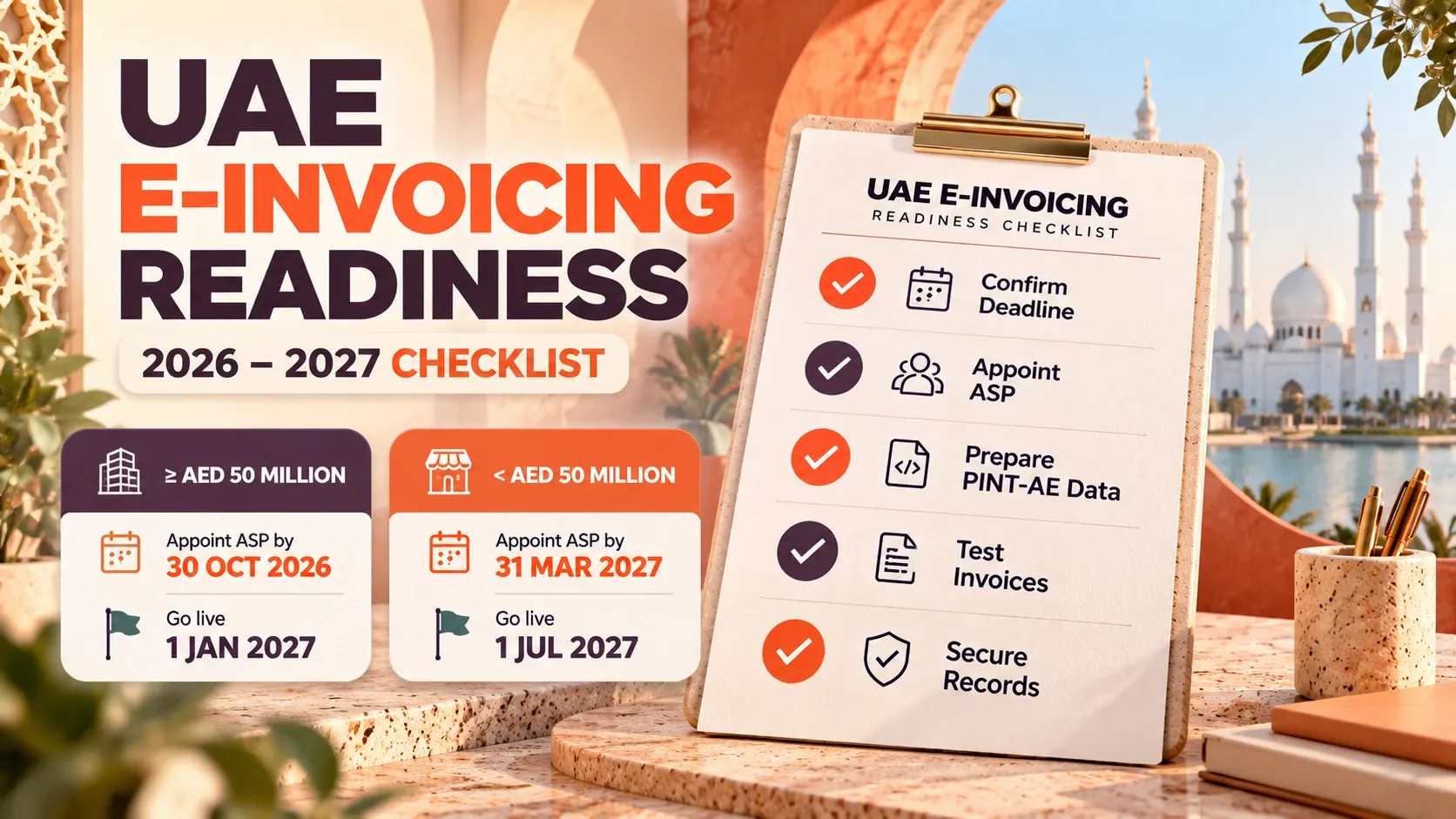
UAE E-Invoicing Readiness Checklist Before 2027 Quick Answer: Before UAE e-invoicing becomes mandatory, businesses should confirm their compliance deadline, appoint an accredited service provider (ASP), verify tax identifiers, prepare PINT-AE invoice data, connect their accounting system and test electronic invoices. They must also establish credit note, error-handling and recordkeeping procedures.
UAE e-invoicing will change how businesses create, exchange and report invoices. Instead of relying on PDF documents, covered companies must exchange structured electronic invoices through accredited providers.
The Ministry of Finance (MoF) has published an official readiness checklist. Businesses should use it to identify gaps before their mandatory implementation date.
1. Check Your E-Invoicing Deadline
Start by identifying which implementation phase applies to your business.
The first-phase ASP deadline is particularly important because it is only days away.
Businesses should also review whether they have qualifying B2B or B2G transactions. B2C transactions remain outside the current mandatory scope.
2. Review Your VAT and Invoice Records
Before upgrading accounting software, examine existing customer, supplier and invoice information.
Check whether records contain:
Correct legal business names and addresses.
Valid tax identification information.
Invoice numbers and dates.
Product and service descriptions.
Quantities and unit prices.
VAT categories, amounts and totals.
Incomplete customer or product information can cause electronic invoice validation errors.
The October 2026 amendments also temporarily exclude transactions between members of the same tax group for 24 months starting 1 January 2027.
3. Appoint an Accredited Service Provider
Businesses must select a Ministry of Finance-accredited ASP for electronic invoice exchange.
Before signing an agreement, verify the provider's accreditation on the official MoF directory.
Compare integration capabilities, service fees, security, technical support and implementation timelines.
After selecting an ASP, complete the required contractual arrangements and onboarding through the FTA's EmaraTax system.
Obtain or confirm the relevant tax identification and Peppol participant identifiers.
4. Prepare Your Accounting or ERP System
Existing accounting software may need modifications to support UAE e-invoicing.
The system should capture mandatory fields and either produce PINT-AE-compatible electronic data or send information to an ASP for conversion.
Important capabilities include:
Accurate invoice and credit note records.
Structured data exchange.
ASP integration.
Validation of tax values and identifiers.
Electronic submission status tracking.
Secure record retention.
A PDF invoice alone is not a valid structured e-invoice under the UAE framework.
5. Test Invoices and Credit Notes
Businesses should test realistic transactions before activating mandatory e-invoicing.
For example, a Dubai trading company should test local sales, applicable VAT categories, discounts, foreign-currency invoices and credit notes.
Testing should confirm that the ASP successfully exchanges invoice data and reports the prescribed tax information.
Teams should also understand how to identify and correct rejected electronic documents.
A successful test should include both invoice transmission and confirmation that the transaction was processed correctly.
6. Prepare Security and Recordkeeping Procedures
Electronic invoicing requires secure access to business and transaction information.
Businesses should review user permissions, backups, audit trails and the ability to retrieve invoice records.
Under the October 2026 amendments, businesses must retain electronic invoices, credit notes and associated data for the applicable period under the Tax Procedures Law.
The previous general requirement to store these records specifically within the UAE has been removed.
Records must still be available to the FTA when requested.
7. Understand E-Invoicing Penalties
Businesses should understand the consequences of missing mandatory implementation requirements.
The October 2026 amendments removed the earlier system-failure notification requirement from the governing ministerial decision. Businesses should review the amended legal framework when assessing their notification obligations.
8. How Can Vinimay Help Businesses Prepare?
Preparing for e-invoicing begins with accurate business records.
Vinimay offers general accounting features that can help businesses organise customer and supplier information, sales invoices, purchases, payments, inventory and financial reports.
These records can support internal data reviews before an ASP integration project.
However, Vinimay's PINT-AE compliance, accredited ASP integration, Peppol connectivity and automated FTA reporting have not been independently verified.
Businesses should confirm these capabilities before relying on any software for mandatory UAE e-invoicing.
Frequently Asked Questions
Published by admin
Our editorial and compliance specialists create practical guides, tax calculation rules, and operational strategies to empower Indian small business owners and accountants.