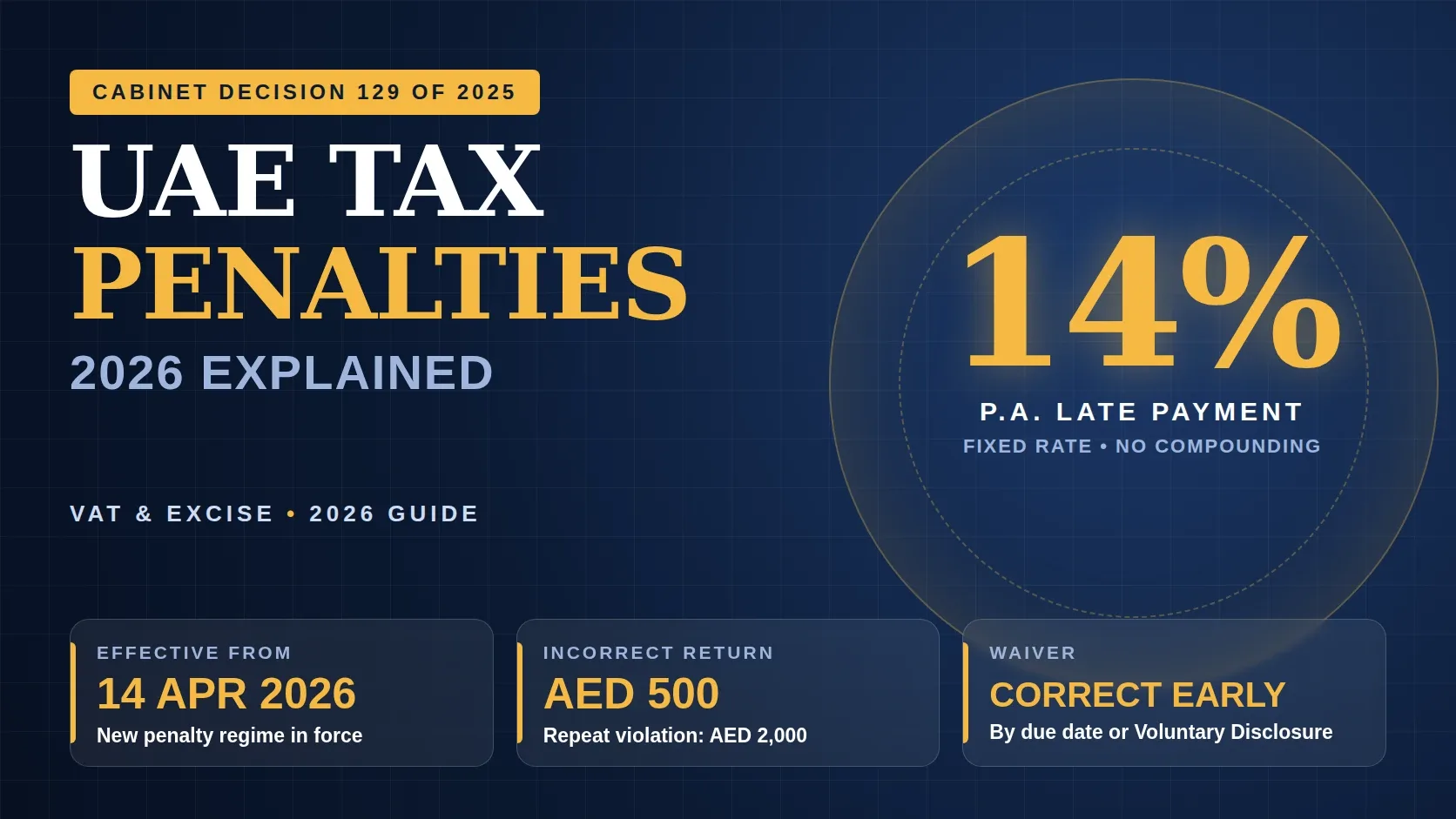
Quick Answer: UAE Cabinet Decision No. 129 of 2025 changes administrative tax penalties effective 14 April 2026. It reduces several fixed fines, replaces the previous late-payment penalty structure with a 14% annualised rate applied monthly, and introduces revised voluntary disclosure penalties to encourage businesses to correct errors promptly.
The UAE has updated its tax penalty framework to make compliance more predictable and encourage voluntary correction of mistakes.
Cabinet Decision No. 129 of 2025 amends Cabinet Decision No. 40 of 2017, primarily affecting administrative penalties under the VAT, excise tax, and tax procedures frameworks.
Businesses should understand the new rates rather than relying on outdated penalty calculations.
What Is Cabinet Decision No. 129 of 2025?
Cabinet Decision No. 129 of 2025 revises penalties for selected violations of UAE tax legislation.
Although issued in 2025, the changes became effective on 14 April 2026.
The amendments affect late tax payments, incorrect returns, voluntary disclosures, tax-record updates and certain other administrative violations.
The decision does not remove businesses'obligation to pay outstanding taxes or comply with FTA requirements.
Which UAE Tax Penalties Have Changed?
The main changes include:
Other violations continue to attract penalties under the relevant legislation.
How Has the Late Tax Payment Penalty Changed?
Previously, the relevant VAT and excise tax late-payment framework included an initial 2% penalty and additional monthly penalties of 4%.
Under the amended framework, the penalty is calculated at 14% per annum, applied monthly to outstanding payable tax.
For example, assume a business has AED 100,000 of unpaid VAT.
An illustrative full-month calculation is:
AED 100,000 × 14% ÷ 12 = AED 1,166.67
The actual penalty depends on the applicable due date, each month or part thereof, outstanding balance and payment history.
Paying the outstanding tax promptly helps limit further penalties.
What Are the New Voluntary Disclosure Penalties?
Voluntary disclosure allows businesses to correct qualifying mistakes in previously submitted tax returns, assessments or refund applications.
The previous framework used fixed penalties that increased according to the period of delay.
The revised rules introduce:
1% of the tax difference per month or part thereof for a voluntary disclosure submitted before audit notification.
15% fixed penalty plus the applicable 1% monthly penalty when the required disclosure is not submitted before audit notification.
For example, an AED 20,000 tax difference disclosed after approximately three chargeable months could attract an illustrative AED 600 monthly-based disclosure penalty.
The actual calculation depends on the statutory starting date and applicable periods.
Have Incorrect Tax Return Penalties Been Reduced?
Yes. The amended rules prescribe an AED 500 penalty for submitting an incorrect tax return.
Exceptions apply where the taxpayer corrects the return before the original filing deadline or submits a qualifying voluntary disclosure that does not affect tax due.
This encourages businesses to identify errors quickly.
However, an incorrect return that understates tax may also create additional tax and separate disclosure-related penalties.
What Other Administrative Fines Were Reduced?
The FTA confirmed several reductions.
These changes reduce the financial consequences of certain administrative errors while retaining compliance obligations.
What Should UAE Businesses Do to Avoid Penalties?
Businessesshould review their tax processes and correct weaknesses early.
A practical checklist includes:
File VAT and other applicable returns on time.
Pay outstanding taxes before their due dates.
Reconcile sales and purchase records.
Review previously submitted tax returns.
Submit required voluntary disclosures promptly.
Update FTA registration details when necessary.
Maintain proper supporting documentation.
Regular accounting reviews can help identify errors before an FTA audit notification.
How Can Vinimay Help Businesses Manage Tax Records?
Accurate accounting information helps businesses prepare returns and investigate mistakes.
Vinimay provides general invoicing, purchase recording, expense tracking, customer and supplier ledgers, payment management and financial reporting functionality.
These tools can help businesses organise transactions and prepare information for accountants reviewing tax liabilities.
However, Vinimay's UAE-specific administrative penalty calculations, VAT voluntary disclosure filing and direct EmaraTax integration have not been independently verified.
Businesses should confirm the required compliance functionality before relying on accounting software for statutory filings.
Conclusion
Cabinet Decision No. 129 of 2025, effective from 14 April 2026, revises several administrative penalties for violations of UAE tax laws, including VAT, Excise Tax, and Tax Procedures requirements. Key changes include reducing the penalty for failing to provide requested tax documents in Arabic from AED 20,000 to AED 5,000, lowering certain tax-record update penalties, and introducing a monthly calculation based on an annualised 14% rate for late tax payments. Penalties for voluntary disclosures have also changed, encouraging businesses to correct errors promptly and maintain accurate tax records. Businesses should review their compliance procedures to avoid unnecessary penalties.
For everyday accounting, businesses can use Vinimay’s free bilingual billing software to create invoices in English and Hindi, manage sales bills, and organise transaction records. This free invoice billing software supports routine bookkeeping and tax preparation.
Frequently Asked Questions
Related Topics
Published by prachi kahar
Our editorial and compliance specialists create practical guides, tax calculation rules, and operational strategies to empower Indian small business owners and accountants.