When Do You Need Small Business Accounting Software
Not every small business needs accounting software from the very first sale. A single freelancer with three clients and a handful of invoices a month can genuinely manage fine with a simple template for a while — the mistake isn't starting manually, it's not noticing when that approach has quietly stopped being sufficient.
The right time to adopt accounting software isn't a fixed revenue number or a specific number of months in business — it's the point where manual tracking starts creating real risk: a missed payment, an incorrect GST calculation, or simply not being able to answer a basic question about the business without digging through scattered records. Recognising that point matters more than following a generic rule of thumb.
This guide covers the honest signs that a business has reached the point of actually needing accounting software, and just as importantly, the situations where it's genuinely fine to wait a little longer.
Is There a Fixed Point Where You "Need" Accounting Software?
Direct answer: No single revenue figure or business age determines this—the need for accounting software shows up when manual tracking starts creating errors, taking noticeably long, or making it hard to answer basic questions about the business accurately.
It's not about business size alone—a very small business with complex billing can need it sooner than a larger one with simple transactions
The signal is risk and reliability, not a specific milestone
Waiting too long usually means correcting a backlog of errors, not just a smoother eventual switch
Why the Right Timing Is About Risk, Not Just Time Saved
Most advice on this topic focuses on time savings, which makes the decision sound like a productivity upgrade you can put off indefinitely without real consequence. The more accurate way to think about it is risk: every month spent tracking GST, payments,and stock manually is another month where a small, unnoticed error has room to grow—a wrong tax rate repeated across several invoices, a customer balance that's quietly become inaccurate, a stock count that no longer matches reality. These errors don't announce themselves; they surface later, usually at an inconvenient moment like a tax filing deadline or a customer dispute, and by then they're harder and more stressful to unwind than they would have been to prevent. Timing the switch well means acting before that risk compounds, not waiting until it forces the decision.
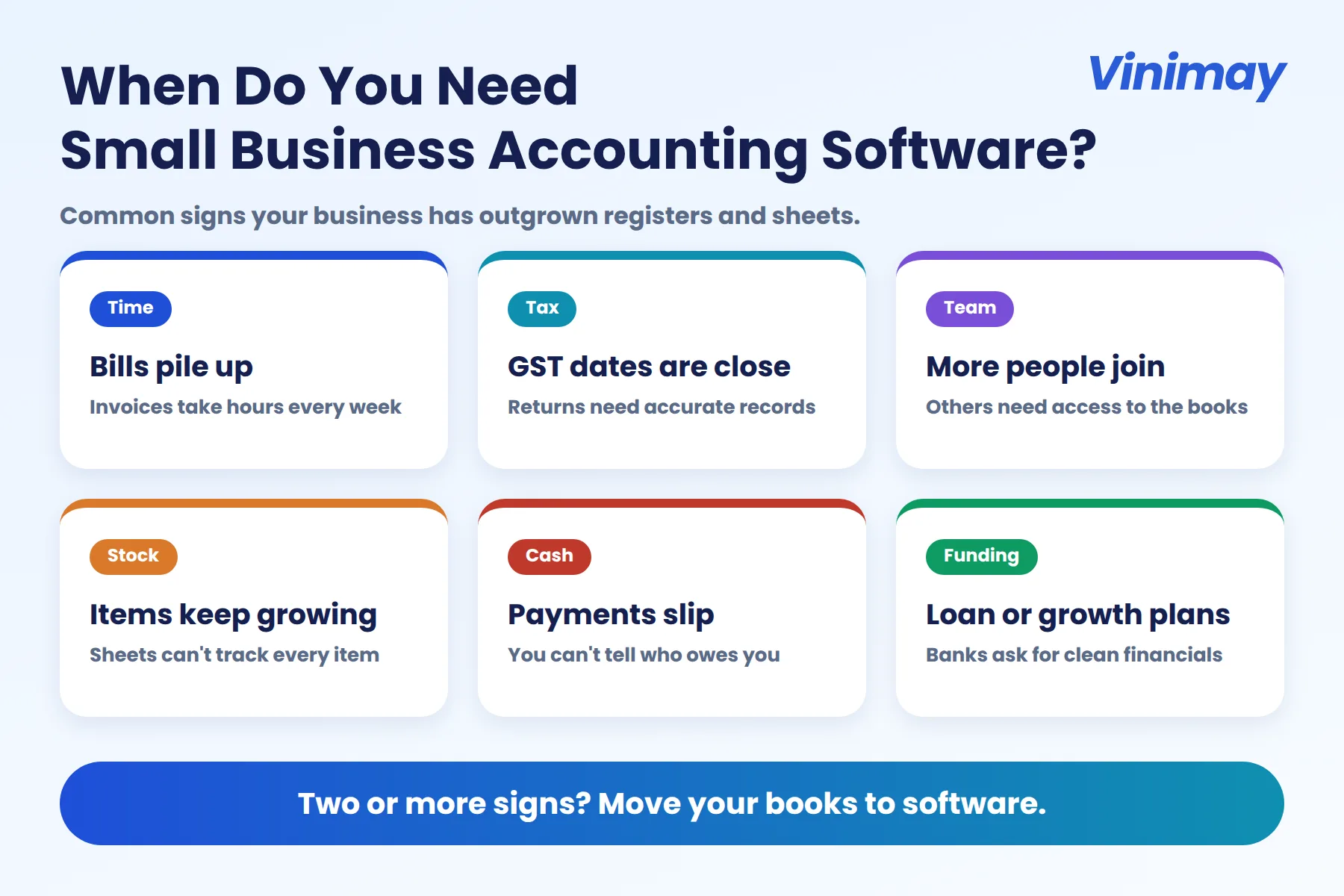
Signs You've Reached the Point of Needing Software vs When It's Fine to Wait
You're spending several hours a week just on invoicing and payment tracking, time that could go toward the business itself
You've had at least one billing or GST calculation error trace back to a manual mistake
You genuinely can't say, without checking multiple places, what your total outstanding receivables are right now
Your stock counts and actual sales have started drifting out of sync
More than one person now handles billing, and records are starting to conflict or duplicate
Preparing information for your CA is taking noticeably longer each time
When It's Genuinely Fine to Wait
You're issuing only a handful of invoices a month, and one person handles all of it reliably
There's no stock or inventory to track alongside billing
You haven't experienced a Home / Platform billing, tax, or payment tracking error yet
You're still validating a new business idea and don't yet have a stable, repeatable billing process
When It's Time to Bring In Vinimay
Once GST invoicing accuracy starts mattering more than occasional manual checking can reliably guarantee
Once tracking outstanding receivables and payables by memory or scattered notes starts feeling risky
Once stock needs to stay connected to billing through inventory and product management, rather than tracked separately
Once more than one person is involved in billing, and customer and vendor management would prevent record conflicts
Once reports and ledger management would save real time compared to manually compiling numbers for a CA
Conclusion
There's no fixed revenue or age threshold—the need for accounting software shows up as growing risk in manual tracking, not a milestone
Every month of unmanaged risk gives small errors more room to grow before they surface
A short, honest self-check—hours spent, past errors, unclear receivables—is more useful than a generic "you should switch now" rule
Vinimay fits naturally once GST accuracy, receivables tracking, or stock-to-billing accuracy start genuinely mattering
FAQs
When do I actually need small business accounting software?
When manual tracking starts creating real risk—billing errors, unclear receivables, or stock mismatches—rather than at a fixed revenue or time-in-business milestone.
Is it fine to manage billing manually when just starting a business? Y
es, for a very small, simple operation with low invoice volume and no stock to track, manual methods can work reasonably well for a while.
What's the biggest risk of waiting too long to adopt accounting software?
Small errors—a wrong tax calculation, an inaccurate customer balance—tend to accumulate unnoticed, making the eventual correction more difficult than an earlier switch would have been.
How many invoices a month means I should consider software?
There's no fixed number, but if invoicing and payment tracking are taking several hours weekly, that's a stronger signal than invoice count alone.
Does having more than one staff member handling billing change the timing?
Yes, once more than one person is involved, manual systems are more prone to conflicting or duplicated records, making software more valuable sooner.
Is business size the main factor in deciding when to adopt accounting software?
Not necessarily—billing complexity and risk matter more than size; a small business with GST invoicing and stock can need software sooner than a larger, simpler one.
What happens if I keep using manual methods past the point I actually needed software?
Errors tend to accumulate rather than resolve themselves, often surfacing at inconvenient moments liketax deadlines or customer disputes.
Can accounting software help even for a very small business with few transactions?
Yes, though the benefit is often smaller at low volume — it becomes more valuable as billing complexity, stock, or team size increases.
Should I wait until I have GST registration to start using accounting software?
Not necessarily — accurate invoicing and record-keeping are useful before GST registration too, and the switch to GST-compliant billing is easier from an already organised system.
What's an honest way to check if I need accounting software now?
Compare your situation against specific signs — hours spent on manual tracking, past errors, unclear receivables — rather than relying on general advice alone.
Related Topics
Published by Team Vinimay
Our editorial and compliance specialists create practical guides, tax calculation rules, and operational strategies to empower Indian small business owners and accountants.