Preparing a business loan proposal often requires detailed financial information, and CMA data is an important part of this process for many borrowers. However, many small businesses struggle to arrange accurate information because their sales, expenses, purchases, inventory, and financial records are maintained in different places.
CMA data preparation requires understanding past performance as well as estimating future business requirements. When accounting records are incomplete or scattered, preparing meaningful financial information becomes time-consuming.
Vinimay helps businesses maintain sales records, purchase records, expense details, inventory information, ledgers, payment tracking, and business reports in a structured system. These organised records can help businesses and professionals access the financial information needed while analysing business performance and preparing financial documents.
What Is CMA Data?
CMA stands for Credit Monitoring Arrangement. CMA data is a set of financial statements and projections generally prepared for evaluating a business's financial position and credit requirements.
It provides information about areas such as:
Past financial performance
Current financial position
Estimated future performance
Working capital requirements
Loan requirements
The exact format and requirements may vary depending on the lender and type of borrowing.
Why Is Accurate Data Important for CMA Preparation?
CMA data is based on business information. If the underlying records are incomplete or inaccurate, the analysis may not represent the actual position of the business. For example, if purchase records are missing or expenses are not properly recorded, the estimated working capital requirement may not reflect the real business situation. Maintaining organised accounting records helps provide a reliable base for preparing financial information.
How Can Accounting Software Support CMA Data Preparation?
Accounting software does not automatically create a complete CMA proposal because CMA preparation involves financial analysis, assumptions, projections, and professional evaluation.
However, accounting software can help maintain the basic business information required for analysis.
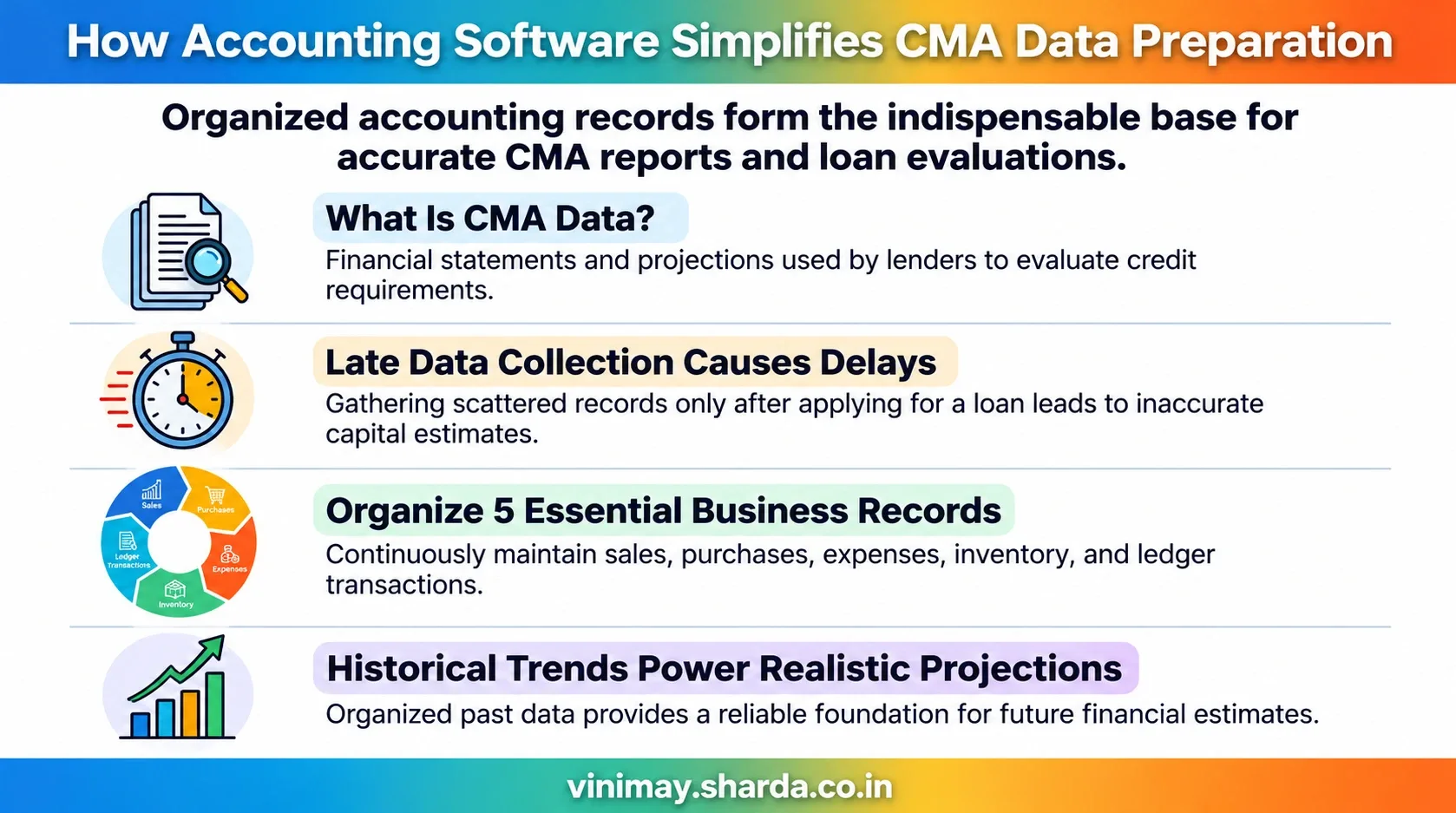
By keeping this information organised, businesses can reduce the effort involved in collecting data from multiple sources.
The Importance of Historical Business Records
CMA preparation often requires reviewing previous business performance. Historical records help understand how the business has performed over time. For example, past sales data can show revenue patterns, while purchase and expense records help understand how much capital is required to operate the business. Businesses that maintain regular records generally have better visibility into their own financial position.
Can Accounting Software Help With Future Projections?
Future projectionsin CMA data require business understanding, market analysis, and professional judgement. Software alone cannot predict future performance.
However, organised historical records can support better planning.
For example, a business can review previous sales, purchase trends, and expense patterns before estimating future requirements.
This helps create projections based on actual business information rather than assumptions alone.
What Records Should Businesses Maintain Before CMA Preparation?
Businesses should regularly maintain their operational and financial records instead of collecting information only when a loan requirement arises.
Important records include sales transactions, purchase details, expense information, inventory records, customer and supplier transactions, and ledger entries.
A structured record-keeping process makes it easier to review business performance whenever financial information is required.
Common Mistakes Businesses Make During CMA Preparation
Many businesses start collecting information only after a loan requirement arises. This can create delays because old records may not be complete.
Some common challenges include:
Missing purchase information
Unorganised expense records
Difficulty understanding actual business performance
Time spent collecting transaction details
Regular accounting practices help businesses stay prepared for future financial requirements.
Frequently Asked Questions
1. Can accounting software directly prepare CMA data?
Accounting software can help maintain financial records required for CMA preparation, but complete CMA preparation usually involves financial analysis and professional evaluation.
2. What information is required for CMA data?
CMA data generally requires information related to business performance, financial position, working capital requirements, and future estimates.
3. How does accounting software help in CMA preparation?
It helps organise sales, purchases, expenses, inventory, and transaction records that may be used while preparing financial information.
4. Is CMA data required for every business loan?
Requirements depend on the lender, loan type, and borrowing amount.
5. Can small businesses prepare CMA data without accounting software?
Yes, but maintaining and collecting information manually can become difficult as business transactions increase.
6. Why are past financial records important for CMA?
Past records help understand business performance and provide a base for financial analysis.
7. Can accounting software create future business projections?
Software can provide historical information, but future projections require business analysis and assumptions.
8. Which records should businesses maintain regularly?
Businesses should maintain sales, purchase, expense, inventory, customer, supplier, and ledger records regularly.
Related Topics
Published by Team Vinimay
Our editorial and compliance specialists create practical guides, tax calculation rules, and operational strategies to empower Indian small business owners and accountants.