Yes—but the more useful way to understand this isn't through a feature list; it's through watching how a vendor payment history actually builds up over time in a real business relationship. Here's what that looks like, month by month, for a fairly ordinary supplier relationship.
Following One Vendor Relationship From Start to Present
Imagine a small manufacturing business that starts buying raw materials from a new supplier. At first, it's just occasional purchases. Over time, it becomes a regular, ongoing relationship—and that relationship generates a payment history worth being able to look back on.
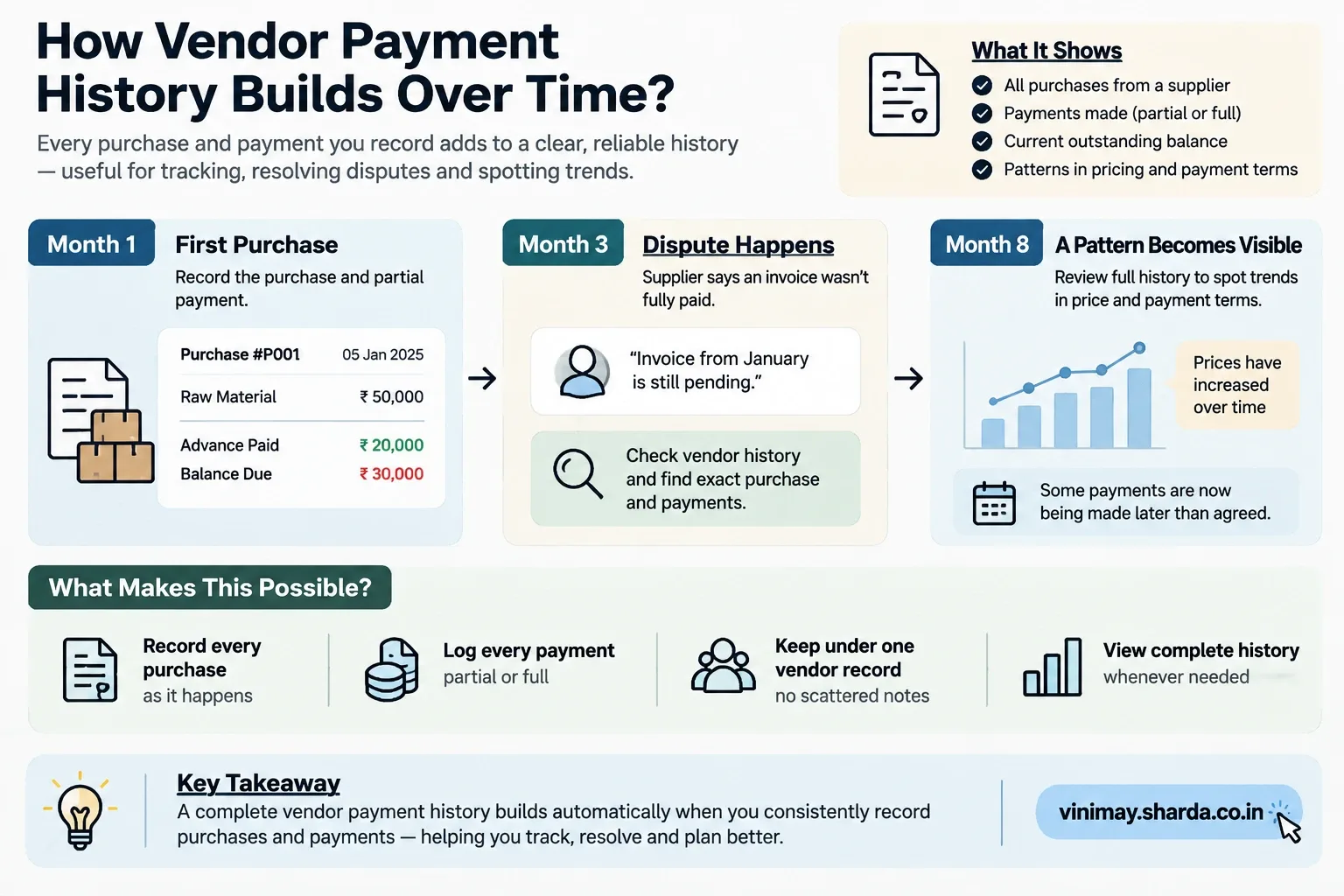
Month One: The First Purchase
The business places its first order and records the purchase—supplier name, amount, date, and agreed payment terms. A partial payment is made upfront, with the rest due on delivery. Both the purchase and the partial payment get logged against the same transaction, so from day one, there's a clear, accurate record of what's been paid and what remains.
Month Three: A Dispute Comes Up
Two months later, the supplier claims a particular invoice from month one was never fully paid. Without a maintained history, this would mean digging through old messages, bank statements, or memory to figure out what actually happened. With a proper vendor payment history, the business can pull up that specific transaction directly—the original purchase amount, the partial payment made upfront, and the final payment on delivery—and resolve the dispute with actual records rather than recollection.
Month Eight: A Pattern Becomes Visible
By month eight, the business has placed a dozen orders with this supplier. Looking at the full vendor payment history now shows something useful beyond just individual transactions: a pattern. Prices have crept up slightly over several orders, and payment terms have occasionally slipped from the agreed schedule. Neither of these would be obvious from any single transaction—they only become visible when the full history is reviewable together.
What Made This Possible
None of this required the business to build a separate tracking system. It came from a few things happening consistently, from the very first transaction:
Every purchase was recorded as it happened, not reconstructed later
Every payment—partial or full—was logged against the specific purchase it belonged to
The vendor's transactions stayed connected under one consistent record, rather than scattered across different notes or files
Nothing was deleted or overwritten as new transactions were added; the history simply grew
What This Looks Like Without Proper History Tracking
Contrast this with a business relying on scattered notes or memory. The month-three dispute becomes a stressful search through old messages and bank statements, possibly resolved in the supplier's favor simply because the business can't produce clear evidence otherwise. The month-eight pattern of creeping prices and slipping terms goes unnoticed entirely, since there's no consolidated view to spot it in.
What a Complete Vendor History Actually Requires
For a vendor payment history to hold up the way it did in this example, a few things need to be true of the underlying system:
Purchase records capture every transaction with the supplier as it happens
Payment tracking logs exactly what's been paid, including partial payments, against the correct purchase
Vendor management keeps this specific supplier's data organized separately from every other supplier
Ledger management consolidates all of it into one reviewable running history, rather than requiring transactions to be pieced back together
This is the combination Vinimay's confirmed features are built around—vendor management, purchase records, and payment tracking working together, consolidated through ledger management, so a vendor's full history is available exactly when it's needed, whether that's resolving a dispute or noticing a pattern that would otherwise stay invisible.
Frequently Asked Questions
1. Can accounting software store a supplier's full payment history over time?
Yes—as long as purchases and payments are consistently recorded and connected to the correct vendor, the history builds up automatically.
2. What happens if a supplier disputes a past payment?
A properly maintained vendor payment history lets you pull up the specific transaction and resolve the dispute with actual records.
3. Can partial payments be tracked accurately in vendor history?
Yes—each partial payment should be logged against its specific purchase, so the history reflects exactly what's been paid and what remains.
4. How far back does vendor payment history typically go?
It generally goes as far back as records have been consistently kept—there's no inherent limit if transactions are logged properly from the start.
5. Can I spot pricing trends from a supplier over time using this history?
Yes—reviewing a full vendor history often reveals patterns, like gradually increasing prices, that aren't visible from any single transaction.
6. What's the risk of not maintaining vendor payment history?
Disputes become harder to resolve, and useful patterns in pricing or payment terms go unnoticed.
7. Does this history require manual reconstruction later?
No, if purchases and payments are recorded as they happen, the history builds itself rather than needing to be pieced together afterward.
8. Is vendor history the same as a general purchase report?
They're related—vendor history specifically consolidates one supplier's transactions, while a purchase report may cover all suppliers together.
9. Can this history help during price negotiations with a supplier?
Yes—having a clear record of past pricing and payment patterns is useful leverage when discussing terms with a supplier.
10. What's needed for vendor history to actually be reliable?
Consistent, immediate recording of every purchase and payment—the history is only as good as the entries feeding it.
Related Topics
Published by Team Vinimay
Our editorial and compliance specialists create practical guides, tax calculation rules, and operational strategies to empower Indian small business owners and accountants.