Losing track of what's owed to a supplier is one of the more avoidable, yet common, problems small businesses run into. It rarely happens all at once—it happens gradually, as purchase records pile up across notes, messages, and memory, until nobody's entirely sure what's actually still outstanding. Tracking suppliers' payments properly isn't complicated, but it does require a consistent process. Here's what that process actually looks like, step by step.
Step 1: Record Every Purchase as It Happens
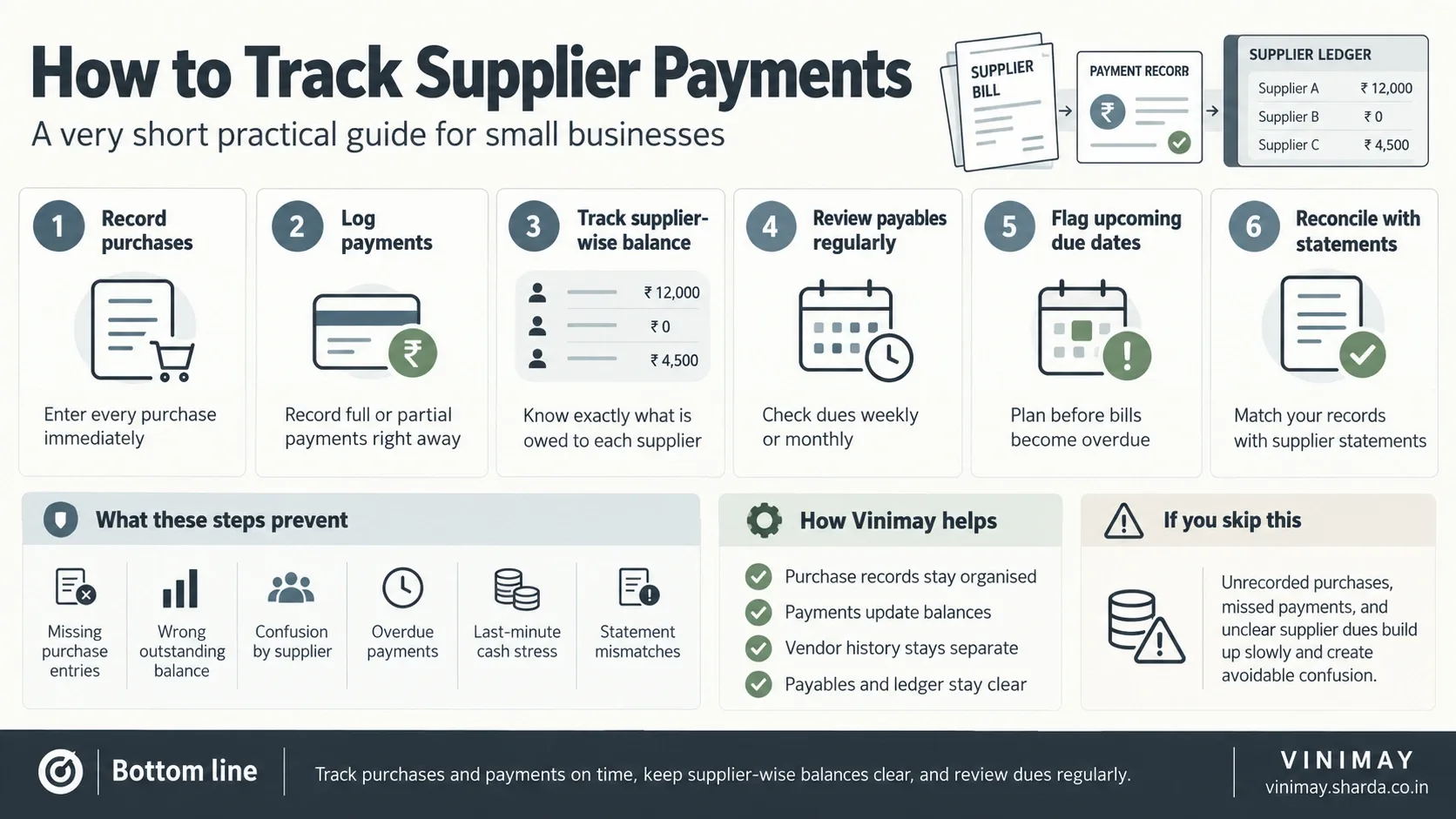
The foundation of accurate supplier tracking is recording every purchase the moment it happens, not days or weeks later from memory. Each purchase record should include the supplier, the amount, the date, and the agreed payment terms. Delayed or batch entry is where most tracking errors originate.
Step 2: Log Partial or Full Payments Immediately
Just as important as recording the purchase is recording the payment against it—the moment it happens, not at the end of the month. If a payment is partial, log the exact amount paid so the remaining balance stays accurate rather than becoming a guess.
Step 3: Keep a Running Balance Per Supplier
Rather than tracking payables as a single combined number, maintain a running balance for each individual supplier. This makes it possible to answer "how much do I owe this specific supplier right now" instantly, rather than needing to recalculate from scattered purchase and payment records.
Step 4: Review Your Payables Regularly, Not Just When a Supplier Asks
Waiting for a supplier to call about an overdue payment is a sign the tracking process has already failed. A better habit is reviewing your full payables list on a fixed schedule—weekly for high-volume businesses, monthly at minimum for lower-volume ones—so overdue amounts are caught before they become a supplier's problem to chase.
Step 5: Flag What's Coming Due Before It's Overdue
Beyond reviewing what's already overdue, it helps to look ahead at what's coming due soon, based on agreed payment terms. This turns supplier payment tracking from a reactive task into a planned one, giving you time to arrange funds rather than scrambling at the last moment.
Step 6: Reconcile Against Supplier Statements Periodically
If a supplier sends periodic statements, compare them against your own records every so often. Discrepancies—a payment they haven't received, or a purchase they've recorded differently—are far easier to resolve when caught early rather than months later.
What Happens If You Skip These Steps
Skipping any of these steps doesn't usually cause an immediate problem—it causes a slow accumulation of uncertainty. Purchases go unrecorded, payments aren't matched to the right bill, and eventually a supplier calls asking about an overdue payment that the business genuinely didn't realize was outstanding. At that point, resolving it means manually reconstructing weeks or months of purchase history—exactly the work this process is meant to avoid.
How This Works in Practice
Each of these steps maps directly onto a specific part of a connected billing system, rather than requiring separate manual tracking:
Purchase records capture each transaction with the supplier as it happens
Payment tracking logs what's been paid against each purchase immediately
Vendor management keeps each supplier's details and history organized separately
Receivables and payables maintain a clear, current balance of what's owed to each supplier
Ledger management consolidates a supplier's full transaction history into one reviewable view
In Vinimay, these areas work together so that recording a purchase and its payment naturally builds the running payables balance described in the steps above—rather than requiring a separate spreadsheet to track what's owed to each supplier alongside the actual purchase records.
Frequently Asked Questions
1. What's the most important step in tracking supplier payments?
Recording purchases and payments immediately, rather than from memory later, is the foundation everything else depends on.
2. How often should I review what I owe suppliers?
Weekly for high-volume businesses, or at minimum monthly for lower-volume ones, to catch overdue amounts before they become a problem.
3. Should I track payables as one combined total or per supplier?
Per supplier—a running balance for each individual supplier gives a clearer, more actionable picture than one combined number.
4. What causes most supplier payment tracking errors?
Delayed or batch entry of purchases and payments, rather than recording them as they happen, is the most common cause.
5. Is it useful to flag upcoming due dates in advance?
Yes—this turns payment tracking from reactive to proactive, giving you time to plan rather than scrambling when something becomes overdue.
6. Should I compare my records against supplier statements?
Yes—periodic reconciliation with supplier statements helps catch discrepancies early, before they become harder to resolve.
7. What does a payables report actually show?
It shows what's currently owed to each supplier, based on recorded purchases and the payments already made against them.
8. Can partial payments be tracked accurately?
Yes, as long as each partial payment is logged individually against the correct purchase, keeping the remaining balance accurate.
9. What happens if a supplier payment isn't logged promptly?
The outstanding balance becomes inaccurate, increasing the risk of either a missed payment or a duplicate one.
10. Does keeping vendor records separate help with tracking?
Yes—organizing each supplier's purchases and payments separately makes it far easier to answer what's owed to any one of them at a glance.
Related Topics
Published by Team Vinimay
Our editorial and compliance specialists create practical guides, tax calculation rules, and operational strategies to empower Indian small business owners and accountants.