How to Choose Free Accounting Software for a Service Business
A consultant billing hourly, a salon billing per appointment, and an agency billing monthly retainers are all "service businesses," but they don't need identical software features. What they do share is a lens that's different from retail or wholesale evaluation criteria—because a service business doesn't sell physical stock, and most generic accounting software guides are written with inventory-heavy businesses in mind.
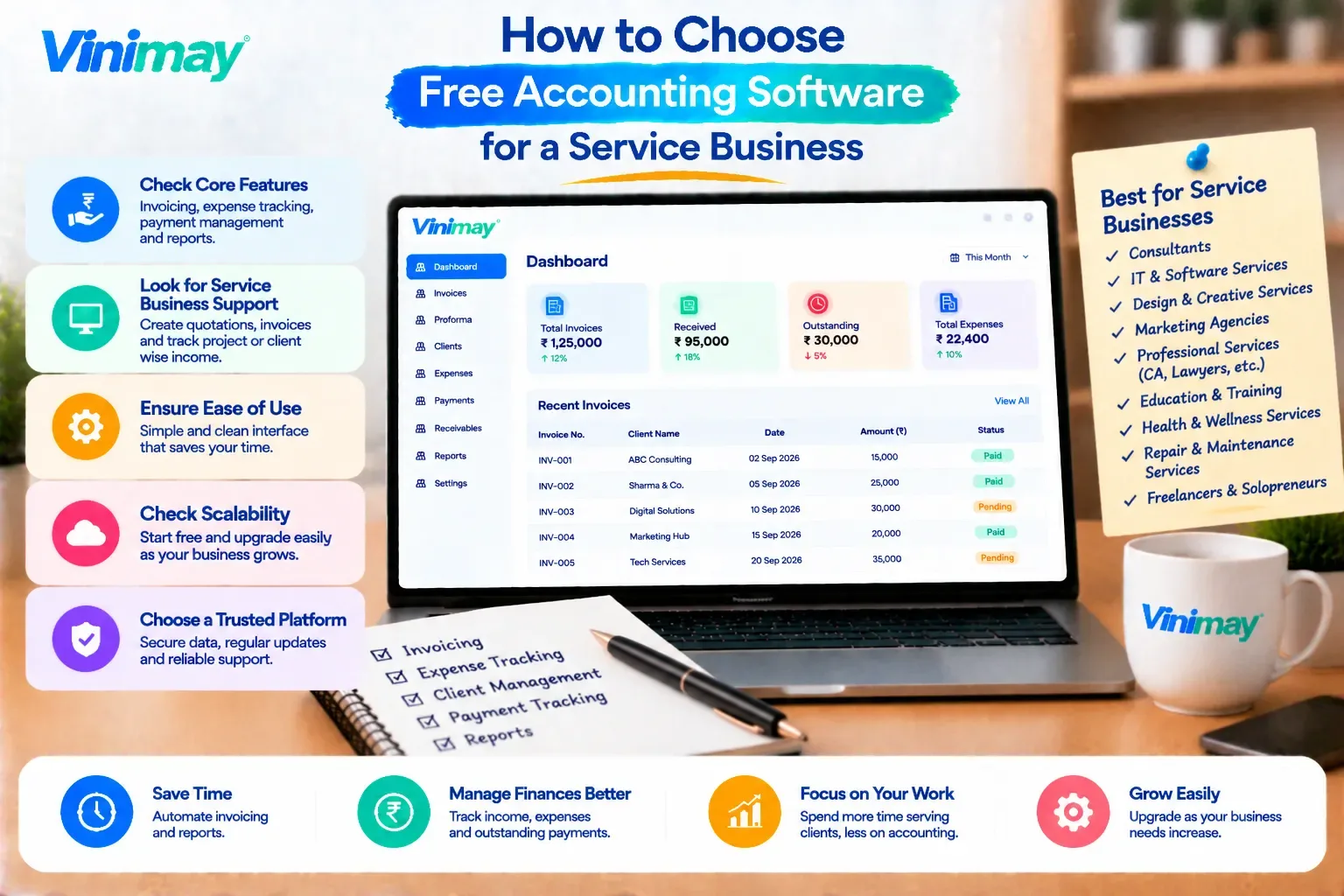
Choosing accounting software for a service business means prioritising how you bill (time, project, or recurring), how you track ongoing client relationships, and how payments get collected—rather than features like stock management, which simply don't apply. Vinimay handles GST invoicing, payment tracking, customer records and reports — several of the features that matter most for this specific business type.
This guide walks through the five requirements that actually matter for service businesses, what you can safely deprioritise, and how to evaluate any tool against your specific billing pattern.
Why Service Businesses Need a Different Evaluation Lens
Generic accounting software guides often lead with inventory and stock features, since a large share of small businesses sell physical products. For a service business, that entire category of features is irrelevant — what matters instead is how flexibly the software handles billing patterns that don't map to a simple "item sold, quantity, price" structure.
Requirement 1: Time or Project-Based Billing
Unlike a fixed-price product sale, service billing often depends on hours worked, milestones completed, or a project's overall scope. Software that lets you invoice based on a described service and an agreed amount — rather than forcing every line item into a rigid "product" structure — fits this pattern more naturally.
Requirement 2: Recurring and Retainer Invoicing
Many service businesses—consultants, agencies, subscription-based services—bill the same client a similar amount on a regular schedule. The ability to create and send similar invoices repeatedly, without rebuilding each one from scratch, saves meaningful time for this specific billing pattern.
Requirement 3: GST-Correct Service Invoicing (SAC Codes)
Services are classified under SAC (Services Accounting Code) rather than the HSN codes used for physical goods. Software needs to apply the correct SAC code and corresponding GST rate for services specifically — a detail that's easy to overlook if a tool is built primarily around product-based HSN logic.
Requirement 4: Payment and Outstanding Tracking
Service businesses frequently deal with partial payments — an advance before work begins, a balance on completion — making clear tracking of what's been paid against what's due especially important. This matters as much or more than in product-based businesses, since service payments often don't happen in one lump sum at the point of sale.
Requirement 5: Client Record Management
For consultants and agencies working with the same clients repeatedly, saved client details, communication history and past invoice records reduce repetitive data entry and give a clearer picture of the overall relationship, not just individual transactions.
What Service Businesses Usually Don't Need
It's worth being direct about what to deprioritize: inventory and stock tracking, product catalogue management, and delivery challans are typically irrelevant for a pure service business. Paying for or configuring these unnecessarily adds complexity without corresponding benefit—a leaner, billing-and-payment-focused tool often fits better than a heavier, inventory-first system.
A Quick Evaluation Table
Where Vinimay Fits for Service Businesses
Vinimay applies GST correctly on service invoices, with CGST, SGST and IGST calculated based on the transaction, and supports proforma invoices for quoting work before it begins. Payment tracking shows what's been received against what's outstanding — directly useful for advance-and-balance billing patterns common in service work. Customer records are saved for reuse, supporting repeat-client relationships without retyping details each time.
For businesses evaluating this specifically, Vinimay's free invoice tool lets you generate up to 5 GST invoices free, so you can test how service-style billing looks and feels before deciding further.
Conclusion
Choosing accounting software for a service business means evaluating it against a different set of priorities than a product-based business would — time or project-based billing flexibility, recurring invoicing, correct SAC-based GST classification, and payment tracking that handles advances and partial payments, while inventory-heavy features can largely be deprioritised.
Vinimay covers the core requirements that matter most here—GST-correct service invoicing, proforma invoices, payment tracking and saved client records—giving service businesses a straightforward way to test the fit before deciding further.
Frequently Asked Questions
1. Do service businesses need inventory management in their accounting software?
Generally no — inventory tracking is built for physical goods and isn't relevant to a pure service business.
2. What's the most important accounting feature for a consultant or freelancer?
Flexible invoicing that accommodates time or project-based billing, along with reliable payment tracking for advances and balances.
3. Are HSN and SAC codes the same thing?
No — HSN codes classify physical goods, while SAC codes classify services, and software should apply the correct one for GST purposes.
4. Does Vinimay support proforma invoices for service quotes?
Yes, Vinimay includes proforma invoices, useful for quoting service work before a final invoice is issued.
5. How important is recurring invoicing for a service business?
Very important for retainer-based or subscription-style services, since it avoids rebuilding a similar invoice from scratch each cycle.
6. Can a service business use the same accounting software as a retail store?
Technically yes, but many retail-focused features like inventory management add unnecessary complexity for a pure service business.
7. Does Vinimay track partial payments for service work?
Yes, Vinimay's payment tracking shows what's been received against what's still outstanding on any invoice.
8. How many free invoices can I test on Vinimay for service billing?
Vinimay's free invoice tool allows up to 5 GST invoices free, downloadable as PDF.
9. Should a service business worry about GST classification differently than a product business?
Yes, services are classified under SAC codes rather than HSN codes, which affects how tax rates are applied.
10. What's the biggest mistake service businesses make when choosing accounting software?
Choosing a heavily inventory-focused tool that adds complexity without offering features relevant to service billing
Related Topics
Published by Team Vinimay
Our editorial and compliance specialists create practical guides, tax calculation rules, and operational strategies to empower Indian small business owners and accountants.