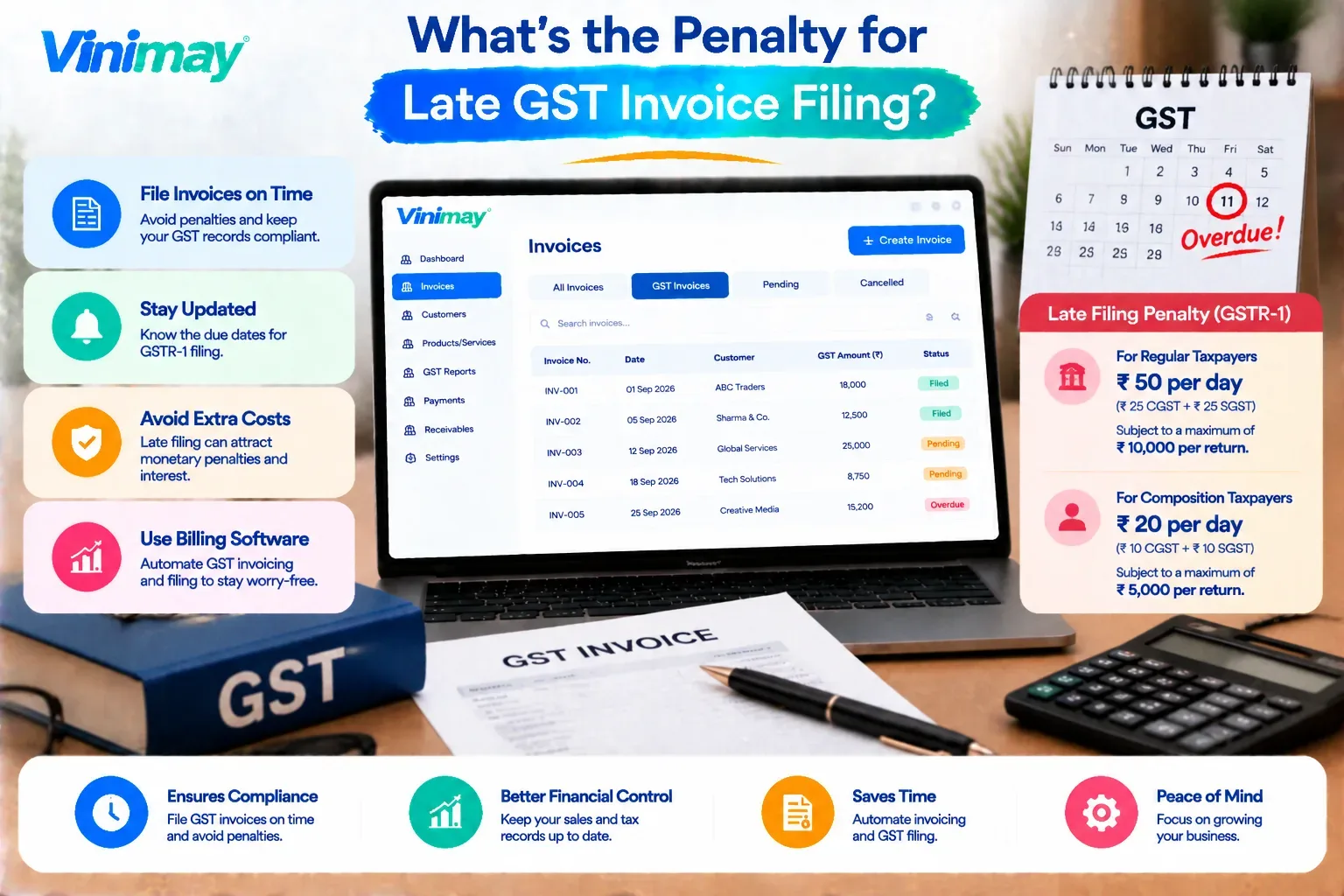
What's the Penalty for Late GST Invoice Filing?
"Late GST invoice filing" is a phrase that actually blends two separate compliance concerns under GST law. One is about issuing an invoice on time — the document a business creates for a sale. The other is about filing a GST return on time — the periodic submission (like GSTR-1 or GSTR-3B) that reports invoices and tax liability to the government. These carry different penalties, apply in different situations, and confusing them can lead to checking the wrong consequence for your actual situation.
Getting this distinction right matters because the penalty amounts, and the actions that trigger them, are genuinely different. Not issuing an invoice at all is treated as a more serious offence under GST law than filing a return a few days late, which mainly attracts a late fee and interest rather than a discretionary penalty.
This guide breaks down both scenarios clearly, with accurate, current information on what triggers each and what the consequences typically are — noting that exact figures can be updated by the GST authorities, so current rates are always worth confirming on the official GST portal.
What Does "Late GST Invoice Filing" Actually Refer To?
Direct answer: This phrase most commonly refers to one of two things: failing to issue a GST invoice within the required timeframe for a supply or filing a GST return (like GSTR-1 or GSTR-3B) after its due date—each carries a different penalty structure under GST law.
Invoice issuance timing is governed separately from return filing deadlines
A return can be filed on time even if an individual invoice was delayed, and vice versa
The two issues can also compound — a delayed invoice can lead to a delayed or inaccurate return
Why This Distinction Matters More Than It Seems
Treating these two situations as the same thing can lead to either unnecessary panic or a missed compliance risk, depending on which way the confusion goes. A business owner worried about a single invoice being issued a few days late might assume they're facing the same daily late fee structure that applies to return filing, when in fact the more relevant risk is different—failing to issue a compliant invoice at all is treated as a specific offense under Section 122 of the CGST Act, with its own penalty provision, separate from the late fee and interest structure that applies to return filing delays. Conversely, a business that's confident because "invoices are all issued correctly" might overlook that the return summarising those invoices is what actually needs to be filed by its own separate deadline—and that's where the daily late fee and interest genuinely start accumulating.
Invoice Issuance Penalty vs Return Filing Penalty — Quick Comparison
Penalty for Not Issuing an Invoice on Time
Under GST law, supplying goods or services without issuing a proper invoice, or issuing an incorrect one, is treated as an offense under Section 122 of the CGST Act
Penalties for invoice-related offences (not issuing an invoice, or issuing an incorrect one) can go up to a specified amount per offence, separate from any tax due
This is distinct from a late fee — it's a penalty tied to non-compliance with invoicing rules, not a daily accumulating charge
Exact penalty amounts and thresholds are set by GST law and can be updated, so current figures should be confirmed on the official GST portal or with a GST practitioner
Penalty for Late GST Return Filing
Late filing of a GST return (such as GSTR-3B) attracts a late fee, typically charged per day per Act (CGST + SGST), until the return is filed
Late fees are generally lower for nil returns and higher for returns with actual tax liability, often subject to a maximum cap per return period
In addition to the late fee, interest is charged annually on any unpaid tax amount for the period of delay
Late fee and interest rates have changed over time and can vary by return type, so the current, exact rates should be checked on the official GST portal before relying on a specific figure
How Vinimay Helps You Avoid Both
Generates GST-compliant invoices with the correct structure and tax calculation applied automatically, reducing the risk of an invoice being incorrect or delayed
Keeps sales records and invoices connected and accurately dated, making it easier to issue invoices within the required timeframe
Maintains organised, accurate records and reports, so the information needed for a GST return is ready well before the filing deadline
Does not file GST returns directly — return filing itself is a separate step handled through the GST portal or your CA, but Vinimay keeps the underlying records accurate and ready for that process
Conclusion
"Late GST invoice filing" actually covers two different issues: not issuing an invoice on time, and filing a GST return late — each has its own penalty
Failing to issue a proper invoice is treated as a specific offence with its own penalty, separate from daily late fees
Late return filing typically attracts a per-day late fee plus annual interest on unpaid tax, both of which vary by return type and can change over time
Vinimay keeps invoicing accurate and records ready for filing, reducing the risk behind both scenarios — though actual return filing remains a separate step
FAQs
What's the penalty for late GST invoice filing?
This depends on which issue applies — not issuing an invoice on time carries a specific penalty under Section 122 of the CGST Act, while late GST return filing carries a separate daily late fee plus interest.
Is there a penalty for issuing a GST invoice a few days late?
Not issuing a compliant invoice within the required timeframe can be treated as an offence, though the practical consequence often depends on whether it's caught during scrutiny or audit.
What's the late fee for filing GSTR-3B late?
Late fees are charged per day per Act (CGST + SGST), generally lower for nil returns and higher for returns with tax liability, subject to a cap — current exact rates should be checked on the official GST portal.
Does interest apply on top of the late fee for late GST returns?
Yes, interest is charged annually on any unpaid tax amount for the period of delay, in addition to the late fee.
What happens if I don't issue an invoice at all for a taxable supply?
This is treated as a more serious compliance issue under GST law, since the supply is still taxable regardless of whether an invoice was issued.
Can I file a GST return without having issued all invoices for the period?
This risks an inaccurate return, since a missing invoice means understated sales and tax liability for that period.
Does a late invoice automatically mean a late GST return?
Not necessarily, but a delayed invoice increases the risk of the resulting return being inaccurate or filed late if it's discovered close to the deadline.
Can GST late fees be waived?
In some cases, waivers or reductions have been granted for genuine reasons or as government relief measures, but this isn't guaranteed and should be checked through official channels.
Do these penalties apply the same way to every business size?
The underlying rules apply broadly to registered businesses,though specific thresholds and figures should always be confirmed against current GST law for your situation.
What's the best way to avoid both invoice and filing penalties?
Keeping invoices accurate and issued promptly, and maintaining organised records throughout the period, makes return filing faster and reduces the risk of either type of penalty.
Related Topics
Published by Team Vinimay
Our editorial and compliance specialists create practical guides, tax calculation rules, and operational strategies to empower Indian small business owners and accountants.