UAE Tax Invoice Format 2026: Mandatory Fields & Examples Quick Answer: A UAE tax invoice must contain prescribed details such as the words “Tax Invoice”, supplier name, address, Tax Registration Number (TRN), invoice date, description, prices and VAT amounts. Full invoices need additional buyer and transaction information. From 2027, qualifying businesses must also follow structured PINT-AE e-invoicing requirements.
Businesses in Dubai, Abu Dhabi, Sharjah and other Emirates must issue accurate tax invoices to comply with Federal Tax Authority (FTA) regulations.
The UAE has a standard VAT rate of 5%. However, businesses must also understand the difference between full and simplified tax invoices and the new electronic invoicing framework.
1. What Is a UAE Tax Invoice?
A tax invoice is a document issued by a VAT-registered supplier to record a taxable supply.
It shows the goods or services supplied, applicable VAT and the total amount payable.
A valid tax invoice helps businesses record sales, prepare VAT returns and support eligible input VAT claims.
An ordinary invoice is not necessarily VAT-compliant if it omits mandatory information.
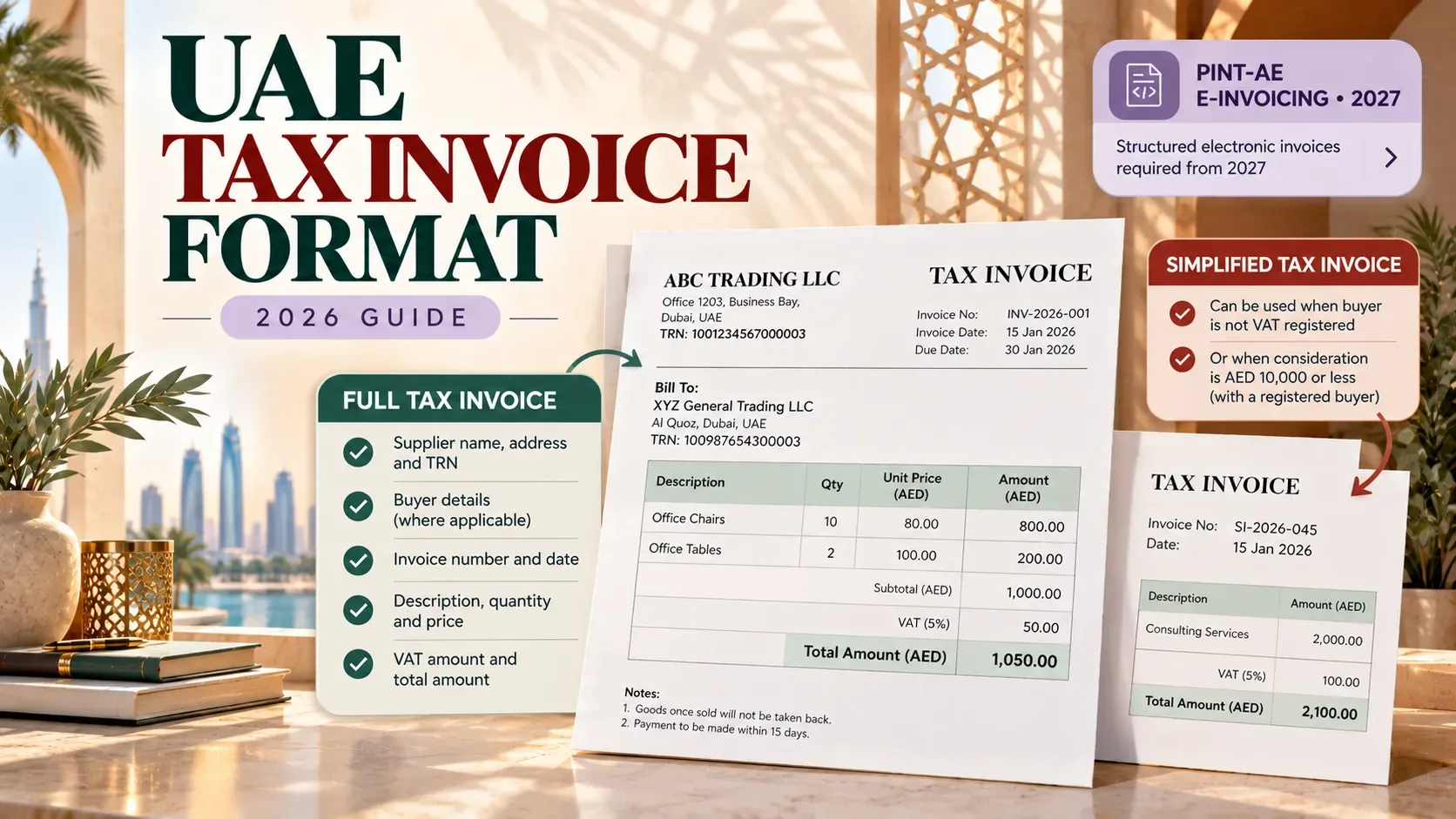
2. What Details Must a Full Tax Invoice Include?
Article 59 of the UAE VAT Executive Regulation sets out the required particulars.
Additional information is required for certain reverse-charge and foreign-currency transactions.
3. What Does a UAE Tax Invoice Look Like?
Consider a Dubai business selling equipment to another VAT-registered company.
This is an illustrative transaction summary, not a complete invoice template. A full invoice must also include the required addresses, customer TRN where applicable, and other prescribed particulars.
4. What Is a Simplified Tax Invoice?
Under the ordinary VAT invoicing rules, a simplified tax invoice may be issued when:
The customer is not registered for VAT; or
The customer is VAT-registered and the consideration does not exceed AED 10,000.
A simplified invoice generally includes the words “Tax Invoice”, supplier name, address and TRN, issue date, goods or services description, total consideration and VAT charged.
Important: The simplified-invoice option under ordinary VAT rules must not be confused with UAE's new mandatory e-invoicing system. For transactions covered by that system, businesses must use the prescribed structured electronic invoice requirements rather than relying on the ordinary simplified format.
5. When Must UAE Tax Invoices Be Issued?
A tax invoice must generally be issued within 14 calendar days from the date of supply.
For example, if the relevant date of supply is 1 November 2026, the normal 14-day deadline must be observed.
Special rules may apply to summary tax invoices, continuous supplies and particular transaction arrangements.
Businesses should establish accurate invoice dates and tax-point controls to avoid late issuance.
6. Can UAE Tax Invoices Be Issued in Foreign Currencies?
Yes. A business may invoice customers in USD, EUR or another foreign currency.
However, the tax invoice must show the VAT payable in UAE dirhams and the applicable exchange rate.
For example, a business issuing a USD invoice for a UAE standard-rated supply must calculate and show the correct AED VAT amount.
The exchange rate must follow applicable UAE VAT requirements.
7. What Changes Under UAE E-Invoicing From 2027?
The UAE is introducing mandatory structured electronic invoicing in phases.
The new system uses PINT-AE XML and Accredited Service Providers (ASPs).
The Ministry of Finance identifies 51 mandatory fields for a PINT-AE tax e-invoice, covering invoice details, supplier and buyer identifiers, tax breakdowns, invoice lines and document totals.
These technical fields are more extensive than those required on an ordinary tax invoice.
A PDF or emailed invoice alone is not considered a valid structured e-invoice.
8. How Can Vinimay Help With UAE Tax Invoicing?
Businesses benefit from accurate customer, supplier and transaction records when preparing tax invoices.
Vinimay offers general tools for invoice creation, purchase recording, customer management, payment tracking and financial reporting.
These features can help businesses organise invoice information and review transactions with their accountants.
However, Vinimay's UAE-specific VAT compliance, PINT-AE XML support, ASP integration and automated FTA reporting have not been independently verified.
Businesses should confirm these capabilities before relying on the software for mandatory UAE e-invoicing.
Frequently Asked Questions
Related Topics
Published by admin
Our editorial and compliance specialists create practical guides, tax calculation rules, and operational strategies to empower Indian small business owners and accountants.