What Are Accounting Software Programs?
Accounting Software Programs Someone encountering this term for the first time — maybe while researching how to formalise their business's record-keeping — often finds it described in ways that assume prior knowledge of accounting itself. That's an unnecessary barrier for what is, at its core, a fairly simple idea.
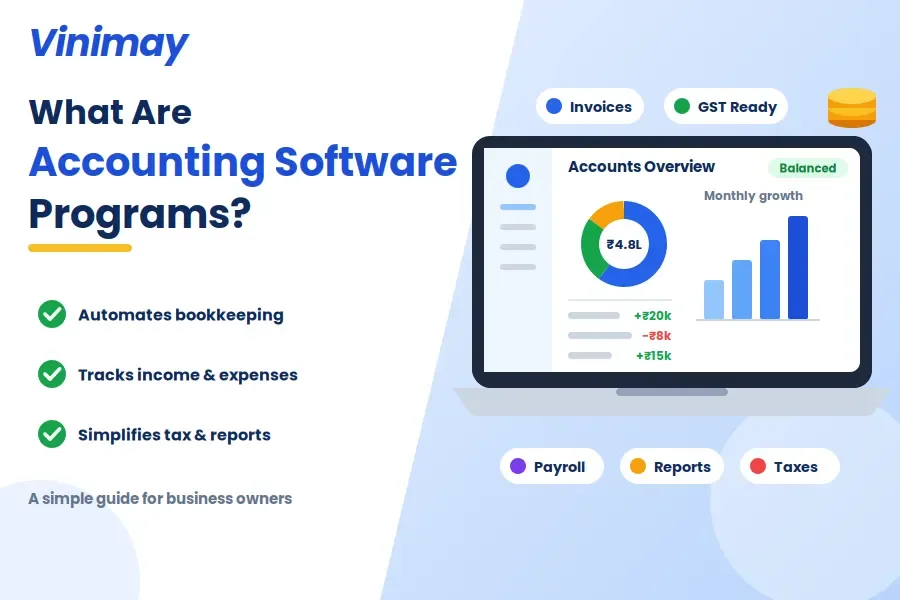
An accounting software program is a digital tool that records a business's financial transactions — sales, purchases, expenses and payments — and organises that information into invoices, records and reports automatically, replacing the manual process of writing entries by hand and calculating totals yourself.
This guide explains what these programs actually do, the different types available, and how they compare to simpler alternatives like a spreadsheet.
What Is an Accounting Software Program, in Simple Terms?
Think of it as a structured, digital version of a business's account books — instead of writing a sale in a register and calculating tax by hand, you enter the same details into the software, and it handles the calculation, formatting and record-keeping automatically.
The core idea isn't complicated: every transaction a business makes — a sale, a purchase, an expense, a payment — gets entered once, and the software organises, calculates and stores it in a structured, retrievable way.
What These Programs Actually Do
At a functional level, accounting software programs typically handle invoice creation with correct tax details, expense and purchase recording, tracking of what customers owe and what's owed to vendors, generation of summaries and reports from that data, and storage of customer, vendor and product details for reuse. None of these individually require specialised accounting knowledge—they mirror transactions a business owner already understands.
Different Types of Accounting Software Programs
Not all accounting software programs are built for the same scope of work:
Invoicing tools focus narrowly on creating and formatting bills, often with minimal reporting
Billing and inventory software connects invoicing with stock management, suited to product-based businesses
Full accounting systems extend further into ledgers, bank reconciliation, and detailed financial statements
Enterprise-level accounting software handles complex, multi-department financial operations for larger organisations
Most small businesses start at the invoicing or billing-and-inventory level, moving toward fuller accounting systems as complexity grows.
Who Typically Uses Them
These programs are used by a wide range of people, not just trained accountants: a shop owner creating daily bills, a freelancer invoicing clients, a wholesaler tracking vendor purchases, and a growing business needing organised records for a loan application or a CA's review. The common thread is a need for organised, accurate financial records, not formal accounting training.
How They Differ From a Simple Spreadsheet
A spreadsheet can technically hold similar information, but it doesn't inherently connect a sale to a stock reduction or a payment to a specific invoice — that connection is what accounting software is specifically built to provide.
What They Generally Don't Do
It's worth being clear about the boundaries too: most accounting software doesn't interpret whether a business decision was sound, doesn't file taxes on your behalf without a separate step, and doesn't replace the judgment a CA brings to compliance or financial strategy. These programs organise and calculate — the decisions and professional review still involve a person.
Where Vinimay Fits This Definition
Vinimay is an example of billing-and-inventory-level accounting software, built around GST invoicing, sales and purchase records, payment tracking, inventory, and customer and vendor management — the functions most small and growing businesses in India need day to day. It fits squarely into the "digital replacement for manual billing and record books" definition described above, without requiring accounting expertise to use.
To see this directly, Vinimay's free invoice tool lets you generate up to 5 GST invoices free, with tax calculated automatically — a simple, practical way to see what an accounting software program actually does in practice.
Conclusion
An accounting software program is, at its simplest, a digital replacement for a business's manual account books — recording sales, purchases and payments, and automatically organising them into invoices, records and reports. Different types exist for different scopes, from simple invoicing tools to full accounting systems, and most small businesses start at the billing-and-inventory level before growing into more complex needs. Vinimay fits this definition directly, built around the everyday transactions a business owner already understands, without requiring accounting expertise to use.
Frequently Asked Questions
1. What is the simplest definition of accounting software?
A digital tool that records business transactions and automatically organises them into invoices, records and reports.
2. Do I need accounting knowledge to use accounting software?
No, most programs are built around everyday transactions like sales and payments, not accounting theory.
3. What's the difference between invoicing software and full accounting software?
Invoicing software focuses narrowly on creating bills; full accounting software extends into ledgers, reconciliation and financial statements.
4. Can a spreadsheet function as accounting software?
It can hold similar data, but it doesn't automatically connect transactions the way dedicated accounting software does — like linking a sale to stock and payment records.
5. Who typically uses accounting software programs?
A wide range of people, from shop owners and freelancers to wholesalers and growing businesses,not just trained accountants.
6. Is Vinimay a full accounting system or a billing tool?
Vinimay is a billing-and-inventory-level accounting tool, covering GST invoicing, records, inventory and payment tracking.
7. Does accounting software file taxes automatically?
Generally not without a separate step — it organises the data that supports filing, but filing itself is typically distinct.
8. What's the most basic function every accounting software program includes?
Invoice creation with automatic calculation, which is the most universally included feature.
9. How many free invoices can I create to try Vinimay?
Vinimay's free invoice tool allows up to 5 GST invoices free, downloadable as PDF.
10. Should a very small business bother with accounting software at all?
Even basic invoicing and record organization offer real value early on, growing more valuable as transaction volume increases
Related Topics
Published by Team Vinimay
Our editorial and compliance specialists create practical guides, tax calculation rules, and operational strategies to empower Indian small business owners and accountants.