Financial statements provide businesses with a clear view of their financial position, including income, expenses, assets, liabilities, and overall performance. Preparing these statements manually can be time-consuming and may lead to errors if transaction records are not maintained accurately.
Accounting software helps businesses organize financial transactions and generate reports that support the preparation of financial statements. By maintaining records of sales, purchases, payments, and expenses in one system, businesses can access more accurate financial information. Vinimay helps businesses manage accounting data, billing, and reports together, making financial reporting more structured and efficient.
What “Financial Statements” Actually Refers To
For most small businesses, financial statements generally refer to three key reports:
Profit & Loss Statement: Shows revenue, expenses, and the resulting profit or loss over a specific period.
Balance Sheet: Provides a snapshot of the business’s assets, liabilities, and equity at a particular date.
Cash Flow Statement: Tracks the movement of cash into and out of the business during a specific period.
Each statement serves a different purpose, from internal financial review and business planning to loan applications, investor discussions, and statutory reporting, depending on the business’s requirements.
Component 1: Profit and Loss Statement
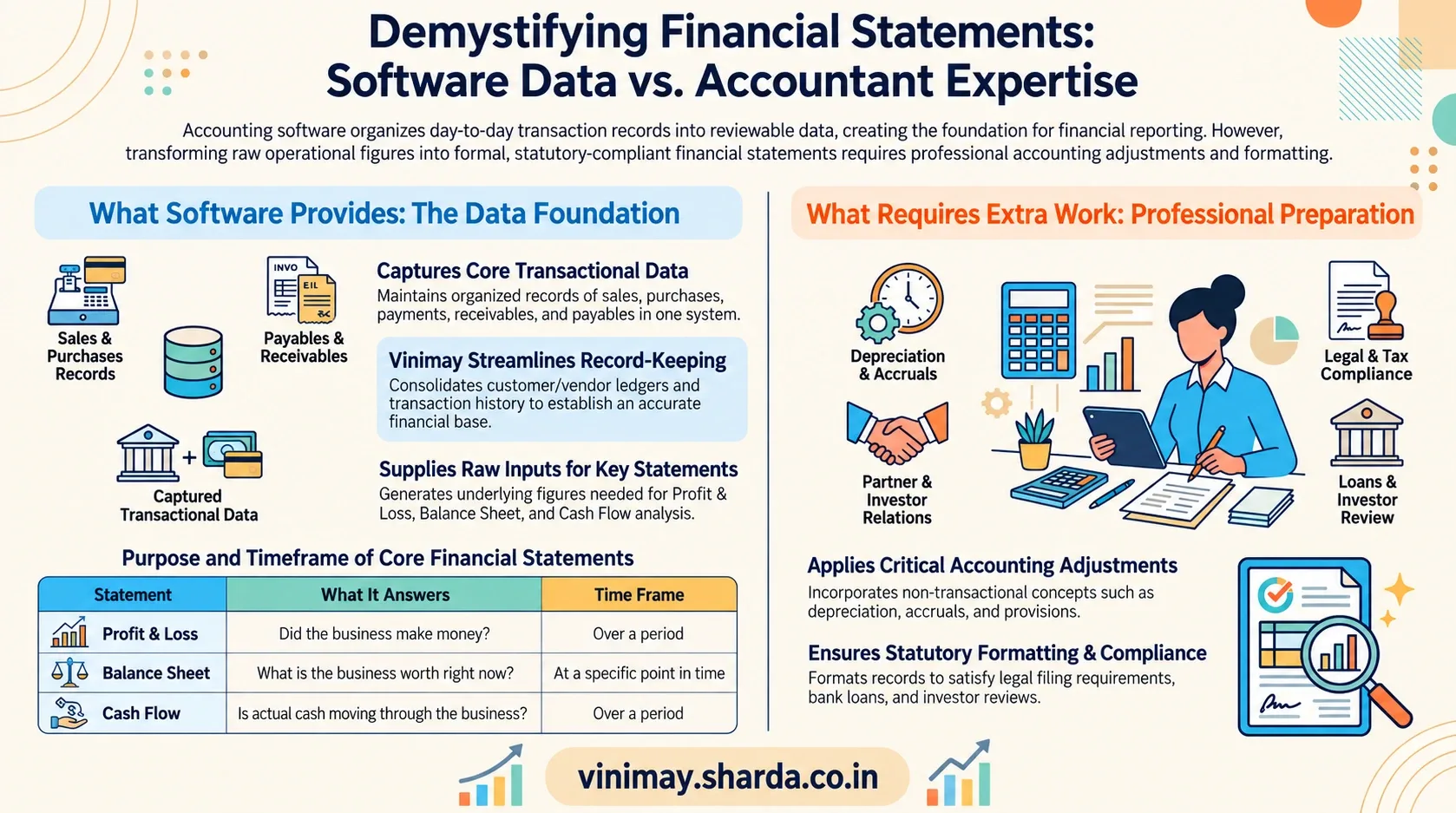
This shows revenue, costs, and resulting profit or loss over a specific period—typically a month, quarter, or year. It answers: Did the business make money during this period, and how much?
Component 2: Balance Sheet
This shows what a business owns (assets), what it owes (liabilities), and the resulting net worth (equity) at a specific point in time. It answers: what is the business actually worth right now?
Component 3: Cash Flow Statement
This shows how cash moved in and out of the business over a period, distinct from profit—a business can be profitable on paper while still facing cash flow problems if payments are delayed. It answers: does the business have enough actual cash moving through it?
What Billing Software Typically Provides Toward These
Most billing and accounting software, including tools focused on GST invoicing and everyday transaction tracking, generates the raw underlying data these statements are built from:
Sales and purchase records feed directly into the revenue and cost figures a profit and loss statement needs
Receivables and payables reflect amounts owed to and by the business, relevant to a balance sheet
Payment and receipt tracking shows actual cash movement, relevant to a cash flow statement
What Usually Still Requires Extra Work
Generating these underlying figures is different from producing a fully formatted, statutory-compliant financial statement. Formal financial statements often require:
Specific formatting and structure required by accounting standards or statutory filing requirements
Additional adjustments—depreciation, accruals, provisions—that go beyond what everyday billing records capture
Professional review to ensure the statements are accurate and compliant, especially if they're being used for loans, investors, or official filings
Who to Involve When Formal Statements Are Needed
For statements that will be submitted to a bank, investor, or regulatory authority, involving an accountant or chartered accountant is standard practice, even for businesses using good billing software. The software's role is to keep the underlying transaction data accurate and organized; the professional's role is to structure that data into a compliant, properly reviewed financial statement.
What Vinimay Contributes to This Process
Vinimay's confirmed features are focused on the transactional side of this picture rather than generating formal financial statements directly:
Sales records and purchase records provide the revenue and cost data a profit and loss statement is built from
Receivables and payables reflect amounts owed to and by the business
Ledger management consolidates transaction history per customer and vendor
Reports summarize this data in a reviewable form
Formal profit and loss statements, balance sheets, and cash flow statements as generated and formatted documents aren't currently part of Vinimay's confirmed feature set. What Vinimay supports is keeping the underlying sales, purchase, payment, and receivables/payables data accurate and organized—which is the material an accountant or business owner would use as the starting point for preparing formal financial statements, rather than a substitute for that preparation itself.
Frequently Asked Questions
1. Does billing software automatically generate financial statements?
This varies by software; many focus on providing the underlying transaction data—sales, purchases, payments—rather than fully formatted, compliant statements.
2. What are the three main financial statements?
The profit and loss statement, the balance sheet, and the cash flow statement each cover a different aspect of financial position.
3. What's the difference between a profit and loss statement and a balance sheet?
A profit and loss statement covers performance over a period; a balance sheet shows what the business is worth at one specific point in time.
4. Can I prepare financial statements using just my sales and purchase records?
These records provide much of the raw data needed, but formal statements often require additional adjustments and proper formatting beyond basic records.
5. Do I need an accountant to prepare financial statements?
For formal statements used in loan applications, investor discussions, or statutory filing, involving an accountant is standard practice.
6. What does a cash flow statement show that a profit and loss statement doesn't?
It shows actual cash movement, which can differ from reported profit if payments are delayed or expenses are recorded before cash changes hands.
7. Can accounting software help even if it doesn't generate full financial statements?
Yes—keeping accurate, organized sales, purchase, and payment records is the essential foundation any financial statement is built from.
8. Why do financial statements sometimes require adjustments beyond basic records?
Items like depreciation, accruals, and provisions reflect accounting concepts that go beyond straightforward transaction recording.
9. Is a balance sheet the same as a bank statement?
No—a balance sheet covers a business's overall assets, liabilities, and equity, not just bank account activity.
10. What should I check before assuming software prepares statutory financial statements?
Confirm directly whether the software generates formatted, compliant financial statements or provides underlying data that still needs professional preparation.
Related Topics
Published by Team Vinimay
Our editorial and compliance specialists create practical guides, tax calculation rules, and operational strategies to empower Indian small business owners and accountants.