Quick Answer: Construction accounting tracks project costs, contract revenue, progress billing, and profitability. Manufacturing accounts for raw materials, labour, production overheads, work-in-progress (WIP), and finished goods. Both require accurate financial records, appropriate cost allocation, and compliance with applicable UAE accounting, VAT, and corporate tax requirements.
Construction and manufacturing companies in Dubai, Abu Dhabi, Sharjah, and other UAE emirates manage complex transactions involving materials, labor, machinery, suppliers, and customer payments. Proper accounting helps businesses control costs, evaluate profitability, manage cash flow, and prepare reliable financial statements.
What Is the Difference Between Construction and Manufacturing Accounting?
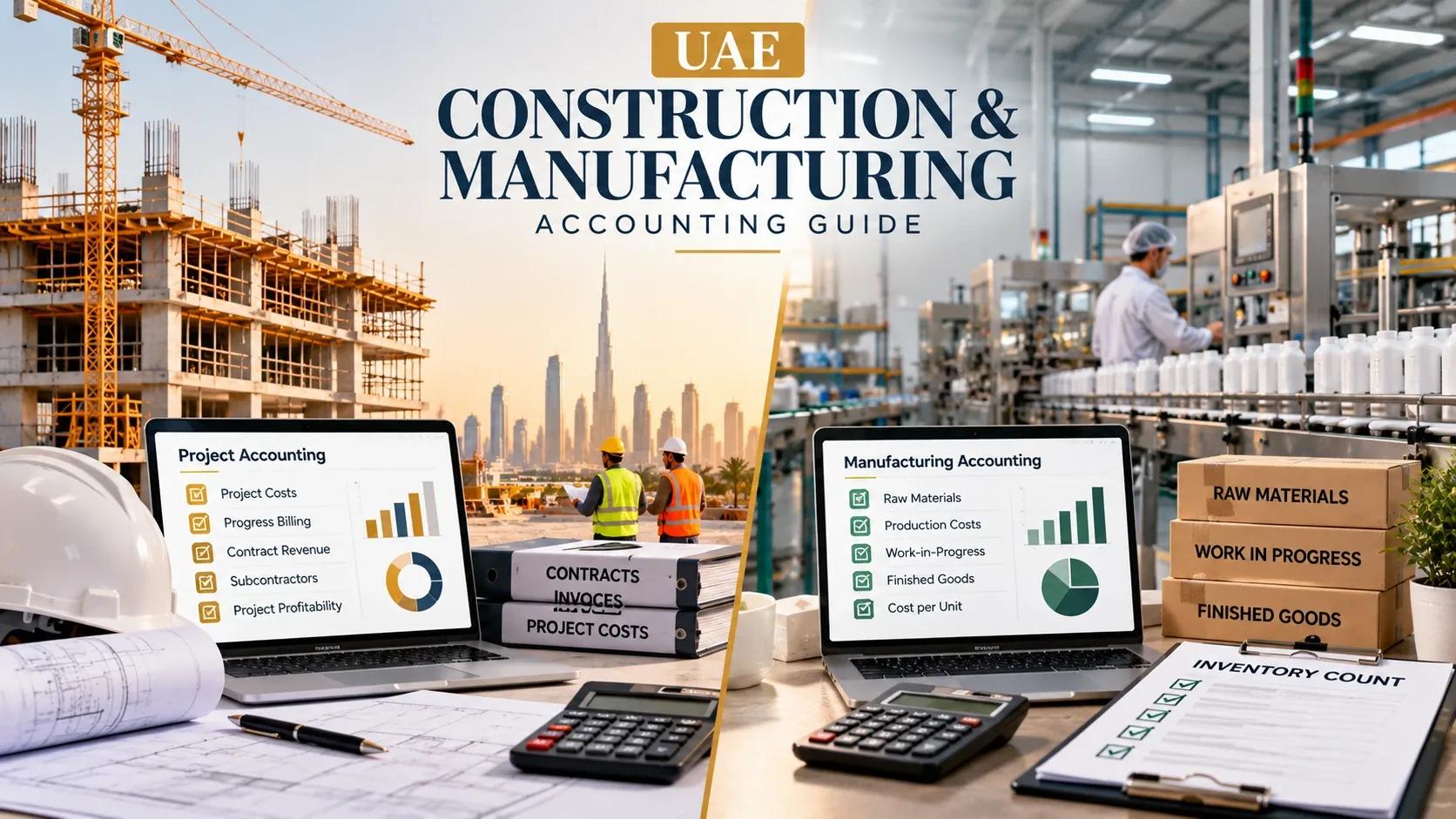
Construction accounting focuses on individual projects, whereas manufacturing accounting focuses on production processes and inventory.
| Construction Accounting | Manufacturing Accounting |
|---|---|
| Tracks individual projects | Tracks products and production batches |
| Records site materials and labour | Records raw materials and factory labour |
| Monitors contract revenue and progress | Calculates production costs and unit costs |
| Tracks progress invoices and retention | Tracks WIP and finished goods |
| Measures project profitability | Measures product profitability |
Both methods help businesses understand their costs and make better financial decisions.
How Do Construction Companies Calculate Project Costs?
Construction companies use job costing to assign materials, labour, subcontractor charges, equipment hire, and attributable overheads to individual projects.
For example, a construction project may incur AED 150,000 in materials, AED 80,000 in labour, AED 50,000 in subcontractor charges, and AED 20,000 in equipment and overheads. The total project cost is AED 300,000.
Maintaining separate project records helps businesses compare actual expenditure with budgets, identify cost overruns, and evaluate project margins.
How Is Construction Revenue Recognized?
Under IFRS 15, construction revenue may be recognised over time when the relevant criteria are satisfied. Otherwise, revenue is recognised when control transfers to the customer.
For example, if a qualifying AED 1 million contract is 40% complete based on an appropriate measure of progress, the company may recognise AED 400,000 in revenue. However, invoice amounts, customer advances, and cash receipts do not automatically determine revenue recognition.
Businesses should maintain records of progress invoices, retention amounts, contract variations, and project costs.
How Do Manufacturers Calculate Production Costs?
Manufacturing accounting includes raw materials, direct labour, and attributable production overheads. Under IAS 2, these costs generally form part of inventory cost when applicable requirements are met.
For example, if total production costs are AED 160,000 for 8,000 units, the cost per unit is AED 20.
Accurate production costing helps manufacturers determine selling prices, evaluate gross margins, and value finished goods correctly.
What Is Work-in-Progress Accounting?
Work-in-progress (WIP) refers to goods that have entered production but are not yet complete. Manufacturing businesses transfer qualifying material, labour, and overhead costs into WIP before transferring completed products to finished goods inventory.
Construction work-in-progress requires separate assessment under applicable accounting standards, including IFRS 15 where relevant. Project expenditure should not automatically be classified as inventory.
What Inventory and Tax Rules Apply in the UAE?
Under IAS 2, inventory is generally measured at the lower of cost and net realisable value. FIFO and weighted-average cost formulas are permitted for interchangeable inventory. Abnormal production wastage is generally recognised as an expense.
For UAE VAT, the standard rate is generally 5% for standard-rated supplies, subject to the applicable rules. Construction businesses should review progress invoices, advances, and retention payments, while manufacturers should reconcile sales VAT, eligible input VAT, imports, and reverse-charge transactions.
For corporate tax, accounting profit generally provides the starting point for determining taxable income, subject to applicable adjustments. Accurate project costing and inventory valuation therefore support reliable financial reporting and tax calculations.
How Can Vinimay Help These Businesses?
Vinimay's free bilingual billing software helps businesses create invoices in English and Hindi, record sales and purchases, manage customer and supplier information, and organize payment records. These functions support routine billing and transaction management.
However, dedicated construction contract accounting, automated IFRS 15 revenue recognition, advanced production costing, UAE VAT compliance, and corporate tax filing capabilities have not been independently verified. Businesses should confirm that their chosen software meets their specific accounting and reporting requirements.
Conclusion
Construction and manufacturing accounting in the UAE requires accurate project costing, production records, revenue recognition, inventory valuation, and tax documentation. Consistent bookkeeping helps businesses monitor profitability, prepare financial statements, and maintain reliable records for VAT and corporate tax reporting. Vinimay's free bilingual billing software can support everyday invoicing and transaction organization, while specialized accounting and statutory compliance requirements should be checked separately.
Frequently Asked Questions
Related Topics
Published by prachi kahar
Our editorial and compliance specialists create practical guides, tax calculation rules, and operational strategies to empower Indian small business owners and accountants.