How Can Multiple Employees Manage Business Transactions Safely?
Giving employees access to billing and financial records solves a workflow problem, but it introduces a different one: risk. Once more than one person can create invoices, record payments, or adjust stock, a business needs to think not just about how smoothly the team works together, but about what could go wrong if access is misused, whether intentionally or by accident.
This concern is different from simple convenience. A business can have perfectly smooth multi-user workflows and still be exposed to real risk if there's no way to trace who did what, or if every employee has the same level of access regardless of their actual role. Safety, in this context, means limiting exposure — making sure a mistake or a bad actor can't quietly cause damage that goes unnoticed for weeks or months.
This article focuses specifically on that safety angle: the risks of shared access, how permission levels reduce exposure, and what to watch for as warning signs. Vinimay supports structured, multi-user access to records, and the safeguards discussed below reflect the same standard worth applying to any system handling financial data across a team.
The Main Risks of Shared Access
Once more than one person can create invoices, record payments, or adjust stock, a few specific risks show up consistently. Untraceable changes are the most common—when multiple people share one login, there's no way to know who made a specific entry or edit. Over-permissioned staff create a related problem, where a junior billing employee ends up with full access to reports or the ability to delete past invoices, far beyond what their role actually needs. Accidental deletion or edits happen regularly too, often from someone who simply didn't understand the consequences of an action. And in some cases, data itself becomes the risk — an employee exporting customer or pricing details before leaving the business, with no record of it happening.
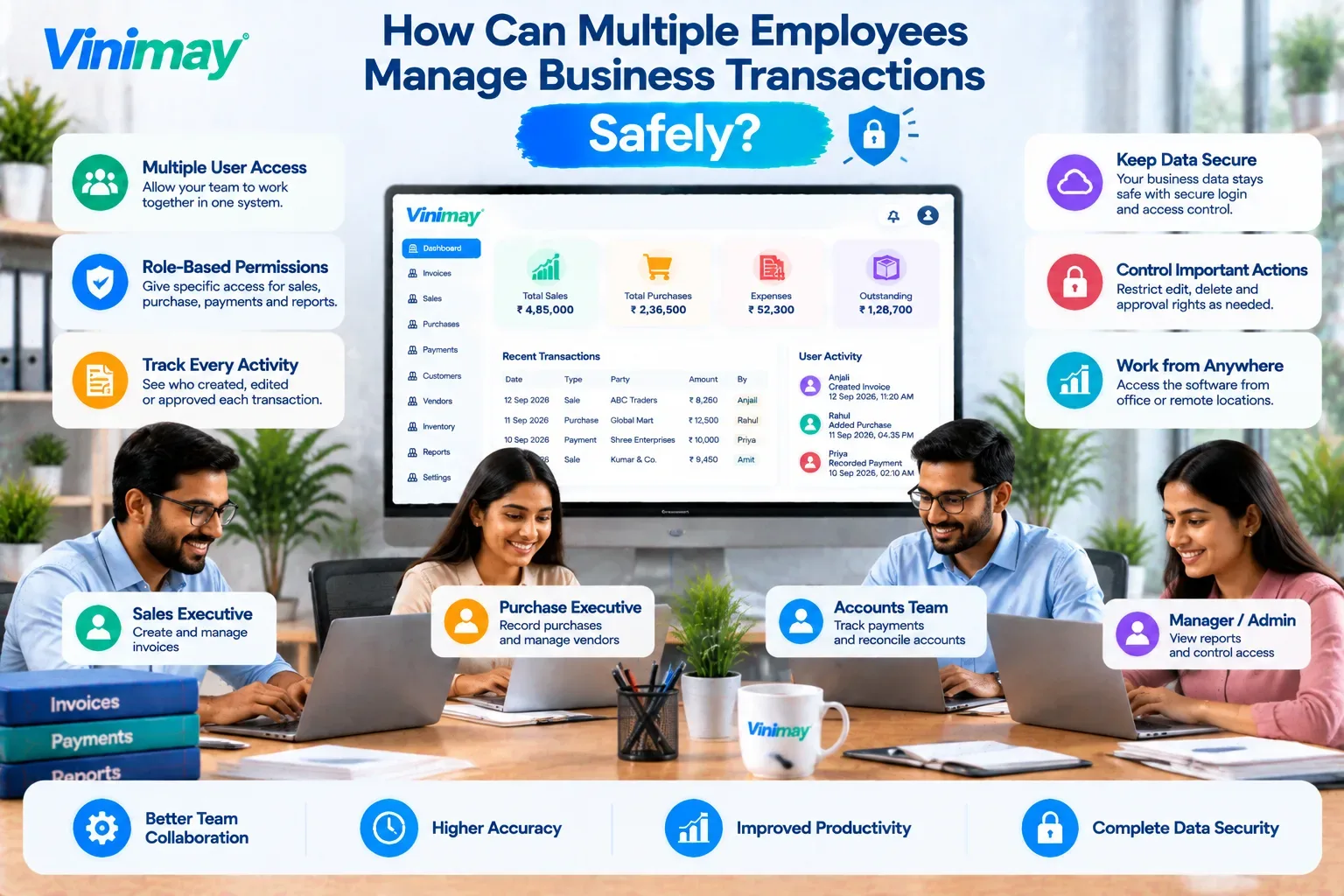
Permission Levels: Who Should See and Do What
Not every employee needs the same access. A practical breakdown by role:
Spotting Misuse Before It Becomes a Bigger Problem
A few warning signs tend to show up before a bigger problem does:
Frequent edits to old, already-closed invoices without a clear reason—legitimate corrections are usually rare and specific, not repeated
Unusual activity timing, such as one employee's system use consistently spiking outside normal working hours
Data exports beyond what a role requires, like a billing staff member regularly pulling full customer reports
Stock discrepancies that keep tracing back to one specific person's entries, pointing to either a training gap or something more deliberate
A system that logs actions by user makes these patterns visible; a shared login makes them invisible by design. This applies just as much to honest mistakes as to intentional misuse—deleting the wrong invoice or entering a payment against the wrong customer happens regularly with well-meaning staff, which is why restricting high-impact actions like deletion to specific roles, and keeping a record of edits, matters regardless of intent.
A Safety Checklist for Multi-Employee Access
Each employee has an individual login, not a shared one
Permission levels are set based on actual role, not given as full access by default
High-impact actions (deletion, major edits) are restricted to specific roles
Activity can be traced back to the specific user who performed it
Access is revoked immediately when an employee leaves
Why This Kind of Structure Earns Trust Over Time
A business doesn't need to assume the worst about its staff to justify structured access — the point isn't suspicion, it's containment. When every action is traceable and permissions match actual roles, small mistakes get caught quickly instead of compounding silently, and the rare case of genuine misuse becomes far easier to identify and stop early.
Vinimay supports this kind of structured, traceable access as part of its multi-user record-keeping, which is the foundation this article recommends checking for in any system before trusting it with a growing team.
Conclusion
Safety in multi-employee access isn't about restricting staff unnecessarily — it's about making sure every action can be traced to a person, that permissions match actual roles, and that both mistakes and misuse are caught early rather than discovered much later
. A business that treats this as a deliberate setup, rather than an afterthought, avoids the kind of quiet, accumulating risk that shared logins and blanket access tend to create.
FAQs
1. What's the biggest risk of letting multiple employees share one login?
The biggest risk is losing all accountability. If something goes wrong, whether a mistake or intentional misuse, there's no way to trace it back to a specific person when everyone shares the same credentials.
2. Should every employee have the same level of access to financial records?
No. Access should match the employee's actual role, so billing staff, for example, don't need the ability to view full financial reports or delete past invoices.
3. How can a business detect if an employee is misusing their access?
Warning signs include frequent edits to old invoices, unusual activity timing, or data exports beyond what the role requires — patterns that are only visible if the system tracks actions by individual user.
4. Is accidental data loss as serious a concern as intentional misuse?
Yes. Honest mistakes like deleting the wrong record happen regularly, so safety measures like restricted deletion rights and edit tracking matter even when there's no bad intent involved.
5. What should happen immediately when an employee with system access leaves the business?
Their individual access should be revoked immediately, which is far simpler and safer with individual logins than with a shared login that would require changing a password used by everyone.
6. Does restricting employee access slow down daily operations?
Not significantly if permissions are set thoughtfully. Restricting only high-impact actions like deletion or report exports, while allowing normal daily tasks like invoicing, keeps operations smooth while still reducing risk.
Related Topics
Published by Team Vinimay
Our editorial and compliance specialists create practical guides, tax calculation rules, and operational strategies to empower Indian small business owners and accountants.