Invoice Management Software vs. Accounting Software: Which Do You Need?
The terms "invoice management software" and "accounting software" are often used interchangeably in marketing, which makes choosing between them more confusing than it needs to be. Some tools genuinely focus on invoicing alone, others are full accounting systems with invoicing as one feature among many, and a fair number sit somewhere in between—connecting invoicing to broader records without being a complete accounting suite.
Getting this distinction right matters because paying for a full accounting system when all you need is accurate invoicing (or the reverse — relying on a basic invoice tool when you actually need connected financial records) both lead to the same outcome: switching software again within a year. An accurate understanding of what each category actually covers makes the decision far more straightforward.
This guide breaks down what invoice management software and accounting software each cover, so a business can choose based on its real needs rather than overlapping marketing terms.
What's the Actual Difference Between the Two?
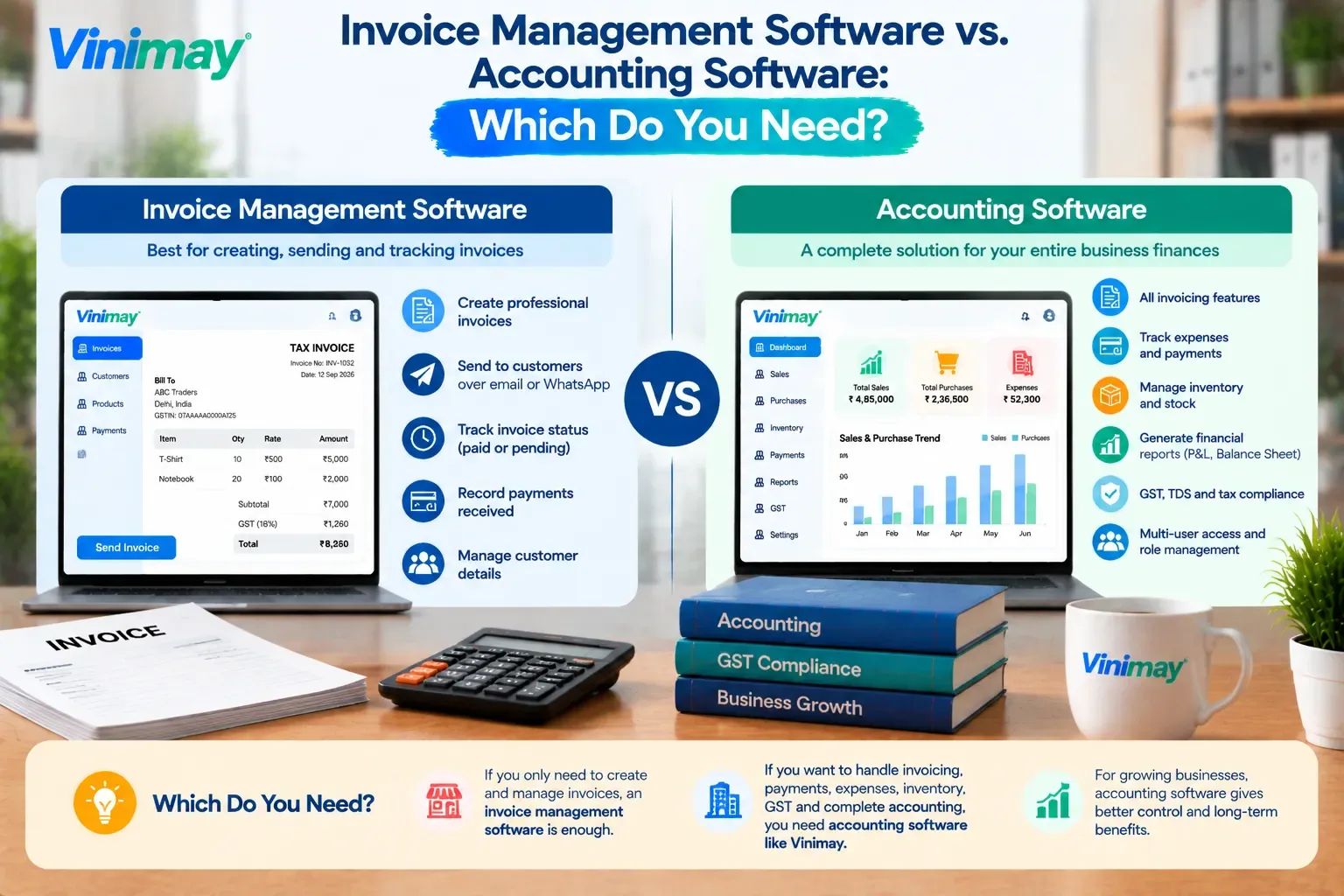
Direct answer:Invoice management software focuses specifically on creating, sending, and tracking invoices and their payment status. Accounting software includes invoicing as one part of a broader system that also covers ledgers, expense tracking, financial reports, and overall business records.
In short: invoice management is a subset of what accounting software does — the question is whether a business needs just that subset, or the fuller picture around it.
What Invoice Management Software Covers
Invoice management software is typically built around:
Creating and sending GST-compliant or standard invoices
Tracking whether an invoice is paid, partially paid, or outstanding
Basic customer records tied to invoicing
Reminders or visibility into overdue payments
Simple invoice-related reports(like outstanding receivables)
It's a focused tool — accurate and reliable for billing, but generally not built to handle deeper financial record-keeping like full ledgers or detailed expense categorisation.
What Accounting Software Covers
Accounting software typically includes invoicing, plus:
Accounting software is built to give a complete, accurate picture of the business's finances — invoicing is just the starting point of that picture, not the whole thing.
How to Decide Which One Your Business Needs
Problem → Reason → Prevention: Choosing the wrong category usually isn't discovered until months later, when a business either outgrows a simple invoice tool or realises it's paying for accounting features it never uses.
A quick way to decide:
If you only need to bill clients and track who's paid — invoice management software is likely sufficient and simpler to use.
If you also need to track expenses, purchases, or stock, and want reports beyond invoicing — full accounting software is the more accurate long-term fit.
If you're not sure yet — choosing software that covers both, without forcing unused complexity, avoids having to switch later as needs grow.
Where Vinimay Sits Between the Two
Vinimay is closer to full accounting software than a standalone invoice tool, but built to stay accurate and simple for small and growing businesses rather than overwhelming them with unnecessary complexity. It generates GST-compliant invoices with accurate tax calculation, while also connecting sales records, purchase records, payment tracking, and receivables and payables — the core coverage a business typically needs beyond invoicing alone.
For businesses that need more than basic invoicing but don't need a heavy, complex accounting suite, Vinimay also includes inventory and product management, customer and vendor management, ledger management, and reports — giving a connected, accurate picture without unused features getting in the way.
Conclusion
Time savings from accounting software aren't uniform. They concentrate heavily in repetitive, cross-referencing tasks like invoice creation, balance checks, and stock reconciliation, while judgment-based decisions remain manual regardless of the tool. Understanding exactly where this time comes from and why it holds up mechanically rather than just as a claim, helps set realistic expectations for what software can and can't speed up.
FAQs
What's the difference between invoice management software and accounting software?
Invoice management software focuses specifically on billing and payment tracking, while accounting software includes invoicing as one part of a broader system covering ledgers, expenses, and reports.
Do I need accounting software if I only send a few invoices a month?
Not necessarily — if invoicing and basic payment tracking cover your needs, simpler invoice management software may be sufficient and easier to use.
Can invoice management software handle GST compliance?
Many invoice management tools do handle GST-compliant invoicing, but it's worth confirming this specifically, since not all focus on tax accuracy the same way.
Will I outgrow invoice management software as my business grows?
Possibly, if you eventually need expense tracking, purchase records, or broader financial reports — at that point, full accounting software becomes the more accurate fit.
Is it more expensive to use accounting software instead of invoice management software?
Often yes, since accounting software covers more functionality, though the better comparison is total value against what your business actually uses.
Can I switch from invoice management software to full accounting software later?
Yes, though switching means migrating historical records, so it's worth choosing software that can grow with you if you expect to need more than invoicing eventually.
Does accounting software make invoicing less simple?
Not necessarily — well-built accounting software keeps invoicing straightforward while adding broader records in the background, without adding friction to daily billing.
What businesses typically only need invoice management software?
Freelancers or very small businesses with simple billing needs and no significant expense tracking or inventory requirements often find invoice management software sufficient.
What businesses typically need full accounting software?
Businesses managing inventory, purchases, multiple revenue streams, or needing broader financial reports for a CA typically need full accounting software's wider coverage.
Is Vinimay invoice management software or accounting software?
Vinimay covers accurate GST invoicing along with connected sales, purchase, and payment records — placing it closer to accounting software, while staying simple enough for small businesses.
Related Topics
Published by Team Vinimay
Our editorial and compliance specialists create practical guides, tax calculation rules, and operational strategies to empower Indian small business owners and accountants.