accounting software7 min readPublished 7 October 2026
Is GST Billing Mandatory Below the ₹40 Lakh Turnover Threshold?
Learn whether GST billing is mandatory below ₹40 lakh turnover, when GST registration applies, and how non-GST businesses should manage invoices.
A
admin
Financial Insights & Compliance Desk
Share:
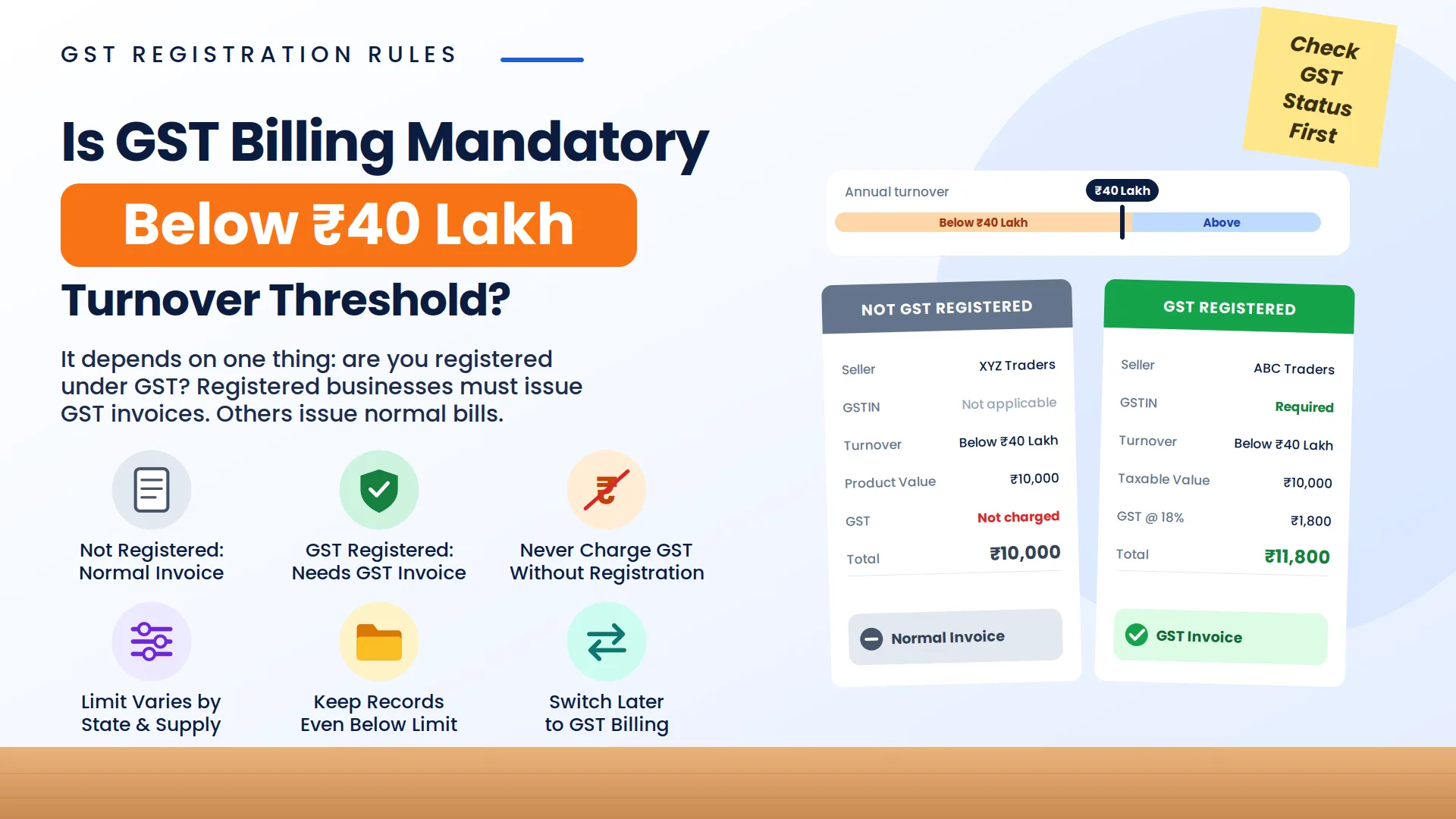
Is GST billing mandatory below the ₹40 lakh turnover threshold? Many small businesses have this common question: "If my turnover is below ₹40 lakh, do I still need to create GST bills?"
The answer depends on whether the business is registered under GST or not.
If a business is not required to register under GST and has not taken GST registration, it generally cannot issue a GST tax invoice or charge GST from customers. However, it may issue a normal bill or invoice for business records.
If a business has voluntarily taken GST registration or is already registered under GST, then GST invoicing rules apply, and the business needs to issue GST-compliant invoices even if its turnover is below ₹40 lakh.
Vinimay Accounting Software helps businesses manage GST and non-GST billing workflows by maintaining invoices, customer records, payments, and accounting information in an organized way.
What Is the ₹40 Lakh GST Turnover Threshold?
Under GST, certain small businesses are eligible for exemption from mandatory GST registration if their annual turnover is below the applicable threshold limit.
For many goods suppliers, the commonly discussed threshold is ₹40 lakh annual turnover, but the actual limit can vary depending on factors such as:
State/Union Territory
Type of business
Nature of supply
Applicable GST rules
Service providers generally have different threshold limits.
Therefore, businesses should check the GST registration requirement applicable to their specific situation.
Does a Business Below ₹40 Lakh Turnover Need GST Billing?
The requirement depends on GST registration status.
Case 1: Business Is Not GST Registered
If a business:
Has turnover below the applicable GST registration limit
Businesses that are not registered under GST can still maintain organized sales invoices and business records.
Vinimay helps them manage:
Normal invoices
Customer records
Sales tracking
Payment records
3. Easy Business Growth Management
As businesses grow and their compliance requirements increase, maintaining proper digital records helps create a smoother transition.
4. Complete Accounting Workflow
Vinimay connects:
Billing
Customers
Payments
Inventory
Accounting records
in one platform, helping businesses manage daily operations efficiently.
Common Mistakes Small Businesses Make Regarding GST Billing
1. Charging GST Without Registration
A non-GST registered business should not collect GST separately from customers.
2. Assuming Turnover Limit Means No Bills Are Required
GST exemption does not mean businesses should stop maintaining invoices.
3. Not Maintaining Sales Records
Poor record keeping can create problems during:
Loan applications
Business expansion
Financial planning
4. Not Updating GST Status After Growth
When turnover increases and GST registration becomes applicable, businesses should complete registration and update their billing process.
Frequently Asked Questions (FAQs)
1. Is GST billing mandatory if turnover is below ₹40 lakh?
If a business is not registered under GST and is below the applicable registration threshold, GST billing is generally not mandatory. However, if the business is GST registered, it must issue GST-compliant invoices.
How Vinimay Helps: Vinimay helps both GST and non-GST businesses maintain organized invoices, customer records, payments, and accounting information according to their business requirements.
2. Can I make invoices without GST if my turnover is below ₹40 lakh?
Yes, if the business is not GST registered and GST registration is not required, it can issue normal invoices without charging GST.
How Vinimay Helps: Vinimay helps businesses create and manage regular invoices while maintaining digital sales records.
3. Can a small business use GST billing software before GST registration?
Yes, small businesses can use billing software to maintain professional invoices and records even before GST registration.
How Vinimay Helps: Vinimay helps businesses manage billing, customers, products, and payments from an early stage.
4. If I voluntarily take GST registration, do I need GST invoices?
Yes, once a business obtains GST registration, it needs to follow GST invoice requirements.
How Vinimay Helps: Vinimay helps GST-registered businesses manage GST invoice creation and maintain organized transaction records.
5. Does turnover below ₹40 lakh mean I don't need accounting software?
No. Accounting software is useful for maintaining sales records, tracking payments, and managing business operations even for small businesses.
How Vinimay Helps: Vinimay helps small businesses manage billing, accounting, inventory, and payment tracking in one place.
6. Can I switch from normal billing to GST billing later?
Yes, businesses can update their billing process after GST registration.
How Vinimay Helps: Vinimay helps businesses maintain structured records, making it easier to manage changing business requirements.
Conclusion
GST billing is not automatically mandatory for every business below the ₹40 lakh turnover threshold. The requirement depends mainly on whether the business is registered under GST and the applicable GST rules for that business category.
Businesses below the threshold should still maintain proper invoices and financial records because organized billing helps in business growth, accounting, and future compliance needs.
Vinimay Accounting Software helps businesses manage GST billing, non-GST invoices, customer records, payments, inventory, and accounting workflows in one platform, making daily business management simpler and more organized.
Our editorial and compliance specialists create practical guides, tax calculation rules, and operational strategies to empower Indian small business owners and accountants.