Is Free Accounting Software Safe for Business Data?
Accounting Software There's a common, understandable assumption that "free" must mean corners were cut somewhere — and when the product in question holds your business's financial data, that assumption feels worth taking seriously rather than dismissing.
The more precise question isn't whether free accounting software is safe in general—safety depends on specific practices, not on price. It's whether being free changes anything about how a provider handles your data, and the honest answer is: sometimes, in specific and identifiable ways, but not automatically or always. Understanding where free tiers genuinely differ from paid ones—and where they don't — is more useful than treating "free" as an automatic red flag.
Vinimay offers a free invoice tool as part of a broader system for managing GST invoicing, sales and purchase records, and customer details. This guide looks specifically at how free accounting tools are typically sustained, where cost-cutting genuinely shows up, where it usually doesn't, and a checklist worth applying to any free tool before trusting it with real business data.
Does "Free" Mean Less Safe?
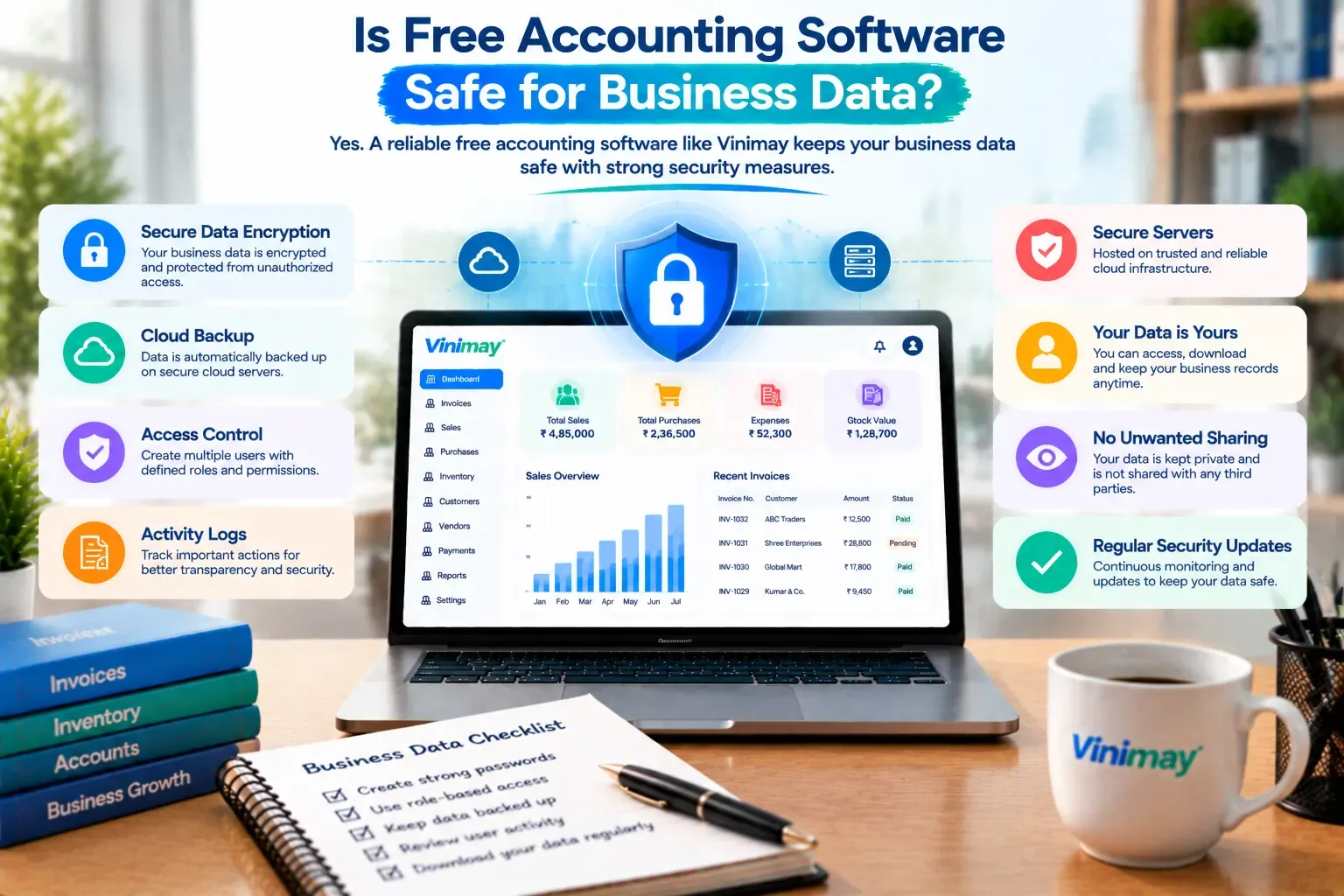
Not inherently—the safety of your data depends on specific practices like encryption, access control and backup, which a provider can apply consistently across both free and paid tiers, since the underlying technical infrastructure is usually shared.
Where "free" does matter is not in the raw safety of the data itself, but in what's typically bundled around it—support responsiveness, data retention length, and how much control you have over exporting or removing your own information. These are business-model differences, not security differences.
How Free Accounting Tools Actually Sustain Themselves
It helps to understand why a free tier exists at all, since this shapes what to watch for. Most free accounting or invoicing tools operate as an entry point into a paid product—the free tier demonstrates value with the expectation that a growing business upgrades once it needs more volume, users or features. Some tools are free specifically to build a user base for a related paid service. Far less commonly, and worth being alert to, some "free" tools generate revenue by using aggregated or anonymised data for other purposes—which is a genuinely different model from a free-to-paid funnel, and one worth checking for specifically in a provider's terms.
Where Free Tiers Genuinely Cut Corners
To be fair to the underlying concern, there are real, specific areas where free tiers sometimes differ from paid ones in ways that affect data handling:
Backup frequency—some free tiers back up data less often than paid tiers, meaning a larger window of potential loss if something goes wrong
Support responsiveness — a data-related issue on a free plan may get a slower response than the same issue on a paid plan
Data retention length — free tiers sometimes purge older data sooner, which is a data-availability risk more than a data-security one
Export limitations — some free tiers restrict how much of your own data you can export at once, or in what format
These are worth checking specifically, rather than assuming they apply universally to every free tool.
Where Free Tiers Are Just as Safe as Paid Ones
On the other hand, core security practices—encryption of data in transit, secure storage, and basic access control — are typically implemented at the infrastructure level and applied uniformly, regardless of which plan a specific account is on. A provider generally doesn't maintain two separate, differently secured systems for free versus paying customers; that would be more complex and costly to manage than applying one consistent standard across both.
The Data Lock-In Risk Nobody Mentions
This is the risk that gets far less attention than "security" in the traditional sense, and it's specific to free tiers: if a free tool restricts how much data you can export, or in what format, your business records can effectively become locked into that one tool. This isn't a hacking risk—it's a practical dependency risk. If you ever need to switch tools, or simply want a personal backup of your own invoices and records, a free tier's export limitations can turn into a real obstacle at exactly the wrong moment.
This is worth checking before relying on any free tool long-term, regardless of how secure its storage otherwise is.
A Checklist Specific to Free Tools
Before trusting a free accounting tool with real business data, it's worth confirming: can you export your own invoices and records at any time, in a usable format like PDF or spreadsheet; is there a stated backup frequency, even a general one; what happens to your data if you don't upgrade or stop using the tool after a period of inactivity; and does the provider's terms mention using your data for anything beyond running your account. These four questions target the areas where free tiers genuinely diverge from paid ones, rather than general security language that likely applies equally to both.
How This Applies to Vinimay's Free Tier
Vinimay's free invoice tool lets you generate up to 5 GST invoices, with each one downloadable as a PDF immediately — meaning your own copy of every invoice you create stays in your hands as a file, independent of the platform itself. This directly addresses the export and lock-in concern raised above: you're not solely dependent on the platform retaining your records, since you hold a usable copy from the moment each invoice is created.
For specifics on backup frequency, data retention, and any broader terms around free-tier data use, it's best to check Vinimay's official terms directly, since these details can be updated over time.
Conclusion
"Free" doesn't automatically mean less secure — the core protections that keep data safe are typically applied the same way across free and paid tiers, since they run on shared infrastructure. What genuinely differs is usually backup frequency, support speed, data retention, and export flexibility — practical, checkable details rather than a security downgrade. The most protective habit, regardless of which tool you use, is making sure you can export and keep your own copy of your records. Vinimay's free invoice tool supports this directly by letting every invoice be downloaded as a PDF the moment it's created, keeping your data usable outside the platform itself.
Frequently Asked Questions
1. Is free accounting software inherently less secure than paid software?
Not inherently — core security practices like encryption and access control are usually applied consistently across both, since they run on the same infrastructure.
2. What actually differs between free and paid tiers regarding data?
Typically backup frequency, support response time, data retention length, and export limitations—not the core security of the data itself.
3. Why do some free accounting tools have shorter data retention?
Often to encourage upgrading to a paid tier, or because storing data indefinitely is costly to sustain for free at scale.
4. Can I download my own invoices from a free tool?
This varies by provider—check specifically whether PDF or file export is available, since this protects you from data lock-in.
5. Does a free tool ever use my business data for other purposes?
It's uncommon but worth checking directly in the provider's terms, particularly for tools that don't clearly follow a free-to-paid business model.
6. How can I protect myself if a free tool's data safety isn't clear?
Regularly export and save your own copies of invoices and records, independent of the platform.
7. Does Vinimay let me download my invoices as PDFs?
Yes, Vinimay's free invoice tool lets you download each invoice as a PDF immediately after creating it.
8. Is data lock-in a security risk or a different kind of risk?
It's a practical dependency risk, not a hacking or breach risk—it affects your ability to access or move your own data.
9. Should I avoid all free accounting tools because of these risks?
No — the risks are specific and checkable, not universal; a free tool that allows easy export and has clear terms can be genuinely safe to use.
10. What's the single most useful question to ask before trusting a free tool?
Whether you can export your own data at any time, in a usable format — this alone protects against the most common free-tier risk.
Related Topics
Published by Team Vinimay
Our editorial and compliance specialists create practical guides, tax calculation rules, and operational strategies to empower Indian small business owners and accountants.