What Do the 2026 FTA and Tax Procedures Law Changes Mean for Compliance?
Quick Answer: The UAE's 2026 Tax Procedures Law amendments introduce clearer tax refund deadlines, updated voluntary disclosure procedures, extended recordkeeping requirements in certain cases and revised FTA audit powers. Businesses must review tax credit balances, correct errors promptly and maintain reliable accounting records to remain compliant.
The UAE introduced important changes to its tax compliance framework in 2026. These affect businesses registered for Value Added Tax (VAT), Corporate Tax, and other federal taxes.
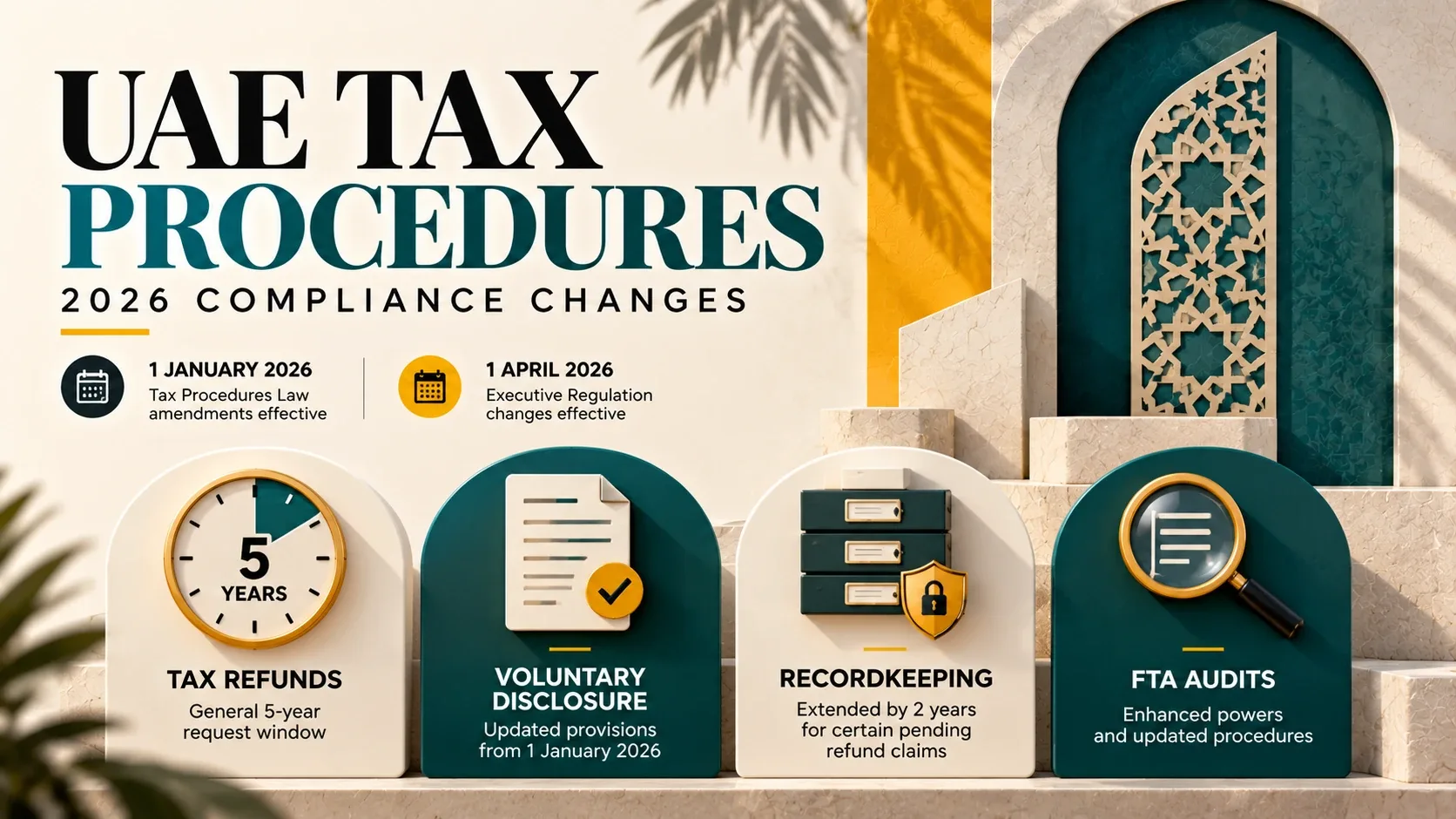
Federal Decree-Law No. 17 of 2025 amended the Tax Procedures Law, effective 1 January 2026. Additional changes to its Executive Regulation took effect on 1 April 2026.
Understanding these updates helps businesses avoid missed refunds, documentation problems and tax disputes.
What Changed in the UAE Tax Procedures Law in 2026?
The amendments focus on improving compliance procedures, taxpayer rights and tax administration.
These changes affect tax administration rather than automatically increasing ordinary VAT or corporate tax rates.
What Is the New Five-Year Tax Refund Rule?
Businesses with eligible tax credit balances generally have five years from the end of the relevant tax period to request a refund or use the balance to settle tax liabilities.
For example, a business may have excess recoverable VAT remaining in its tax account.
Under the amended framework, it should review when that balance arose and whether the limitation period is approaching.
Special provisions apply where a credit arises near or after the expiry of the normal period.
Transitional rules also allow certain older credit balances to be claimed within one year from 1 January 2026.
How Have Voluntary Disclosure Rules Changed?
A voluntary disclosure is used to correct qualifying errors in previous tax returns, assessments, or refund applications.
The 2026 amendments clarify how the disclosure process operates alongside updated limitation and refund provisions.
For example, a company discovering omitted taxable sales should determine whether the error requires a formal voluntary disclosure or another permitted correction method.
Businesses should document the original figures, corrected amounts, reasons for the error and discovery date.
The amendments do not mean every small accounting mistake automatically requires the same correction process.
What Are the New Recordkeeping Requirements?
Businesses must preserve accounting records and supporting documents for their applicable statutory periods.
General minimum periods include:
The April 2026 amendments provide an additional two-year extension for tax periods connected to qualifying refund claims submitted before the limitation deadline where the FTA has not issued its decision.
FTA Decision No. 4 of 2026 also addresses rules for maintaining information contained in accounting records and commercial books.
Businesses should maintain invoices, ledgers, bank statements and supporting documents in an accessible format.
How Do the Changes Affect FTA Tax Audits?
The updated Tax Procedures framework addresses circumstances in which the FTA may conduct audits or issue assessments beyond the ordinary limitation period.
These include specified situations involving refund requests submitted near the end of the limitation period.
The amendments also address preservation or seizure of documents and assets for examination purposes.
Businesses should not assume that a tax period becomes impossible to examine immediately after the ordinary limitation period expires.
Accurate records and clear transaction histories remain important.
What Changed Regarding Taxpayer Information?
The amendments clarify circumstances in which taxpayer information may be disclosed to competent government authorities.
They also reinforce safeguards concerning confidentiality, permitted use and the scope of information sharing.
Separately, the legislation allows the FTA to issue official binding directions on the interpretation and application of tax legislation.
Businesses should monitor published FTA decisions, directions and clarifications rather than relying exclusively on outdated guidance.
What Should UAE Businesses Do to Stay Compliant?
Businesses should review their existing accounting and tax procedures.
A practical checklist includes:
Reconcile VAT and corporate tax records.
Review outstanding tax credit balances.
Identify refund limitation deadlines.
Investigate incorrect tax returns promptly.
Maintain invoices and supporting records.
Review applicable document retention periods.
Monitor new FTA decisions and clarifications.
Prepare records for possible tax audits.
For example, a trading company should regularly reconcile sales, purchases, bank statements and tax returns instead of waiting until an FTA examination.
How Can Vinimay Help With UAE Tax Compliance Preparation?
Organised accounting information helps businesses identify discrepancies and prepare tax documentation.
Vinimay provides general tools for sales invoicing, purchase recording, expense tracking, customer and supplier ledgers, inventory and financial reporting.
These features can help businesses organise transaction records for accountant reviews, reconciliations and tax return preparation.
However, Vinimay's UAE-specific refund eligibility monitoring, voluntary disclosure filing, FTA audit compliance and EmaraTax integration capabilities have not been independently verified.
Businesses should confirm the required compliance functionality and obtain specialist advice where necessary.
Conclusion
The 2026 amendments to the UAE Tax Procedures Law and its Executive Regulations require businesses to pay closer attention to tax refunds, voluntary disclosures, record retention, and FTA audit procedures. Effective from 1 January 2026, the amended law generally sets a five-year period for requesting tax-credit refunds or using credit balances, subject to specific exceptions. Further regulatory changes effective from 1 April 2026 clarify refund procedures and record-keeping obligations, including additional retention requirements for pending refund applications. Businesses should review their tax records, correct errors promptly, track deadlines, and seek professional advice where necessary. <Cite refs={["turn524491search0","turn524491search1"]} />
For everyday billing and record organization, businesses can also use Vinimay’s free bilingual billing softwareto create invoices in English and Hindi, manage sales bills, and organize transaction records. This free invoice billing software can support routine bookkeeping and tax preparation.
Frequently Asked Questions
Related Topics
Published by prachi kahar
Our editorial and compliance specialists create practical guides, tax calculation rules, and operational strategies to empower Indian small business owners and accountants.