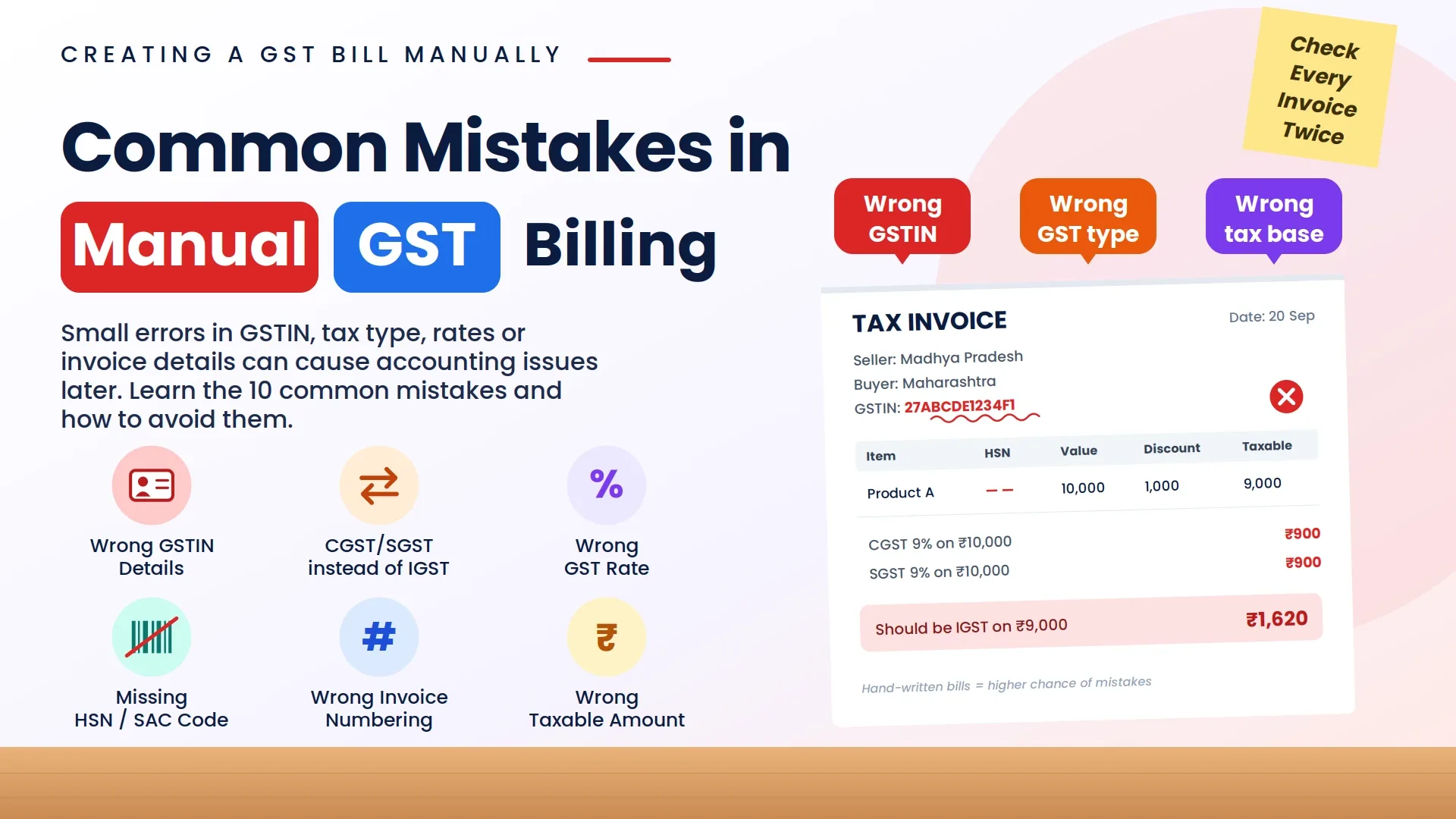
A GST bill without GSTIN is generally not valid as a regular GST tax invoice when the seller is a GST-registered person required to issue a tax invoice. Whether a business can issue a GST invoice depends primarily on its GST registration status and the nature of the transaction. A registered business issuing a tax invoice is required to include its name, address, and GSTIN along with other prescribed invoice particulars. CBIC GST
On the other hand, a business that is not registered under GST cannot simply charge GST to its customers and call the document a GST tax invoice. It may issue an ordinary commercial invoice or bill for its sale, but it should not show GST as tax collected merely because the customer asks for a GST bill.
There are also specific situations where invoice documentation can differ. For example, CBIC's FAQ notes that a person who has applied for registration but has not yet received a GSTIN may, in the stated circumstances, supply on a bill of supply without mentioning GSTIN/ARN and later issue a revised invoice after receiving the GSTIN. CBIC GST
Therefore, the important question is not simply whether a bill can be created without GSTIN, but what type of bill the business is legally permitted to issue based on its GST status.
Can a GST-Registered Business Issue a GST Bill Without GSTIN?
Generally, no.
If a business is GST-registered and is issuing a regular GST tax invoice, the supplier's GSTIN is one of the particulars prescribed under the GST invoice rules. Rule 46 specifies the supplier's name, address, and GSTIN as invoice particulars. CBIC GST
A GST tax invoice generally contains details such as:
- Business name
- Business address
- Seller's GSTIN
- Invoice number
- Invoice date
- Customer details
- Product or service description
- HSN/SAC
- Quantity, where applicable
- Taxable valuehttps://vinimay.sharda.co.in/blogs/complete-guide-gst-invoicing-indian-businesses
- GST rate
- GST amount
- Place of supply where applicable
- Total invoice value
- Other prescribed particulars
Therefore, simply removing the GSTIN from a GST tax invoice does not turn it into a compliant GST invoice.
What If the Business Is Not GST Registered?
A business that is not registered under GST should not charge GST merely by adding a GST percentage to its invoice.
For example:
Product Value: ₹10,000
GST charged: ₹0
Invoice Total: ₹10,000
The business can maintain a normal sales invoice or commercial bill according to its business requirements, but it should not represent the document as a GST tax invoice or collect GST as though it were registered.
This distinction is important because a normal business invoice and a GST tax invoice are not the same document.
Can a Business Apply for GST Registration but Not Have GSTIN Yet?
There can be specific transitional situations.
CBIC's GST FAQ states that where a person has applied for registration but has not received the ARN or GSTIN, supplies may, in the circumstances covered by the FAQ, be made on a bill of supply without mentioning GSTIN and/or ARN. Once GSTIN is received, the person is required to issue revised invoices mentioning the GSTIN and comply with the applicable tax requirements. CBIC GST
Therefore, businesses should not assume that every situation where a GSTIN is unavailable allows them to issue a normal GST tax invoice without it. The exact registration status and applicable provisions should be checked.
Is Customer GSTIN Required on a GST Invoice?
It depends on whether the recipient is registered and the circumstances of the transaction.
Under Rule 46, the recipient's GSTIN or UIN, if registered, is one of the prescribed invoice particulars. For an unregistered recipient, Rule 46 contains separate requirements, including name and address and, where the taxable supply is ₹50,000 or more, the address of delivery along with the state and state code. CBIC GST
B2B Transaction
When the buyer is GST registered, the buyer's GSTIN should be recorded correctly on the invoice where applicable.
Example:
Seller: GST Registered
Buyer: GST Registered
The invoice can contain:
- Seller GSTIN
- Buyer GSTIN
- Invoice number
- Product/service details
- Taxable value
- GST details
B2C Transaction
When the customer is an unregistered consumer, there is generally no customer GSTIN to enter. The applicable recipient details depend on the transaction and invoice requirements. CBIC GST
Can You Charge GST Without a GSTIN?
A business should not charge GST merely because it wants to collect tax from customers.
For example, suppose an unregistered business sells a product for ₹10,000.
Incorrect approach:
| Particular | Amount |
|---|---|
| Product Value | ₹10,000 |
| GST @ 18% | ₹1,800 |
| Total | ₹11,800 |
If the business is not entitled to collect GST, simply adding ₹1,800 as GST does not make the transaction a valid GST tax invoice.
The business should instead follow the invoicing requirements applicable to its actual GST status.
GST Tax Invoice vs Normal Business Invoice
| GST Tax Invoice | Normal Business Invoice/Bill |
|---|---|
| Issued by a registered person for applicable taxable supplies | Can be used by businesses that are not issuing a GST tax invoice |
| Supplier GSTIN is required under the invoice rules | GSTIN is not applicable if the business is not GST registered |
| GST tax components are shown where applicable | GST should not be charged merely as a tax collection |
| GST rate and tax amount are shown where applicable | No GST tax breakup if GST is not being charged |
| Used for GST-related documentation | Used as a commercial sales record |
The exact document required depends on the seller's registration status and nature of supply.
What About a Bill of Supply?
A bill of supply is different from a GST tax invoice.
Under the GST rules, a bill of supply is used in specified situations, such as supplies by certain registered persons where a tax invoice is not issued. The prescribed bill-of-supply particulars include the supplier's name, address, and GSTIN. CBIC GST
Therefore, a bill of supply should not be confused with an ordinary invoice issued by an unregistered business.
How GST Billing Software Manages GSTIN
GST billing software can make invoice management more consistent by keeping business registration information within the business profile.
A structured billing system can help maintain:
- Business name
- Business address
- GSTIN
- State details
- Customer information
- Product/service information
- HSN/SAC
- GST rates
- Invoice numbering
- Tax calculations
This reduces the need to repeatedly type the same business information into every invoice.
However, software does not replace the need to ensure that the business's GST registration status and invoice information are correct.
How Vinimay Helps With GST and Non-GST Billing
Vinimay Accounting Software helps businesses organize their billing and accounting records according to their business requirements.
1. GST Invoice Management
GST-registered businesses can maintain GST-related business information and create structured GST invoices.
2. Business Profile Management
Business information such as registration details can be maintained centrally instead of being entered manually on every invoice.
3. Customer Management
Customer information can be maintained digitally, helping reduce repetitive data entry during billing.
4. Product and Service Management
Products and services can be organized along with relevant billing information.
5. Sales Records
Invoices and sales transactions can be maintained digitally for easier review and accounting.
6. Non-GST Business Records
Businesses that do not operate as GST-registered suppliers can maintain their applicable sales and business transaction records without incorrectly presenting themselves as GST-registered suppliers.
Common Mistakes to Avoid
1. Using Someone Else's GSTIN
A business should never use another company's GSTIN on its own invoice.
2. Charging GST Without Being Entitled to Collect It
A business should not simply add GST to an invoice because the customer requests a GST bill.
3. Removing GSTIN From a Registered Business's Tax Invoice
If a registered business is issuing a tax invoice, the supplier's GSTIN is a prescribed invoice particular. CBIC GST
4. Entering the Wrong Customer GSTIN
For registered customers, incorrect GSTIN information can create reconciliation and tax-record issues.
5. Confusing a Normal Invoice With a GST Tax Invoice
A normal commercial invoice is not automatically a GST tax invoice just because it contains a tax calculation.
6. Using the Wrong Invoice Type
Businesses should distinguish between a tax invoice, bill of supply, credit note, debit note, and ordinary commercial documentation according to the applicable circumstances.
Frequently Asked Questions
1. Can I make a GST bill without GSTIN?
Answer: If a business is GST registered and is issuing a regular GST tax invoice, the supplier's GSTIN is a prescribed invoice detail and should be included. A non-GST-registered business should not issue a GST tax invoice or charge GST merely because it wants to provide a GST bill. CBIC GST
How Vinimay Helps: Vinimay helps businesses maintain their billing information and create structured invoices based on their business requirements.
2. Can a business without GST registration issue an invoice?
Answer: Yes, a business can issue a normal commercial invoice or bill for its sales. However, it should not represent that document as a GST tax invoice or collect GST when it is not entitled to do so.
How Vinimay Helps: Vinimay helps businesses maintain sales invoices and transaction records digitally.
3. Is GSTIN mandatory on a GST tax invoice?
Answer: For a registered supplier issuing a tax invoice, the supplier's name, address, and GSTIN are among the particulars prescribed under Rule 46. CBIC GST
How Vinimay Helps: Vinimay helps businesses maintain GST-related business information in their billing workflow.
4. Can I charge 18% GST without GSTIN?
Answer: A business should not simply charge GST without being legally entitled to collect it. GST should be charged according to the business's registration status and applicable GST provisions.
How Vinimay Helps: Vinimay helps businesses organize GST and billing information according to their configured business requirements.
5. Is customer GSTIN mandatory on every GST invoice?
Answer: The recipient's GSTIN or UIN is required where the recipient is registered. For an unregistered recipient, different recipient-detail requirements apply under Rule 46. CBIC GST
How Vinimay Helps: Vinimay allows customer details to be maintained systematically for invoice preparation.
6. Can a B2C customer get a GST invoice without having GSTIN?
Answer: Yes, an unregistered customer does not have a GSTIN. A registered supplier can issue the appropriate invoice to an unregistered customer while following the applicable invoice requirements. CBIC GST
How Vinimay Helps: Vinimay helps businesses maintain customer and transaction details while creating invoices.
7. What is the difference between a GST invoice and a normal invoice?
Answer: A GST tax invoice is issued by a registered person for applicable taxable supplies and contains prescribed GST details. A normal commercial invoice does not become a GST tax invoice simply because it contains a price or sales amount.
8. Can I create a GST invoice while waiting for my GSTIN?
Answer: There are specific situations for persons who have applied for GST registration but have not yet received GSTIN. CBIC's FAQ provides for supplies on a bill of supply without GSTIN/ARN in the circumstances covered there, followed by revised invoicing after GSTIN is received. CBIC GST
9. Does GST billing software automatically add GSTIN?
Answer: GST billing software can store the business's GSTIN in its business profile and use that information while generating invoices. The business should still verify that the stored GST details are correct and current.
How Vinimay Helps: Vinimay helps businesses maintain business and GST information in an organized billing workflow.
10. Can a small business use billing software without GST registration?
Answer: Yes. A business can use accounting or billing software even if it is not GST registered. The important point is that the invoice generated should reflect the business's actual GST status and should not incorrectly charge GST.
How Vinimay Helps: Vinimay supports organized sales and transaction record management for different business requirements.
Conclusion
Whether you can create a GST bill without GSTIN depends on the business's GST registration status and the type of document being issued. A GST-registered business issuing a regular tax invoice generally needs to include its GSTIN and other prescribed invoice particulars. CBIC GST
A business that is not GST registered can maintain normal sales invoices, but it should not charge GST or present the document as a GST tax invoice when it is not entitled to do so. There are also specific situations involving pending GST registration where different documentation rules may apply.
Related Topics
Published by admin
Our editorial and compliance specialists create practical guides, tax calculation rules, and operational strategies to empower Indian small business owners and accountants.