How Can I Prevent Missing Entries in Business Accounts?
A missing entry rarely announces itself. A sale that was made but never billed, a payment that was received but never recorded, a purchase that was noted verbally but never entered anywhere—these gaps sit quietly in the background until something forces them into view, usually a stock count that doesn't add up, or a customer insisting they already paid for something your records don't show.
The frustrating part is that missing entries aren't usually caused by carelessness; they happen because of ordinary, busy-day interruptions: a phone call in the middle of billing, a customer paying in a rush, or a purchase confirmed verbally with a promise to "note it down later" that never actually happens. Preventing this isn't about being more careful in a general sense; it's about building specific habits and checks that catch gaps before they compound.
This article looks at how entries most commonly get missed and the practical habits and cross-checks that reduce how often this happens.
The Most Common Ways Entries Get Missed
Interruptions during billing — a transaction started but not completed because something else demanded attention first
Verbal agreements never logged — a purchase or sale confirmed by conversation but never entered into any system
Batch entry delays — deciding to "enter it all later," which increases the chance that specific details, or the transaction itself, get forgotten
Multiple people handling transactions — without clear coordination, each assuming the other already recorded something
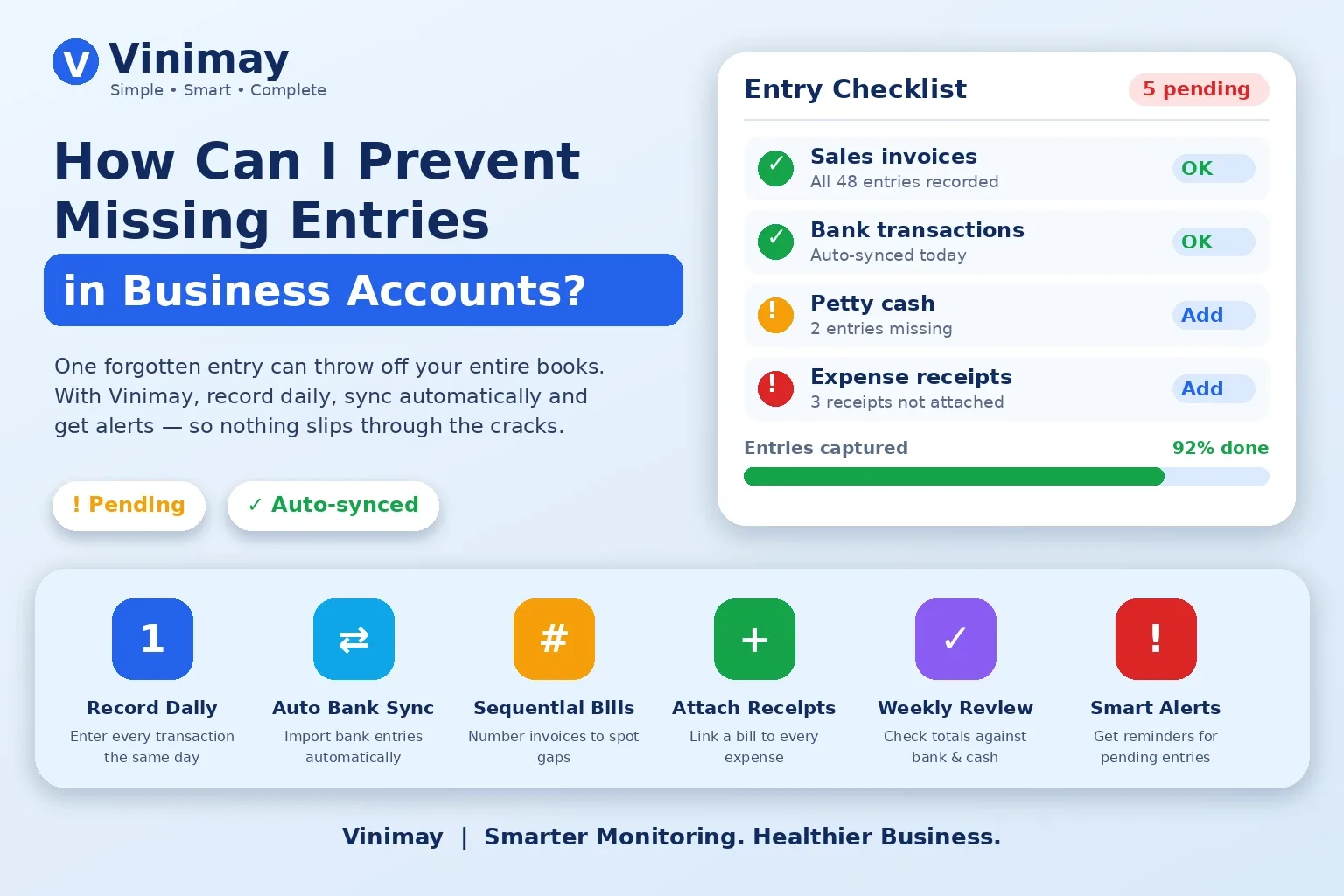
Direct answer: The single most effective prevention method is entering every transaction the same day it happens, ideally immediately, rather than relying on memory to batch-enter things later.
The longer the gap between a transaction happening and it being recorded, the higher the chance of it being forgotten entirely or entered with a wrong detail. A same-day habit doesn't need to mean instant entry for every single transaction, but it does mean nothing carries over to the next day unrecorded.
A Cross-Check Method to Catch What's Already Been Missed
Even with good habits, occasional gaps happen, which is why a periodic cross-check matters:
Compare recorded sales against actual cash and digital payments received for the same period
Compare recorded stock reduction against a physical count for a sample of products
Compare recorded purchases against actual vendor bills or delivery challans received
Investigate any mismatch immediately rather than assuming it will resolve itself
Where Missing Entries Cause the Most Damage
Not all missing entries carry equal risk:
A Weekly Gap-Check Routine
Compare a week's recorded sales total against actual money received across all payment modes
Spot-check stock for a handful of fast-moving products against system records
Ask staff directly if any transaction was handled verbally or informally and not yet entered
Review any invoice left in a draft or incomplete state, and either complete or clarify it
Conclusion
Missing entries in business accounts almost always come from ordinary, busy-day interruptions rather than carelessness, which is why the fix isn't vague vigilance but specific habits, same-day entry, and a regular cross-check between records and physical reality. Catching a gap within a week is manageable; catching the same gap months later, after it's compounded with several others, is considerably harder.
FAQs
1. Are missing entries usually caused by carelessness?
Not typically, they're usually caused by ordinary interruptions, like a call during billing or a rushed verbal agreement, rather than a lack of attention, which is why specific habits and checks matter more than simply "being more careful."
2. Why is same-day entry so much more effective than batch entry later?
Because the longer a transaction goes unrecorded, the more likely specific details, or the transaction itself, are forgotten entirely, so same-day entry significantly reduces the window in which something can slip through.
3. What's the most damaging type of missing entry?
An unbilled sale tends to be the most directly costly, since it represents revenue that's never invoiced or collected at all, though an unrecorded payment can also create awkward, incorrect follow-ups with a customer.
4. How can I catch entries that have already been missed?
Cross-checking recorded totals against actual cash,digital payments, and physical stock counts periodically helps surface gaps, since a mismatch between what's recorded and what's physically true usually points directly to a missing entry.
5. Does having multiple staff handling transactions increase the risk of missing entries?
Yes, without clear coordination, each person may assume someone else recorded a specific transaction, so establishing a clear, individual responsibility for entering what each person handles reduces this particular risk.
Related Topics
Published by Team Vinimay
Our editorial and compliance specialists create practical guides, tax calculation rules, and operational strategies to empower Indian small business owners and accountants.