Understanding where money is being spent is important for maintaining control over business finances. Many businesses record expenses regularly but struggle to identify which categories are consuming the most resources. Without proper tracking, it becomes difficult to analyze spending patterns, control unnecessary costs, and make informed financial decisions.
Accounting software helps organize expenses by category and provides a clearer view of business spending. Vinimay helps businesses record expenses, manage transactions, and access financial information in a structured way, making it easier to track where funds are being utilized. This guide explains how businesses can identify their biggest expenses, which reports can help with analysis, and how proper expense tracking supports better financial management.
Why This Question Is Harder to Answer Than It Sounds
Expenses come from multiple sources: Supplier invoices, one-time purchases, rent, utilities, and other recurring bills can all contribute to total expenses.
Records may be scattered: When expenses are recorded across different invoices, bills, spreadsheets, or accounts, getting a complete picture becomes difficult.
Categorization matters: Without properly grouping expenses into categories, it is difficult to compare where the business is actually spending the most.
Memory is not enough: Relying on assumptions or recollection can give a misleading answer; accurate records provide a clear, verifiable figure.
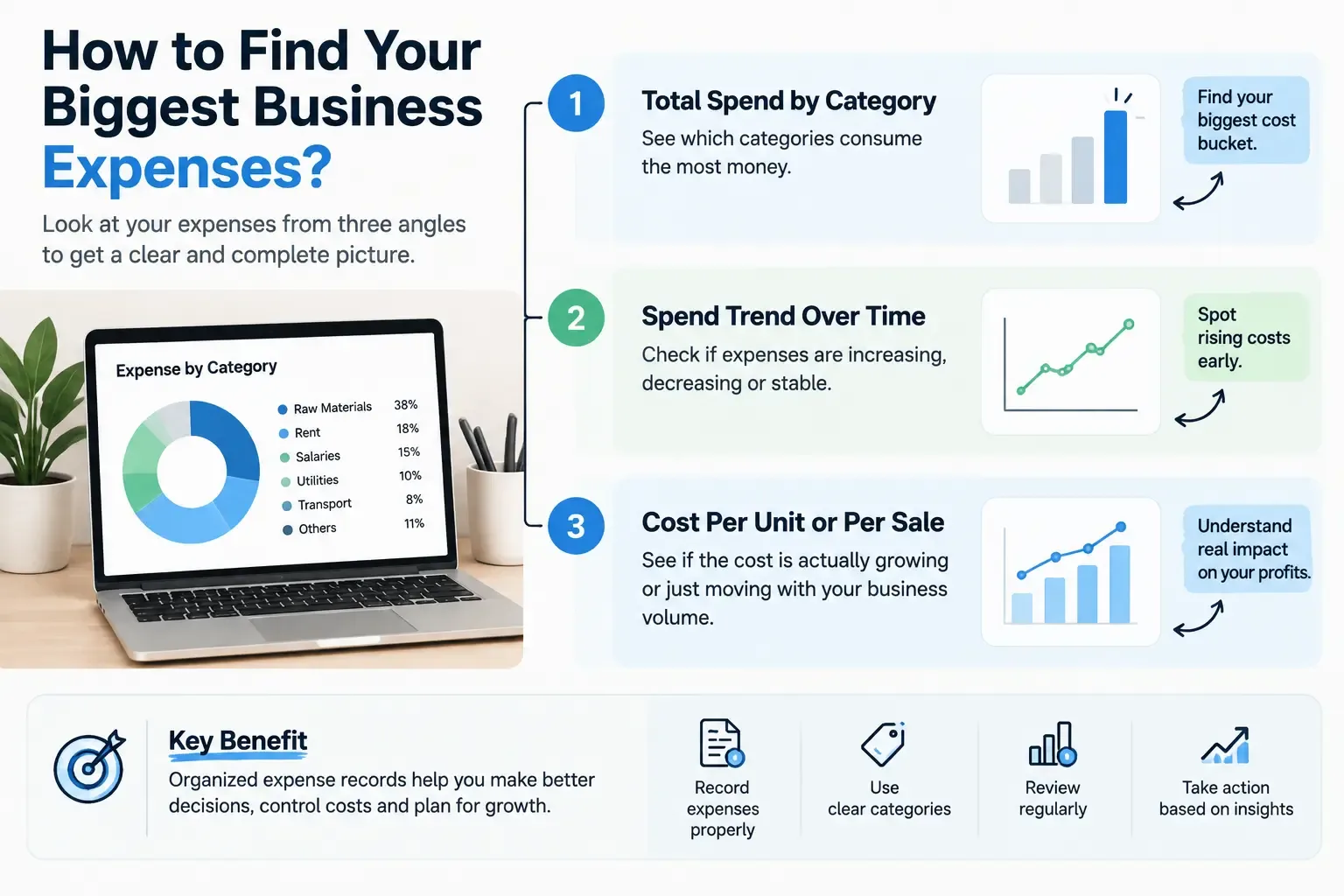
The Three-Layer Way to Look at Expenses
Rather than trying to answer this in one step, it helps to look at expenses through three different lenses, each revealing something the others don't.
Layer 1: Total Spend by Category
The most basic view is simply adding up how much has gone toward each expense category—raw materials, rent, utilities, staff, transport, and so on—over a given period. This alone often reveals the obvious biggest expense, but it can also hide things, since a category with many small transactions can add up to more than an occasional large one.
Layer 2: Spend Trend Over Time
A single total doesn't show whether an expense is stable, growing, or shrinking. Looking at the same category across several months reveals whether a cost is creeping upward—a supplier gradually raising prices, or utility costs increasing with usage—something a single snapshot total would miss entirely.
Layer 3: Cost Per Unit or Per Sale
For businesses selling products, raw total spend can be misleading if sales volume is also changing. Looking at cost per unit sold, or expense as a percentage of revenue, gives a more accurate sense of whether a cost is actually becoming a bigger burden or simply growing in line with more business overall.
A Quick Example
Imagine a small retail business reviewing three months of expenses. Layer 1 shows raw materials as the single biggest category—no surprise. Layer 2 reveals that a specific supplier's prices have crept up roughly 8% over those three months, something that wasn't obvious from the total alone. Layer 3 shows that even with this increase, cost per unit sold has stayed roughly stable, because sales volume grew at a similar pace. Without all three layers, the business might have reacted to the raw materials total alone and missed the more useful insight—that the actual per-unit cost pressure was manageable, even if the category as a whole looked large.
What Makes This Analysis Possible
Accurate expense analysis starts with consistent recording and categorization of business spending. This means maintaining expense records with details such as amount, date, and category; keeping purchase records that connect supplier costs to individual transactions; using reports to review spending by category and period; and maintaining ledgers that show payments made to suppliers or different expense categories over time.
In Vinimay, expense and purchase records flow directly into reports, making it easier to analyze spending without manually compiling figures from scattered bills and receipts. Cost-per-unit analysis requires one additional step: connecting expense data with sales or production volume. Businesses can build this analysis from the same underlying records, even when a single automated report is not available.
Frequently Asked Questions
1. What's the simplest way to find my biggest business expense?
Categorizing all spending over a period and totalling each category is the simplest starting point, though it can hide gradually growing costs.
2. Why isn't a single expense total enough to understand spending?
It doesn't show trends over time or whether a cost is scaling proportionally with your business—both of which matter for real decisions.
3. How can I tell if a specific cost is creeping up over time?
Comparing the same expense category across several consecutive periods reveals gradual increases that a single total wouldn't show.
4. What does "cost per unit" tell me that a total doesn't?
It shows whether a cost is genuinely becoming a bigger burden or simply growing in proportion to increased sales volume.
5. Do I need special software to analyze expenses this way?
You need consistent, categorized expense and purchase records—the analysis itself can be done with those records, with or without dedicated reporting tools.
6. How often should I review my business expenses?
Monthly reviews are common for catching trends early, though quarterly reviews can also work for lower-volume businesses.
7. What's a common mistake when reviewing expenses?
Reacting to a single large total without checking whether it's a stable, expected cost or an actual growing trend.
8. Can expense records help with supplier negotiations?
Yes—seeing a clear cost trend for a specific supplier is useful leverage when discussing pricing or terms.
9. Should I track expenses by category or by supplier?
Both are useful—category totals show where money goes broadly, while supplier-level tracking shows specific cost drivers within a category.
10. What's the biggest benefit of understanding my expenses this way?
It replaces guesswork with an actual, checkable picture of where money goes, making cost decisions based on evidence rather than impression.
Published by Team Vinimay
Our editorial and compliance specialists create practical guides, tax calculation rules, and operational strategies to empower Indian small business owners and accountants.

