Managing multiple suppliers requires businesses to keep accurate records of vendor details, purchase transactions, payments, and outstanding amounts. When supplier information is maintained through separate registers or spreadsheets, it can become difficult to track purchase history, pending payments, and supplier-wise expenses.
Accounting software helps businesses organize supplier information and manage purchase-related activities from a single system. Vinimay allows businesses to maintain vendor records, track purchase transactions, manage payments, and keep financial data connected for better visibility. This guide explains how businesses can efficiently manage multiple suppliers, the benefits of digital vendor management, and the features to look for in accounting software.
Habit 1: Keep One Record Per Supplier, Not One Big List
A single combined list of "all purchases" becomes hard to navigate once the supplier count grows. Instead, each supplier should have their own distinct record—contact details, agreed terms, and their own transaction history—so pulling up "everything related to this one supplier" doesn't mean filtering through everyone else's data first.
Habit 2: Standardize How You Log Every Order
Inconsistent logging—sometimes noting a full order date, sometimes just a rough date; sometimes including payment terms, sometimes not—makes supplier records unreliable over time. Deciding on a consistent format for every purchase entry, and sticking to it regardless of which supplier it's for, keeps records usable months or years later.
Habit 3: Separate "Active" Suppliers From Occasional Ones
Not every supplier needs the same level of ongoing attention. A regular supplier you order from weekly deserves more frequent review than one you've used twice in a year. Mentally (or practically) separating your active, frequent suppliers from occasional ones helps you focus review time where it actually matters.
Habit 4: Track Payment Terms Alongside Contact Details
Different suppliers often have different payment terms—some expect payment on delivery, others offer a 30-day window. Keeping this information stored alongside each supplier's contact details, rather than trying to remember it, avoids accidentally paying late or missing a discount for early payment.
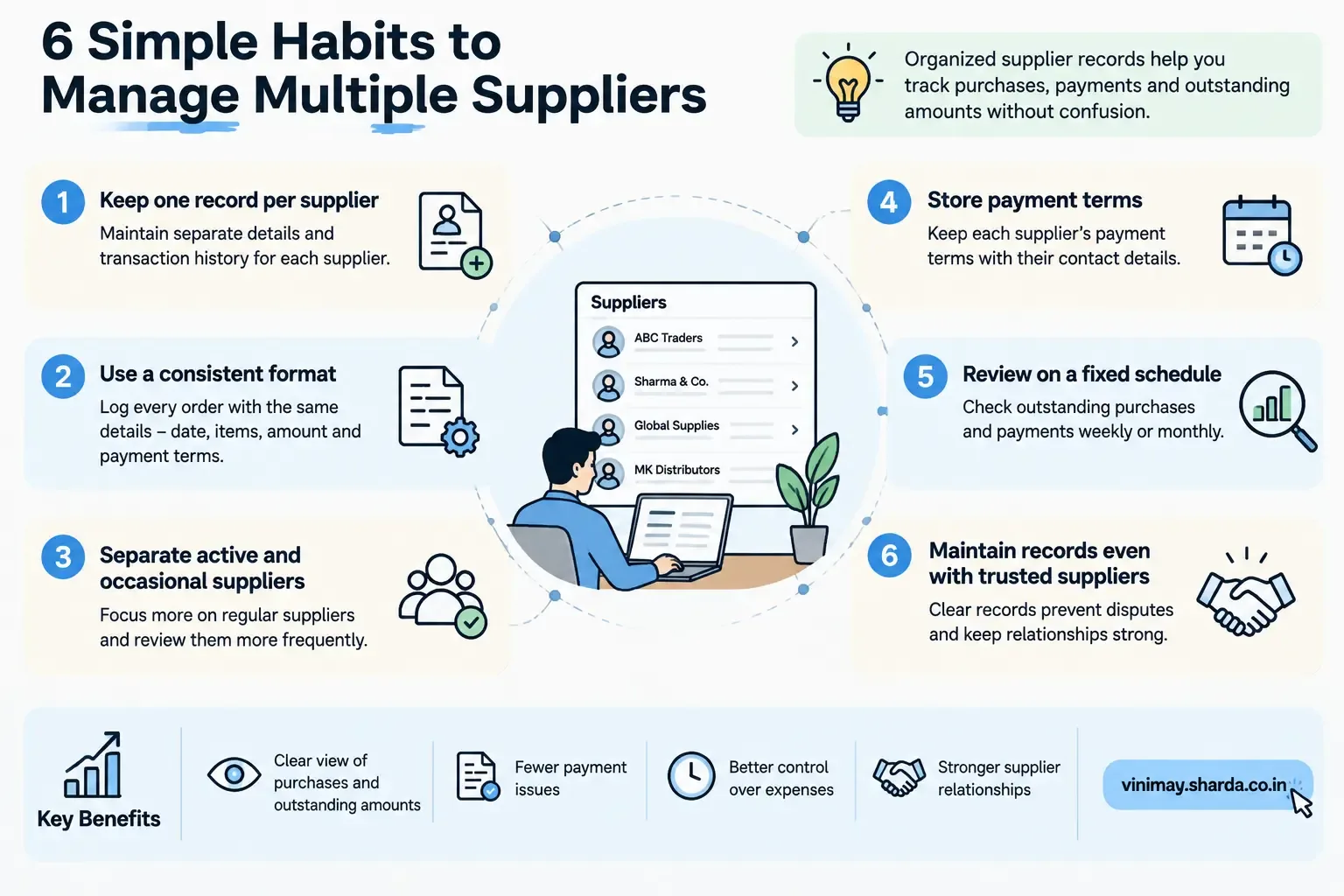
Habit 5: Review Supplier Activity on a Fixed Schedule
Rather than reacting only when a supplier follows up, set a regular schedule — weekly or monthly, depending on volume — to review outstanding purchases and payments across all your suppliers. This catches issues while they're still small and easy to resolve.
Habit 6: Don't Let Good Relationships Replace Good Records
A friendly, long-standing relationship with a supplier can create a false sense that "we'll sort it out" if records get sloppy. In practice, good relationships and good records aren't a trade-off—maintaining clear records actually protects the relationship by avoiding disputes over what was ordered, delivered, or paid.
Putting These Habits Together
None of these habits require complicated tools—they require consistency. A business with five suppliers and disciplined habits will manage far more easily than a business with two suppliers and no consistent process. That said, having a system that naturally supports these habits—rather than fighting against them—makes consistency much easier to maintain over time.
What This Looks Like in Practice
These habits can be supported through a few connected areas of a billing system. Vendor management keeps individual supplier information organized, while purchase records maintain a consistent transaction history. Ledger management helps track running supplier balances, and receivables and payables provide a consolidated view of outstanding amounts, making regular financial reviews quicker and easier.
In Vinimay, vendor management and purchase records are connected, so supplier details, transaction history, and payment information can be maintained together. This reduces the need for separate manual tracking and makes it easier to maintain consistent records as the number of suppliers and transactions grows.
Frequently Asked Questions
1. What's the biggest challenge in managing multiple suppliers?
Keeping each supplier's information, order history, and terms organized separately, rather than letting everything blend into one confusing list.
2. How often should I review my suppliers' activity?
Weekly for active, frequent suppliers, and at least monthly for occasional ones, depending on your overall purchase volume.
3. Should all suppliers be reviewed with the same frequency?
No—separating active suppliers from occasional ones helps focus review time where it's actually needed.
4. Why does consistent logging matter for supplier management?
Inconsistent records become unreliable over time, making it harder to trust or use historical purchase data later.
5. Is it enough to rely on a good relationship with a supplier instead of detailed records?
No—clear records actually protect the relationship by avoiding disputes over what was agreed, ordered, or paid.
6. What should be stored alongside each supplier's contact details?
Payment terms, order history, and any agreed pricing should be stored together with basic contact information.
7. Does managing many suppliers require special software?
It requires more consistent organization than specific software, though a connected system makes maintaining that consistency easier.
8. What's a sign that supplier management has become unmanageable?
If you're regularly unsure what's owed to a specific supplier or missing payment terms, it's a sign the current process needs more structure.
9. Can payment terms differ significantly between suppliers?
Yes—some expect payment on delivery, others offer 30-day terms or early-payment discounts, so tracking this per supplier matters.
10. What's the most sustainable way to manage growing supplier relationships?
Building a few consistent habits—separate records, standard logging, regular review—rather than relying on memory as supplier count grows.
Related Topics
Published by Team Vinimay
Our editorial and compliance specialists create practical guides, tax calculation rules, and operational strategies to empower Indian small business owners and accountants.