Every business owner eventually reaches the same moment—GST return season approaches, and suddenly the question isn't "Did I make money this month?" but "Can I actually produce the numbers this filing needs?" Vinimay handles this specific transition well, since its reports draw directly from the same GST-tagged sales and purchase records used for everyday billing, rather than requiring a separate reporting exercise. Yes, businesses can generate tax reports from their accounting software — specifically summaries of taxable sales, tax collected, tax paid on purchases, and net tax position for a chosen period — as long as the underlying invoices carry accurate, consistent tax details throughout that period. The report itself is rarely the hard part; the accuracy of what feeds into it is.
What a Tax Report Actually Contains
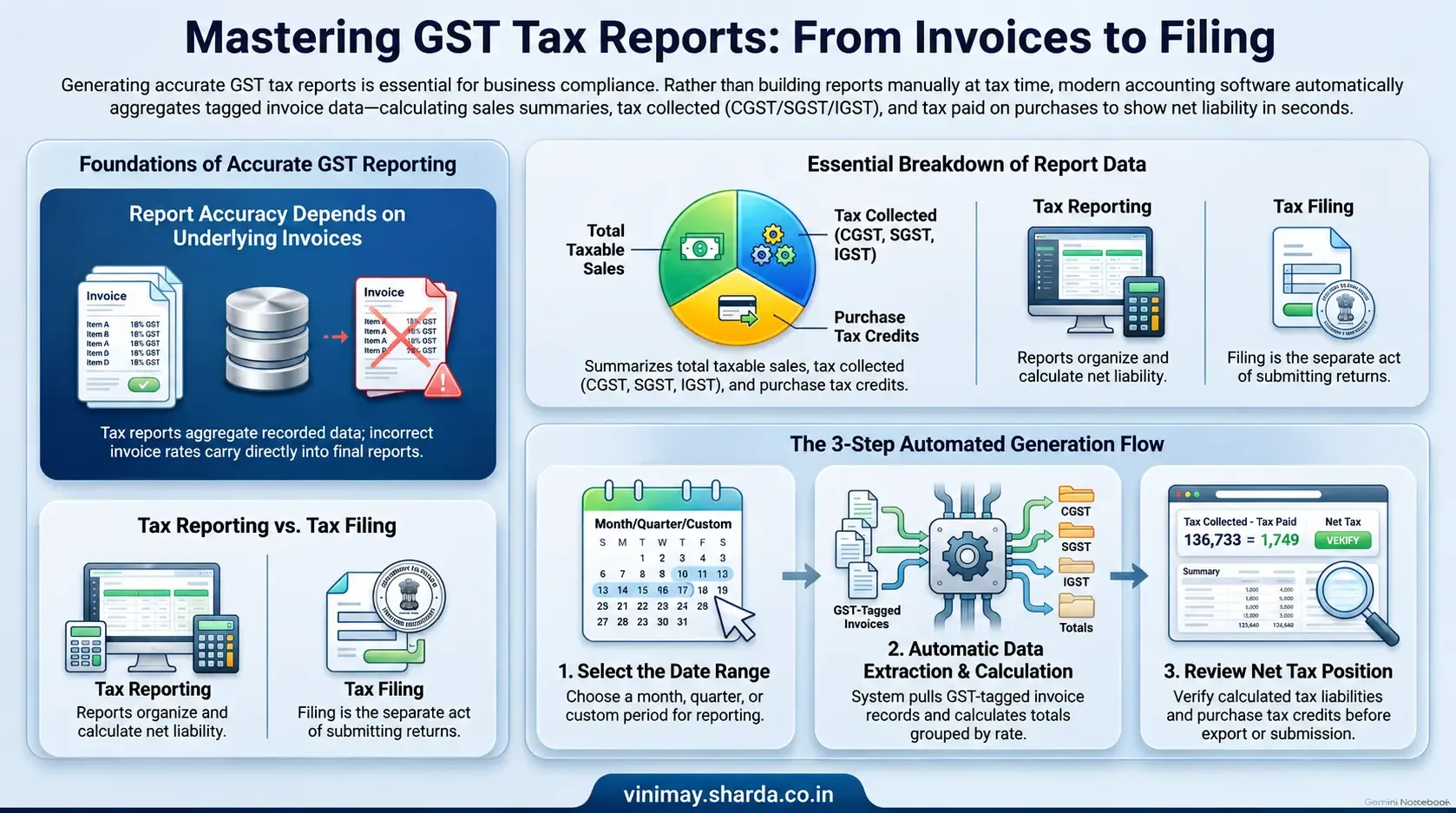
A useful tax report for GST purposes typically breaks down total sales by tax rate, total tax collected (split by CGST, SGST, and IGST), total tax paid on purchases, and the resulting net liability or credit for the period. This is essentially a structured, categorised version of every invoice issued and received, summed up rather than listed individually.
Why the Report Is Only as Good as the Invoices Behind It
A tax report doesn't independently verify anything — it aggregates whatever was entered. If an invoice applied the wrong tax type, or a purchase was recorded with an incorrect rate, that error carries directly into the report without any flag. This is why tax report accuracy is really a downstream reflection of invoice accuracy, not a separate quality the report has on its own.
Common Report Types Businesses Need
Sales tax summary — total taxable sales and tax collected for a period
Purchase tax summary — tax paid on purchases, relevant for credit calculations
Net tax position — the difference between collected and paid, showing what's owed or claimable
Period-over-period comparison — useful for spotting unusual shifts worth investigating
What Generating a Report Actually Looks Like
This process, when the underlying data is clean, typically takes seconds rather than the hours a manual calculation would require.
Where This Fits Into the Bigger Filing Picture
It's worth being clear that a tax report isn't the same as an actual tax filing — the report organises and summarises what you owe or can claim, but submitting a return to the tax authority is a separate step, whether done directly or through a CA. The report is preparation; filing is action.
Where Vinimay Fits Into This
Vinimay's reports pull directly from GST-tagged sales and purchase records, meaning the tax summary reflects actual invoice data rather than requiring separate manual calculation. Since CGST, SGST, and IGST are applied automatically based on verified customer and product setup, the resulting reports carry that same accuracy forward. This makes report generation less about building something new at filing time and more about reviewing what the system has already been tracking.
To see this directly, Vinimay's free invoice tool lets you generate up to 5 GST invoices free, with tax details applied consistently from the start.
Frequently Asked Questions
1. Can businesses generate tax reports using accounting software?
Yes. Many accounting software systems can generate tax-related reports from recorded sales, purchases, expenses, and other financial transactions.
2. What information is included in a tax report?
Depending on the software, reports may include taxable sales, purchases, tax collected, tax paid, and transaction-level tax details.
3. Can accounting software generate GST reports?
Yes, many accounting systems provide GST-related reports based on recorded transactions. The exact reports available depend on the software.
4. Can tax reports be generated automatically?
Some software can generate reports automatically from thetransactions already recorded in the system, reducing the need for manual calculations.
5. Can businesses export tax reports?
Many accounting platforms allow reports to be downloaded or exported in formats such as Excel or PDF, depending on the software.
6. Can tax reports help with GST filing?
Tax reports can help organise the information needed for GST filing, but businesses should verify the data before submitting any tax return.
7. Can accounting software calculate tax liability?
Some accounting software can calculate tax based on configured rates and recorded transactions. The accuracy depends on correct tax settings and transaction data.
8. Can businesses generate reports for different periods?
Yes. Many systems allow businesses to select a specific date range and generate tax or transaction reports for that period.
9. Can accountants use software-generated tax reports?
Yes. Accountants can use these reports to review transactions, reconcile tax amounts, and prepare or verify compliance records.
10. Are software-generated tax reports always accurate?
Not necessarily. Reports depend on the accuracy and completeness of the underlying records and tax settings. Businesses should review important tax reports before using them for compliance.
Related Topics
Published by Team Vinimay
Our editorial and compliance specialists create practical guides, tax calculation rules, and operational strategies to empower Indian small business owners and accountants.