What Is the Difference Between Billing Software and Accounting Software?
Billing Software Two business owners can use the exact same words — "I need software for my business" — and mean completely different things. One wants faster invoices at the counter. The other wants to know if the business made a profit last quarter. Both are reasonable needs, but they point to two different categories of tools.
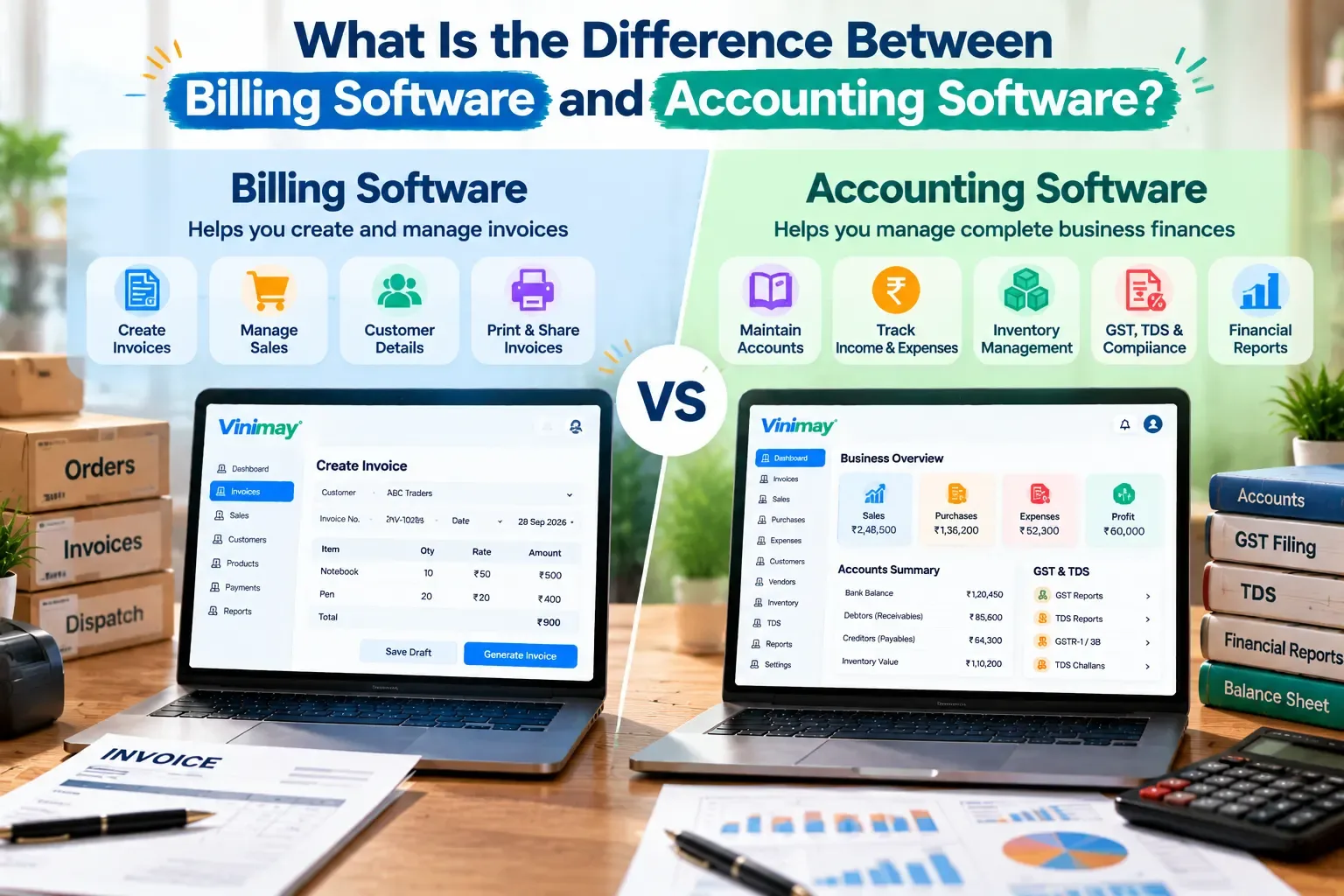
The difference between billing software and accounting software comes down to what each one is built to answer. Billing software answers "what did I sell, and what's owed to me?" Accounting software answers a broader question: "what is the overall financial position of my business?" One focuses on transactions as they happen; the other focuses on the complete financial picture built from those transactions.
Vinimay helps businesses handle GST invoicing,sales and purchase records, payment tracking, inventory and customer management — functions that sit at the billing end of this spectrum. This guide breaks down exactly where billing software ends and accounting software begins, and how to tell which one fits your business right now.
What Is Billing Software?
Billing software is built around the day-to-day act of selling — creating an invoice, applying the correct tax, recording the payment, and updating stock if relevant.
Typical billing software includes:
GST-compliant invoice creation with tax fields
Customer and vendor detail storage
Payment tracking for individual bills
Inventory or stock updatestied to sales
PDF export and printing in various formats
Its focus is transactional — each entry is tied to a specific sale, purchase or payment.
Accounting software is built around the complete financial record of a business — not just individual transactions, but how they add up into ledgers, statements and a full financial position.
Typical accounting software includes:
Ledger management across all account types
Bank reconciliation
Profit and loss statements, balance sheets
Tax preparation support
Multi-account financial reporting
Its focus is cumulative—it exists to answer "what does the business look like overall" rather than "what happened in this one sale."
Where the Two Overlap
In practice, the line between these has blurred. Most modern billing tools include basic reports, and many accounting tools include invoicing. The overlap is real, but it doesn't erase the distinction — a tool built primarily for fast, GST-correct daily billing will always be shallower on financial statements, and a tool built primarily for financial statements will often feel slower or heavier for quick counter billing.
Which One Does Your Business Actually Need?
This depends on what problem is actually costing you time right now. If your daily pain point is slow bill creation, missing GST details, or untracked stock, that's a billing problem — and billing software solves it directly. If your pain point is not knowing your overall profit, needing a balance sheet for a loan application, or preparing for a formal audit, that's an accounting problem, and it usually needs either dedicated accounting software or a CA working alongside your billing records.
Many small businesses in India start with billing software because it solves the immediate, daily problem, and bring in accounting support — software or a CA — once the business is large enough to need financial statements regularly.
What Vinimay Covers in This Picture
Vinimay sits on the billing side of this distinction. It handles GST invoicing, sales and purchase records, payment tracking, inventory and stock management, customer and vendor management, and business reports drawn from those records — the tools most small businesses reach for first when the daily problem is billing, not financial statement preparation.
It is not built to replace a full accounting system that prepares balance sheets or profit and loss statements from the ground up. For most small retail, wholesale and service businesses, though, the daily bottleneck is exactly what Vinimay is built to solve — organised, GST-correct billing connected to stock and payments.
Conclusion
Billing software and accounting software solve different problems, and the right choice depends on which one is actually creating friction in your business today. If your daily struggle is invoicing, GST accuracy, or tracking what's owed, billing software addresses that directly.
If your struggle is understanding overall business performance for a loan, audit or long-term planning, that calls for accounting software or a CA's involvement. Vinimay is built for the first category— keeping billing, stock, payments and records connected — and works well as the foundation many small businesses build their financial process around before adding deeper accounting support.
Frequently Asked Questions
1. Is billing software the same as accounting software?
No. Billing software focuses on invoicing and transactions; accounting software focuses on the complete financial position of a business, including ledgers and statements.
2. Can billing software replace an accountant?
No. It organises transaction data, but preparing financial statements and tax filings typically still needs a professional.
3. Do I need accounting software if I already use billing software?
Only if you need financial statements like profit and loss or balance sheets regularly — many small businesses manage well with billing software plus a CA.
4. What features does billing software typically include?
GST invoicing, customer and vendor records, payment tracking, and inventory management.
5. What features does accounting software typically include?
Ledger management, bank reconciliation, financial statements, and broader tax preparation support.
6. Does Vinimay function as billing or accounting software?
Vinimay covers the billing side—GST invoicing,sales and purchase records, inventory, payments and reports.
7. Can a small business survive with only billing software?
Yes, particularly in early stages, as long as financial statement preparation is handled separately when needed.
8. Why do billing and accounting tools look so similar now?
Many tools have added overlapping features over time, but their core focus — transactions versus overall financial position — still differs.
9. Which should a new business start with?
Most new businesses start with billing software to solve immediate invoicing and GST needs, adding accounting support as complexity grows.
10. Does billing software generate reports?
Yes, typically sales, purchase and outstanding-payment summaries, though usually not full financial statements
Published by Team Vinimay
Our editorial and compliance specialists create practical guides, tax calculation rules, and operational strategies to empower Indian small business owners and accountants.