Why Are Businesses Switching from Manual Accounting to Software?
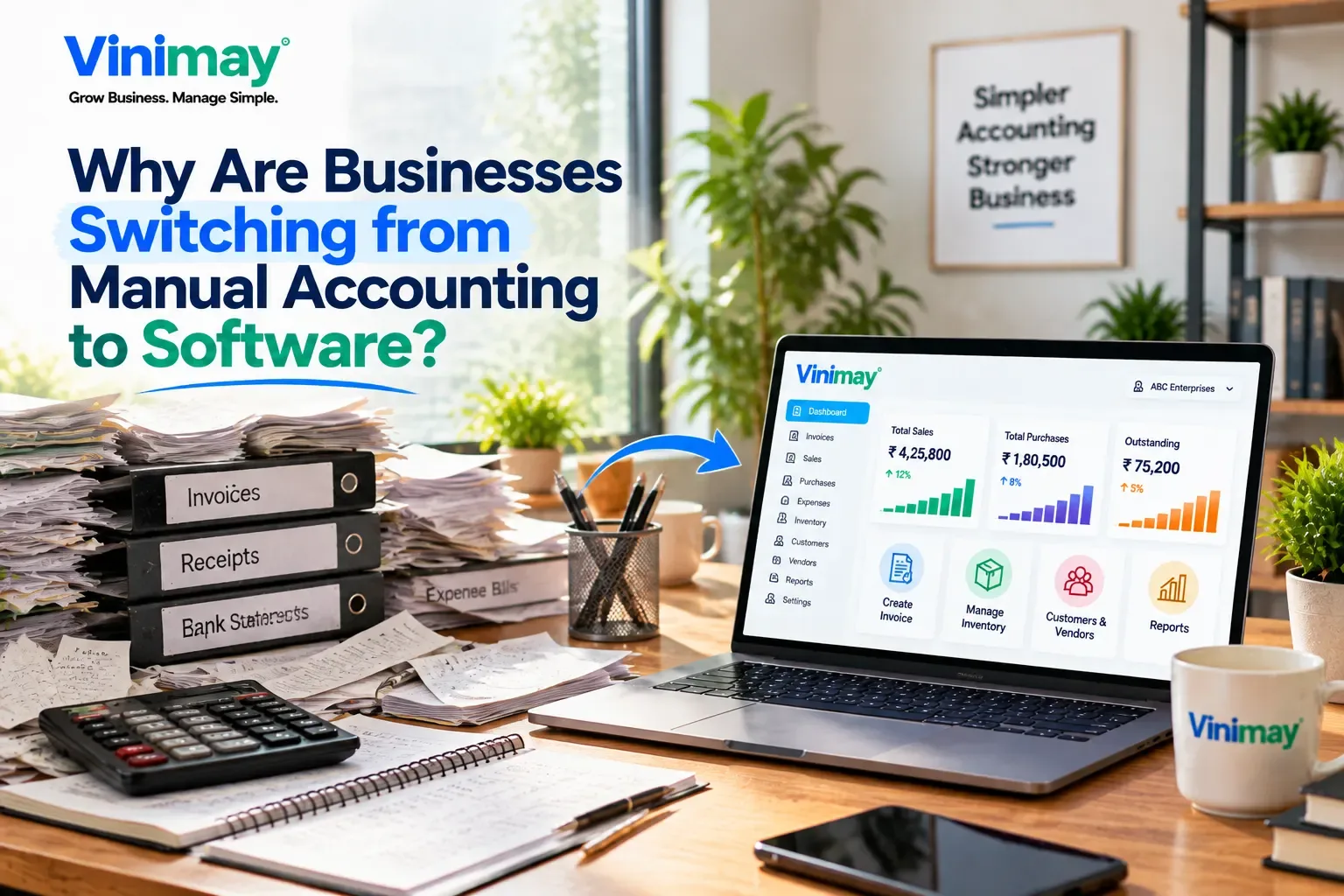
Businesses don't usually switch from manual accounting because someone tells them to — they switch because a specific, repeated frustration finally becomes too costly to keep tolerating. A duplicate invoice that confuses a customer, a GST mismatch discovered right before filing, a stock count that doesn't match what's actually on the shelf. None of these individually forces a decision, but they accumulate, and at some point the manual system stops feeling manageable and starts feeling like a liability.
Understanding the actual triggers behind this switch — rather than a generic "software is better" argument — helps clarify whether your own business has already reached that point, or whether manual methods are still genuinely fine for your current stage.
The Real Triggers Behind Switching
Errors start compounding, not just occurring. Early on, a mistake in a notebook or spreadsheet is a one-off annoyance, fixed in a few minutes. As transaction volume grows, the same kind of error — a wrong GST rate, a missed payment entry — happens more often, and each one takes longer to trace back and correct, because there's more data to sift through.
More than one person starts touching the books. A single owner keeping records is naturally consistent, even if imperfect. The moment a second person starts billing or recording purchases, manual systems fracture — two invoice books, two numbering sequences, two slightly different versions of "what happened this week."
GST compliance stops being simple. At low volume, manually calculating CGST/SGST or IGST on each invoice is tedious but manageable. As invoice count grows, or as a business starts selling across state lines, the error rate on manual tax calculation increases, and the cost of getting it wrong—return mismatches, correction filings — becomes harder to justify avoiding software over.
Customer outstanding becomes genuinely hard to track. With a handful of customers, remembering who's paid is feasible. Past a certain number, manual tracking turns into active guesswork, and businesses start losing track of real money sitting uncollected simply because there's no connected record showing it clearly.
Stock and sales start disagreeing. A business that bills manually and counts stock separately eventually finds the two don't match — not because of theft or major error, but because manual recording of two related things in two separate places naturally drifts apart over time.
What Actually Changes After Switching
When Manual Methods Are Still Genuinely Fine
It's worth being honest that not every business needs to switch immediately. A very low invoice volume, a single person handling everything, and no interstate sales can mean manual methods remain workable for a while longer. The switch tends to make sense once two or more of the triggers above start showing up regularly, not the moment a business is founded.
How Vinimay Fits Into This Transition
Vinimay addresses the specific pain points that usually drive the switch. GST is applied automatically on every invoice — CGST, SGST, or IGST depending on the transaction — removing the manual calculation step that becomes error-prone at higher volume. Sales, purchases, receipts, and payments are recorded against shared customer and vendor accounts, so outstanding balances stay accurate without separate reconciliation, and inventory adjusts as invoices are created, closing the gap between recorded stock and actual sales.
If you're weighing whether your business has reached the point of switching, testing with real invoices is a reasonable way to find out — Vinimay's free tool generates up to 5 GST-compliant invoices without requiring signup, letting you see the difference directly rather than deciding in the abstract.
[Create Your First Invoice Free with Vinimay]
FAQs
What usually pushes a business to finally switch from manual accounting?
A combination of accumulating errors, multiple staff creating inconsistent records, GST tax-split mistakes, and difficulty tracking customer outstanding — rarely a single dramatic event.
Is manual accounting always a bad idea for a small business?
Not necessarily — at very low invoice volume with a single person handling everything, manual methods can remain workable. The switch becomes more valuable as volume, staff, or GST complexity grows.
Why does GST calculation get harder to manage manually over time?
Because thetax split (CGST/SGST vs IGST) depends on the transaction, and manually applying the correct one on every invoice becomes more error-prone as invoice count increases.
How does software actually reduce customer outstanding mismatches?
By recording payments against the same invoice or customer record rather than tracking them separately, removing the need for manual reconciliation between the two.
Do stock mismatches happen even with careful manual record-keeping?
Yes — even careful manual tracking tends to drift when sales and stock counts are recorded in two separate places rather than connected to the same transaction.
Does adding staff make manual accounting harder to maintain?
Generally yes—multiple people keeping separate records or notebooks tend to produce inconsistent numbering and duplicated or missed entries over time.
Is switching to software a one-time fix, or does it require ongoing habit changes?
Both — software removes calculation-based errors, but accurate results still depend on every transaction being entered consistently and promptly.
Related Topics
Published by Team Vinimay
Our editorial and compliance specialists create practical guides, tax calculation rules, and operational strategies to empower Indian small business owners and accountants.