Which Accounting Free Software Is Suitable for Small Companies?
"Suitable" isn't a fixed answer—it depends entirely on what your company actually does day to day, not on a general ranking of free tools. A five-person retail shop and a two-person consulting firm are both "small companies," but their billing patterns, GST needs, and reporting requirements are different enough that the same free software could feel perfect for one and frustrating for the other. Rather than asking which free software is objectively best, the more useful question is: which free plan's limits actually match how my company operates?
This piece walks through the specific factors that determine suitability for a small company—not features in the abstract, but the practical checks that decide whether a free plan will genuinely work for you or quietly fall short within a few months.
What "Suitable" Actually Depends On
Your invoice volume. A company generating ten invoices a month has very different needs from one generating two hundred. Free plans are almost always capped somewhere — by invoice count, by turnover, or by user count — so the first check is whether your actual volume fits comfortably inside that cap, not just today, but in six months.
Whether you sell within one state or across several. GST tax treatment differs — CGST plus SGST for sales within the same state, IGST for sales to a different state. If your company sells across state lines, this needs to be handled correctly and automatically, since manual calculation error rates climb the more invoices you process.
How many people need to bill. Free plans are frequently single-user. If your company has even one other person handling invoices alongside you, this single-user restriction becomes a real limitation, not a minor inconvenience.
Whether you carry physical stock. A service-based small company doesn't need inventory tracking at all. A retail or wholesale company does and needs to check specifically whether the free plan updates stock as invoices are created, or leaves that as a separate manual task.

A Quick Self-Check
Why Generic "Best Free Software" Lists Don't Actually Answer This
Most comparison lists rank free accounting tools by overall feature count or user reviews, which tells you almost nothing about suitability for your specific company. A tool with more total features isn't automatically better for a two-person consulting firm that only needs basic GST invoicing — in fact, it can be worse, adding a learning curve for capability you'll never use. The right approach is checking your own company against the four factors above first, then narrowing your search based on what actually matters to you.
Where Vinimay Fits for Small Companies
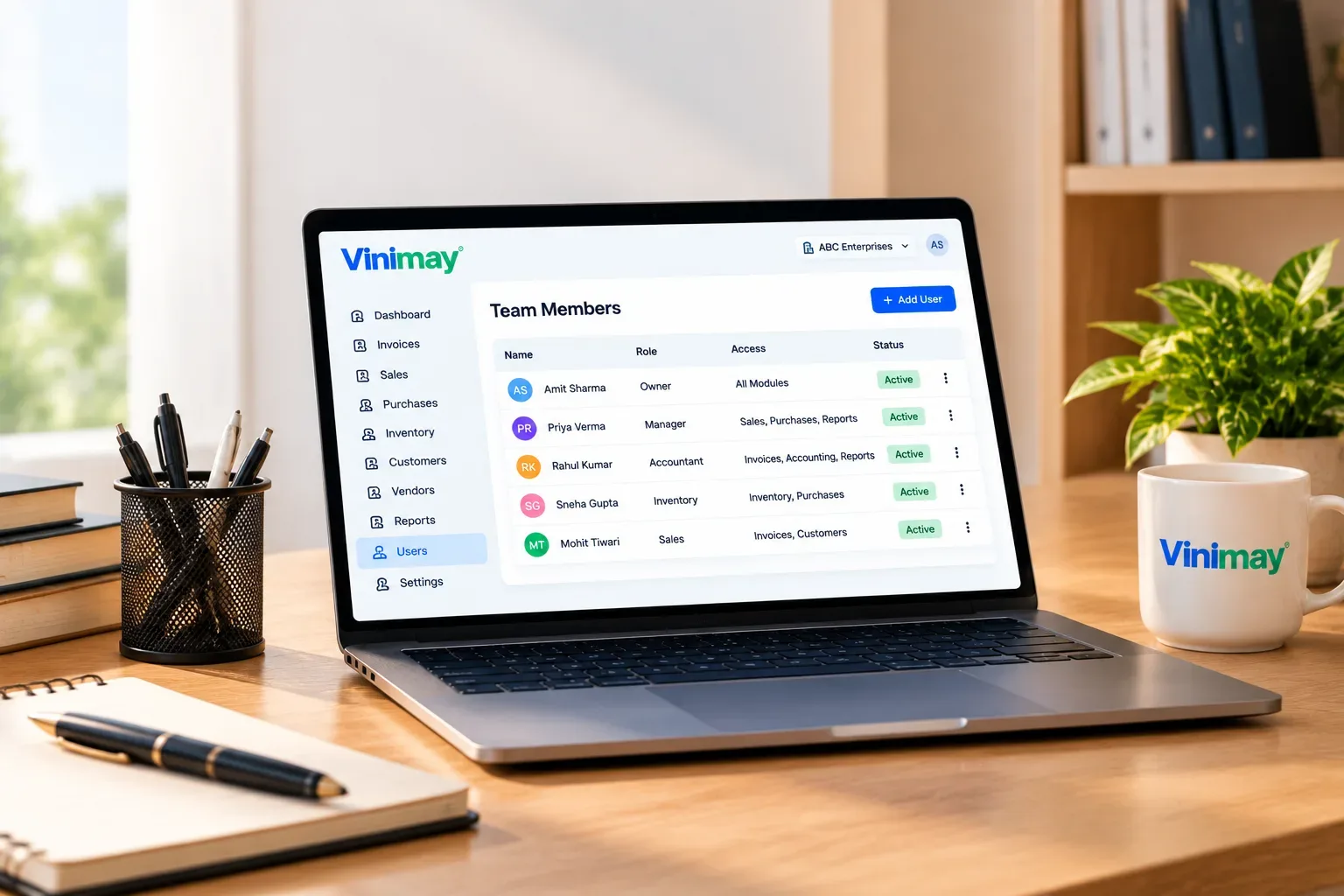
For a small company whose primary need is GST-compliant invoicing connected to customer records, transactions, and stock, Vinimay's structure maps directly onto that need. GST is applied correctly — CGST, SGST, or IGST depending on the transaction—and invoices can be exported or printed in A4, A5, or Thermal format. Sales, purchases, receipts, and payments are recorded against shared customer and vendor accounts, so outstanding balances update automatically rather than needing separate reconciliation, and inventory adjusts as invoices are created if your company carries stock.
Before committing to anything, Vinimay's free tool lets you generate up to 5 GST-compliant invoices without needing to sign up — a practical way to check whether the invoicing experience actually fits your company's workflow. If your company specifically needs multi-user access, detailed financial reports, or GST return filing built into the same tool, those aren't part of what's currently confirmed for Vinimay, so it's worth checking directly rather than assuming.
[Create Your First Invoice Free with Vinimay]
FAQs
Is there one free accounting software that's suitable for every small company?
No — suitability depends on your invoice volume, whether you sell across states, how many people need to bill, and whether you manage stock. The right fit varies by company.
What's the most common reason a free plan stops being suitable?
Usually crossing the invoice or turnover cap, or needing a second person to bill customers when the plan only supports one login.
Do small service companies need inventory features in accounting software?
Generally not—inventory tracking matters mainly for companies handling physical stock. A service-based company can usually ignore this entirely when comparing tools.
How do I know if free software handles GST correctly for interstate sales?
Check specifically whether it applies IGST automatically for sales outside your home state, rather than assuming GST compliance covers this by default.
Is a longer feature list a sign of better software for a small company?
Not necessarily — features you don't use add complexity without benefit. Matching the tool to your actual needs matters more than total feature count.
Does Vinimay support more than one person billing on the free tier?
The free invoice tool is meant for individual testing and occasional use; multi-user access details for ongoing use should be confirmed directly.
What should a small company check first before adopting free accounting software?
Your own invoice volume and whether sales cross state lines—these two factors determine more about suitability than any general feature comparison
Related Topics
Published by Team Vinimay
Our editorial and compliance specialists create practical guides, tax calculation rules, and operational strategies to empower Indian small business owners and accountants.