Is Free Accounting Software Safe for Business Data?
Business financial data includes important information such as sales records, customer details, payment history, and transaction records, making data security an important consideration when choosing accounting software. Many businesses hesitate to use free accounting solutions because they want to ensure their information remains protected and accessible when needed.
The safety of free accounting software depends on factors such as security practices, data backup options, user access controls, and the reliability of the software provider. Businesses should evaluate these aspects before storing financial information digitally. Vinimay helps businesses manage billing, accounting records, and transaction data through a structured platform, supporting organised financial management with better control over business information.
Where Free Tiers Sometimes Differ from Paid Ones
Export limitations. Some providers restrict full data export to paid plans, meaning your data is harder to retrieve or leave with on a free tier.
Support responsiveness. If something goes wrong with your data, free-tier support access may be slower or more limited than paid-tier support.
Backup guarantees. Some providers document stronger backup commitments for paid accounts specifically, leaving free-tier backup practices less clearly stated.
Where Free Tiers Usually Don't Differ
Basic encryption in transit and storage is typically applied platform-wide, not tier-specific, since it's usually a foundational security practice rather than a premium feature.
Access control basics (your login protecting your own account) generally work the same regardless of plan.
What to Ask Before Trusting a Free Tier With Your Records
Data Export: Is complete data export available on the free plan, or only on paid plans?
Backup Policy: What is the documented backup process, and does it apply to free accounts?
Data Retention: What happens to your data if you stop using the free plan?
Account Closure: Will your records be deleted, retained, or made available for export after account closure?
Data Ownership: Can you access and retrieve your business records whenever required?
Migration: Can your data be moved to another accounting or billing system if needed?
Access Restrictions: Are there any limitations on accessing historical records under the free plan?
Storage Limits: Is there a storage limit that could affect your records as the business grows?
Security: What security measures are used to protect financial and customer information?
Terms of Service: What do the provider's terms say about data access, retention, and deletion?

Where Vinimay Stands, Honestly
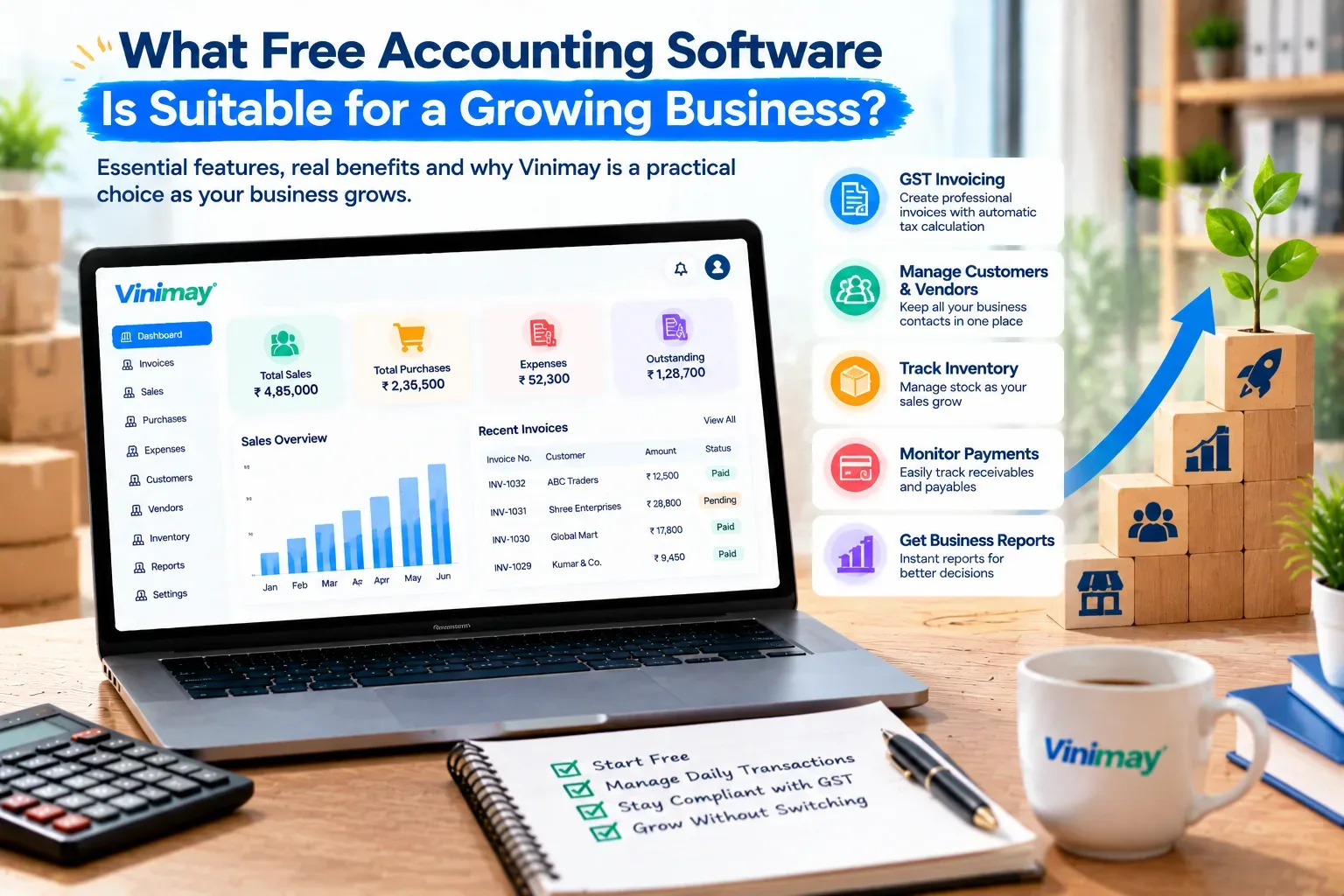
Vinimay's confirmed functionality centres on GST-compliant invoicing, transaction recording, customer/vendor management, and inventory. Specific data-safety practices — encryption standards, backup documentation, and whether these differ between the free tool and paid ongoing use — aren't part of what's independently confirmed here. If data safety specifics on the free tool specifically matter to your decision, it's worth asking Vinimay directly for documented practices rather than assuming parity with paid plans, since that assumption isn't always accurate across the industry generally.
Conclusion
Free accounting software isn't automatically less safe than paid — but some providers do genuinely differ in export access, support responsiveness, or backup documentation between tiers. The way to know for certain is to ask directly, specifically about the free tier you're considering, rather than assuming either the best or the worst.
Frequently Asked Questions
Q1. Are free accounting software plans generally less secure than paid ones?
Not necessarily for basic security like encryption, but export access, support speed, and backup documentation sometimes differ between free and paid tiers.
Q2. Can I export my data if I'm on a free accounting software plan?
This varies by provider — some restrict full export to paid tiers, so it's worth confirming specifically for the free plan you're considering.
Q3. Does a free tier get the same backup protection as a paid one?
Not always documented equally — some providers detail stronger backup commitments for paid accounts specifically.
Q4. What happens to my data if I stop using a free accounting tool?
This depends on the provider's specific policy — ask directly whether data is deleted, retained, or remains exportable after inactivity.
Q5. Is basic data encryption usually included on free plans?
Generally yes — this is typically a foundational practice applied platform-wide rather than a paid-only feature, though it's still worth confirming.
Q6. Should I ask a provider directly about data safety or trust the general marketing language?
Ask directly — vague reassurance without specifics doesn't tell you much; documented practices (encryption standards, backup frequency) are what actually matter.
Q7. Does Vinimay have documented data safety practices for its free tool?
Not currently confirmed here. If this matters for your decision, ask Vinimay directly for documented specifics.
Q8. Is support response time typically slower for free-tier users?
This varies by provider, but it's a common pattern worth checking specifically rather than assuming equal treatment across tiers.
Q9. What's the biggest data-safety risk specific to free accounting tools?
Restricted data export is one of the more commonly reported limitations — meaning if you want to leave, retrieving your full data may be harder than expected.
Q10. How do I verify a provider's data safety claims rather than just trusting their wording?
Ask for documented specifics — encryption standards, backup frequency, export policy — rather than accepting general reassurance phrases at face value.
Related Topics
Published by Team Vinimay
Our editorial and compliance specialists create practical guides, tax calculation rules, and operational strategies to empower Indian small business owners and accountants.