accounting software5 min readPublished 18 October 2026
Switch From myBillBook: When Should You Move?
Thinking about switching from myBillBook? Learn when billing is no longer enough and how a complete accounting platform can simplify business management.
A
admin
Financial Insights & Compliance Desk
Share:
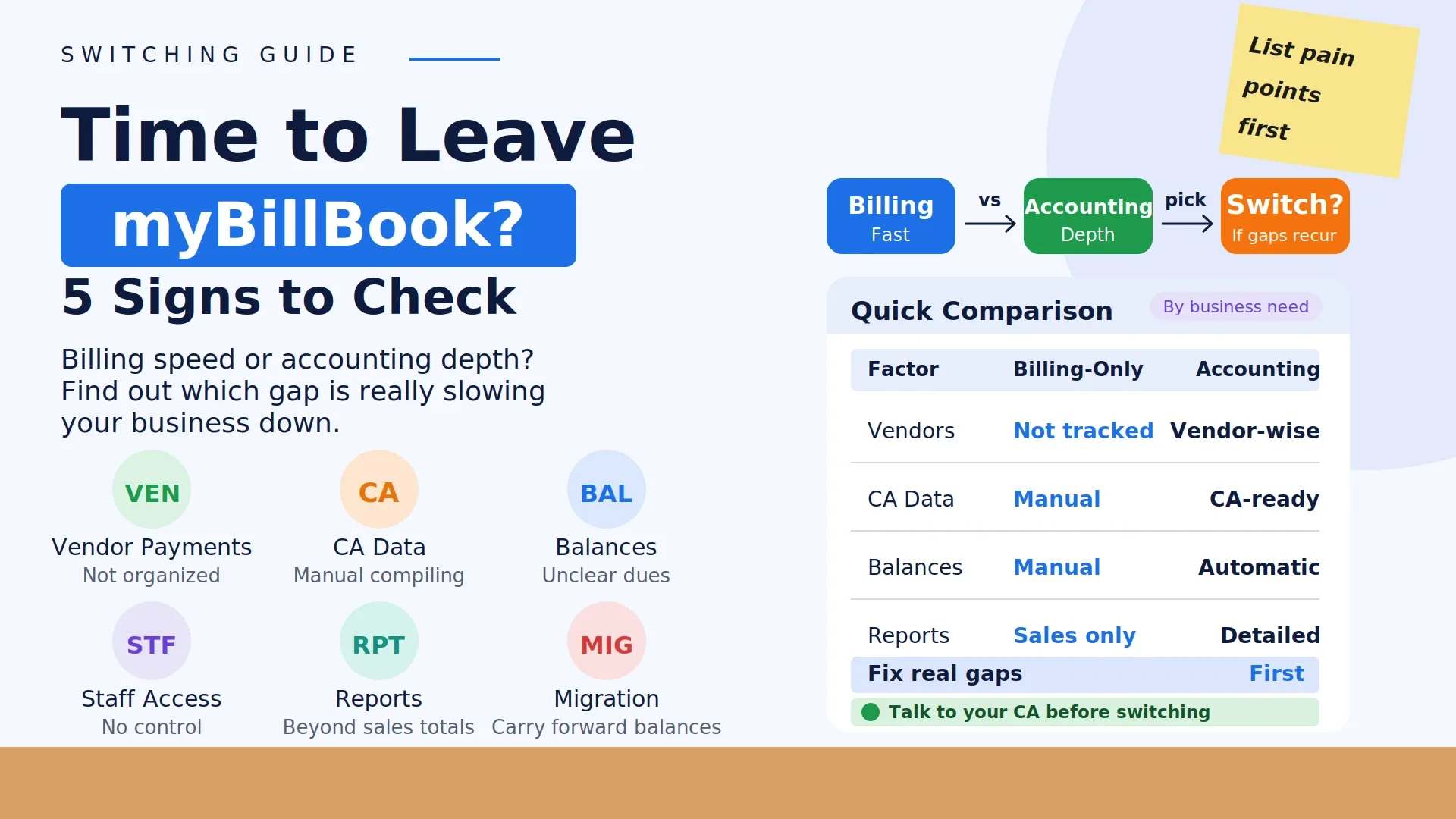
Businesses consider whether to switch from myBillBook when billing alone stops being enough — when vendor payments need tracking, customer credit balances need to be clear at a glance, or the CA keeps asking for data that takes hours to compile. If your business has grown beyond simple invoicing and now needs structured accounting, switching to a more complete platform can reduce manual work and make financial management more organized. myBillBook works well as a fast, mobile-friendly billing tool, which is exactly what many small businesses need in their early stages. But as vendor relationships multiply and credit transactions become routine, the gap between "billing" and "accounting" starts to show — dues get missed, balances get unclear, and preparing data for the CA becomes a manual exercise every time.
The decision to switch should come down to whether your actual pain points are about accounting depth, not billing speed — myBillBook already handles billing speed well.
Signs It Might Be Time To Switch
Vendor payments and purchase history aren't tracked in an organized way
You're manually compiling data every time your CA needs it
Customer outstanding balances aren't visible without manual calculation
Multiple staff bill without any access control in place
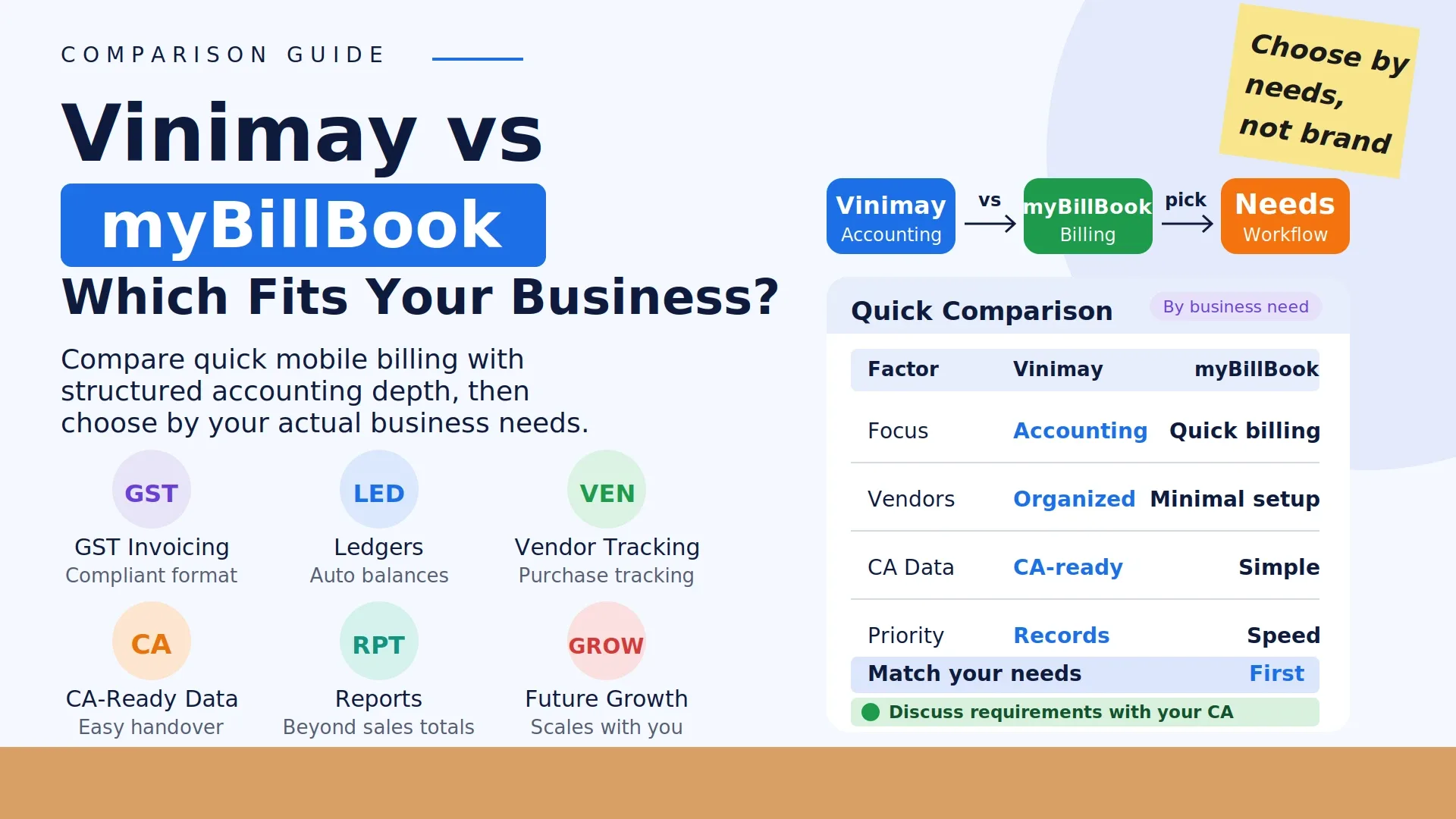
Customer and Vendor Management: Organized data on both sides
Ledgers: Auto-updating balances
Reports: A comprehensive business overview
Digital Invoice Records: CA-ready, organized data
FAQs
1. Should every myBillBook user switch to another software?
No. If myBillBook meets your current billing requirements and you do not need additional accounting features, there may be no reason to switch. A change makes more sense when your business requires capabilities that your current workflow does not handle efficiently.
2. When is the right time to switch from myBillBook?
The right time is when limitations in your current workflow start creating recurring manual work. Common signs include difficult vendor tracking, unclear customer balances, manual CA data preparation, limited reports, or the need for more structured accounting records.
3. What should I look for in a myBillBook alternative?
Look beyond invoice creation. Compare customer and vendor management, GST billing, purchase tracking, payments, ledgers, stock management, reports, user access, data migration, and the ability to support your future business requirements.
4. Will I lose my old data if I switch from myBillBook?
Data migration depends on the software and migration process used. Before switching, identify the customer, vendor, invoice, payment, and balance information that needs to be retained and confirm how it will be transferred or preserved.
5. Does switching billing software affect GST records?
Changing software does not automatically mean your previous transaction history should be discarded. Businesses should plan how historical invoices and relevant GST-related records will be retained and how new transactions will be recorded in the replacement system.
6. Can I switch from myBillBook without stopping daily billing?
A properly planned transition can reduce disruption. Businesses should prepare their data, configure the new system, verify opening balances, and train staff before fully moving their daily billing operations.
7. Is Vinimay suitable for businesses that have outgrown basic billing?
Vinimay is designed for businesses that need a broader workflow covering purchases, stock, sales, invoices, payments, ledgers, and reports rather than invoice generation alone.
8. Does Vinimay provide customer and vendor ledgers?
Yes. Vinimay includes customer and vendor management with ledger-based tracking, helping businesses maintain organized transaction and balance records.
9. Can Vinimay help reduce manual CA preparation?
Vinimay keeps transaction information organized across invoices, payments, ledgers, and reports. This can make it easier for businesses to maintain records and provide relevant information to their CA.
10. Is switching from myBillBook necessary for a growing business?
Not necessarily. Growth alone is not a reason to switch. The decision should be based on whether your current billing and accounting workflow continues to meet your business requirements efficiently.
Conclusion
Moving away from myBillBook makes sense when your business's accounting needs have outgrown what a billing-only tool can offer — particularly around vendor management, clear customer balances, and CA-ready data. Identify your actual pain points, plan the data migration carefully, and Vinimay can provide the complete accounting foundation to support that next stage.
Our editorial and compliance specialists create practical guides, tax calculation rules, and operational strategies to empower Indian small business owners and accountants.