Choosing between Vinimay vs Zoho Books comes down to how your business works: your GST workflow, your team's comfort with software, how you collaborate with your CA and whether you need a wider set of connected business tools. Vinimay is built around Indian MSME workflows and CA-led accounting, while Zoho Books is part of a broader global software ecosystem. This guide compares both so you can decide based on your actual needs, not on brand name.
Vinimay's India-Focused Accounting Approach
Vinimay is designed for Indian MSMEs that need a simple but structured accounting system. It covers the core areas most small businesses work with every day.
GST Invoice Management
Create GST invoices with the required details and keep organized invoice records. Businesses can manage sales invoices, tax details, customer information and invoice history.Customer and Vendor Management
Indian businesses often deal with customer credit and supplier payments. Vinimay helps maintain customer records, vendor details, outstanding balances and transaction history, which gives better visibility into business payments.Detailed Ledgers
Proper ledgers are essential for understanding your financial position. Vinimay provides organized ledger tracking for customer accounts, vendor accounts, transaction records and balances.
Inventory Management
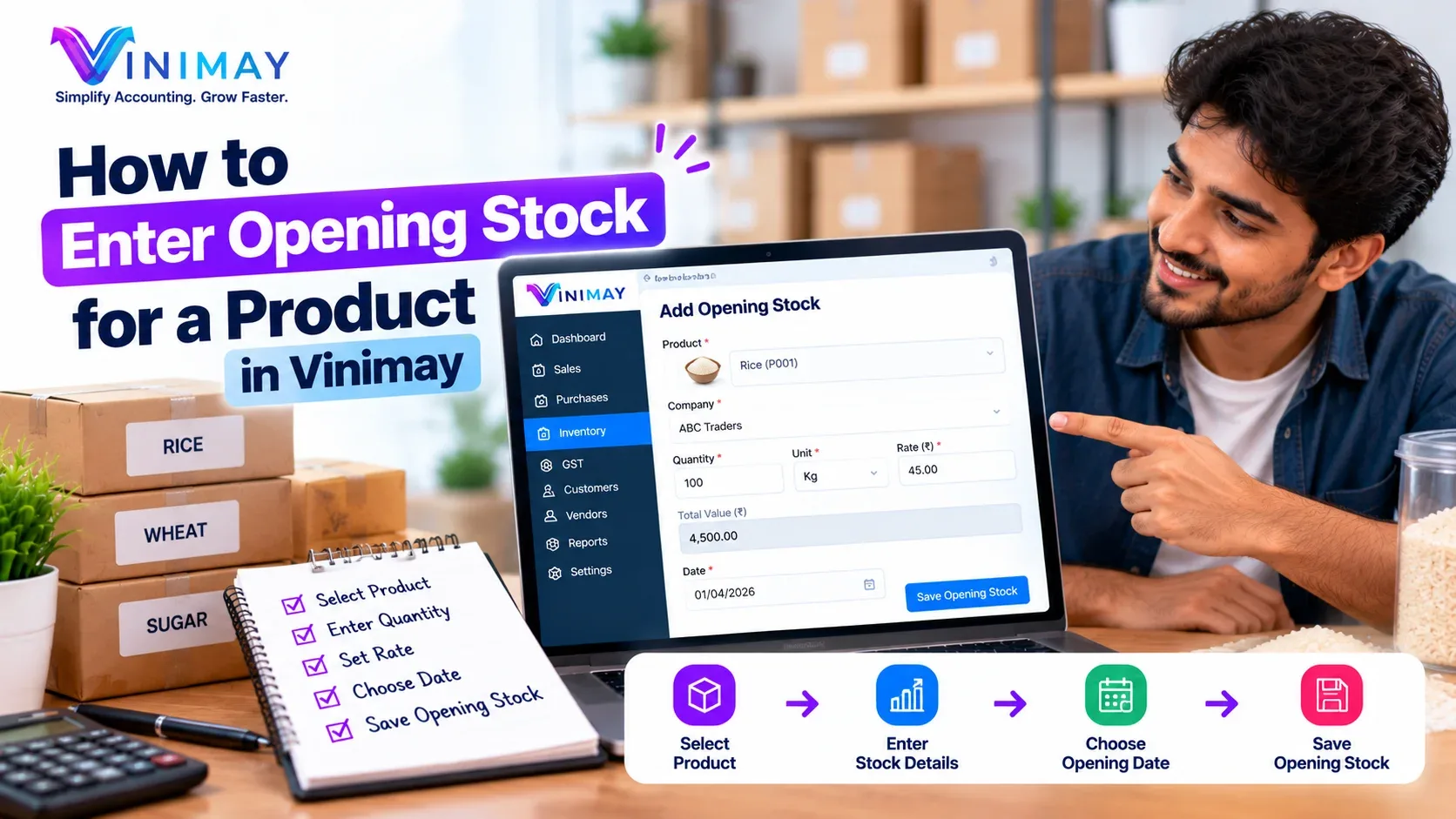
Businesses that deal in products need stock control. Vinimay helps manage product records, stock movement, and sales and purchase transactions together with billing.
Business Reports
Reports help owners understand performance. Vinimay provides structured information on sales, purchases, payments, transactions and overall business activity.
Vinimay vs Zoho Books: Quick Comparison
| Factor | Vinimay | Zoho Books |
|---|---|---|
| Primary focus | Indian MSMEs and local business practices | Broader, global accounting ecosystem |
| GST workflow | Core focus of the platform | GST features supported for Indian businesses |
| Accounting approach | CA-led, simple and structured | Wider feature range within a larger software suite |
| Best for | Businesses that want a simple, focused Indian workflow | Businesses that need connected tools or operate across regions |
| Ecosystem | Focused accounting platform | Integrates with other Zoho applications and business tools |
| Ease of adoption | Simple workflows for non-accountants | Depends on the features and setup you choose |
Plans and features change over time, so confirm current details on each vendor's official website before you decide. For specific Vinimay capabilities such as multi-branch reporting, check with the Vinimay team.
When Should a Business Choose Vinimay?
Vinimay may be suitable if you prioritize:
- Indian GST-focused accounting
- Simple accounting workflows
- CA-friendly records
- Customer and vendor tracking
- Inventory management
- Easy business reporting
Businesses such as retail shops, traders, manufacturers, restaurants, service providers and growing MSMEs can benefit from a platform designed around Indian business practices.
When Might Zoho Books Be Suitable?
Zoho Books may be useful if your business:
- Already uses other Zoho applications
- Needs a broader software ecosystem
- Requires integration with multiple business tools
- Operates across different regions
Whichever you consider, check whether the platform matches your accounting requirements and daily workflow.
Which Should You Choose? A Simple Decision Guide
- List your must-have tasks. GST invoicing, customer and vendor ledgers, stock tracking and reports usually top the list.
- Check your team's comfort. A simpler tool means faster onboarding for non-accountants.
- Look at your tool ecosystem. If your business already runs on a suite of connected apps, integration may matter more.
- Think about growth. Consider transaction volume, number of customers and vendors, and reporting needs over the next two to three years.
- Ask your CA. Find out which reports and data formats they need.
- Try before you commit. Create sample invoices, check ledgers and run reports.
Common Mistakes Businesses Make While Selecting Accounting Software
Choosing only based on brand name.
A popular brand does not always match every business requirement. Evaluate features, ease of use, compliance needs and reporting requirements.Ignoring local accounting requirements.
Indian businesses often need GST-focused workflows and local practices. Ignoring them can create extra manual work.
Not considering future growth.
Pick software that can support increasing transactions, more customers and vendors, and better reporting.
Not discussing requirements with the CA.
Your CA can guide you on accounting structure, the reports you need and compliance requirements.
Skipping migration planning.
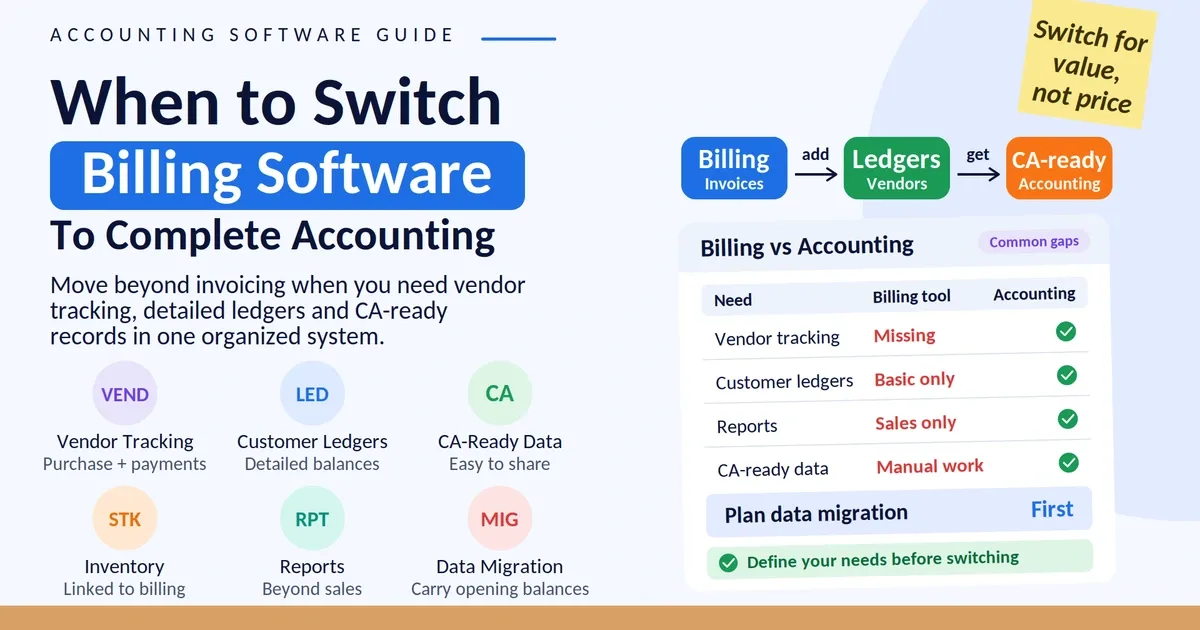
Switching without carrying forward customer balances, vendor balances and stock accurately creates problems from day one.
A Practical Scenario
A small trading business with a team of four compared two platforms. One was part of a large connected suite, the other a focused Indian accounting tool. Their needs were GST invoices, customer dues, vendor payments, stock and monthly reports for the CA. They did not use any other connected business apps. After listing their must-haves and testing sample invoices and ledgers, they chose the simpler, focused option because it matched their daily workflow. A business that already ran several connected applications might have reached the opposite conclusion, and that is exactly why the right choice depends on the business.
How Vinimay Helps Small Businesses
Vinimay provides an organized accounting foundation for Indian businesses:
- GST Invoice Management: Create and manage GST invoices with structured records.
- Customer and Vendor Management: Track customers, suppliers, payments and balances efficiently.
- Ledger Management: Maintain detailed transaction records and account balances.
- Inventory Management: Manage products and stock along with billing operations.
- Reports: Understand business performance through organized reports.
- Digital Records: Keep accounting data in a structured format suitable for professional review.
Frequently Asked Questions
1. Which is better: Vinimay or Zoho Books?
It depends on your requirements. Vinimay focuses on Indian MSME workflows, GST compliance and CA-led accounting, while Zoho Books provides a broader global accounting ecosystem.
2. Is Vinimay an alternative to Zoho Books?
Yes. Businesses looking for a platform focused on Indian GST requirements, local business practices and simplified workflows can consider Vinimay.
3. Does Zoho Books support GST in India?
Yes, Zoho Books supports GST features for Indian businesses. Compare whether the overall workflow matches your specific requirements.
4. Which accounting software is easier for small business owners?
Ease of use depends on your needs. Businesses looking for a focused Indian accounting workflow may prefer software designed around local operations. Try a demo or trial before deciding.
5. Can Vinimay manage GST invoices?
Yes, Vinimay supports GST invoice management with structured transaction records.
6. Does Vinimay support inventory management?
Yes, Vinimay includes inventory-related features to help manage products, stock, sales and purchases.
7. Which software is better for CA collaboration?
Software with organized records and proper reports makes CA collaboration easier. Vinimay follows a CA-led approach designed around Indian accounting workflows. Ask your CA which tool suits their working style.
8. Is Vinimay suitable for retailers and traders?
Yes. Vinimay is designed for Indian businesses including retailers, traders, manufacturers, restaurants and service providers.
9. Can accounting software track customer outstanding payments?
Yes. Accounting software can maintain customer records, payment history and outstanding balances.
10. Can accounting software manage vendor payments?
Yes. It can track supplier details, purchase records and pending payments.
11. Should a small business choose global or India-focused accounting software?
It depends on your needs. Businesses requiring Indian GST workflows may prefer India-focused solutions, while businesses needing broader integrations may consider global platforms.
12. Why do businesses switch accounting software?
Usually for better reporting, improved accounting control, GST management, inventory tracking or easier financial record management.
13. How do I compare Vinimay vs Zoho Books before deciding?
List your must-have features, test both with sample invoices and ledgers, check pricing and support on each vendor's website, and ask your CA for input.
14. Can I move my data from my current software to a new one?
Yes. Verify customer and vendor closing balances and stock, then enter them as opening balances in the new system. Keep your old data for reference.
15. Does the Vinimay vs Zoho Books choice affect GST compliance?
Both can support GST workflows, but your compliance depends on correct data entry and your CA's guidance. Check that invoices include the required details and that reports match your filing needs.
16. Do I need an integration-heavy platform?
Only if you already use several connected business applications. If your needs are invoicing, ledgers, stock and reports, a focused platform may be enough.
17. What should I check about pricing?
Review current plans, user limits, feature limits and support options on the official websites, because these change over time.
18. Is it risky to switch mid-year?
It can be done, but many businesses prefer a financial year start for cleaner records. Discuss timing with your CA.
Conclusion
The Vinimay vs Zoho Books comparison shows that both platforms serve different business requirements. Zoho Books offers a broader global accounting ecosystem, while Vinimay focuses on Indian MSMEs with GST compliance, local workflows and CA-led accounting practices.
Small businesses should select software based on their actual needs, including compliance requirements, reporting expectations, workflow simplicity and future growth plans.
For Indian businesses looking for a focused accounting platform with GST billing, customer and vendor management, ledgers, inventory and organized financial records, Vinimay provides a structured solution designed around local business needs.
Related Topics
Published by admin
Our editorial and compliance specialists create practical guides, tax calculation rules, and operational strategies to empower Indian small business owners and accountants.