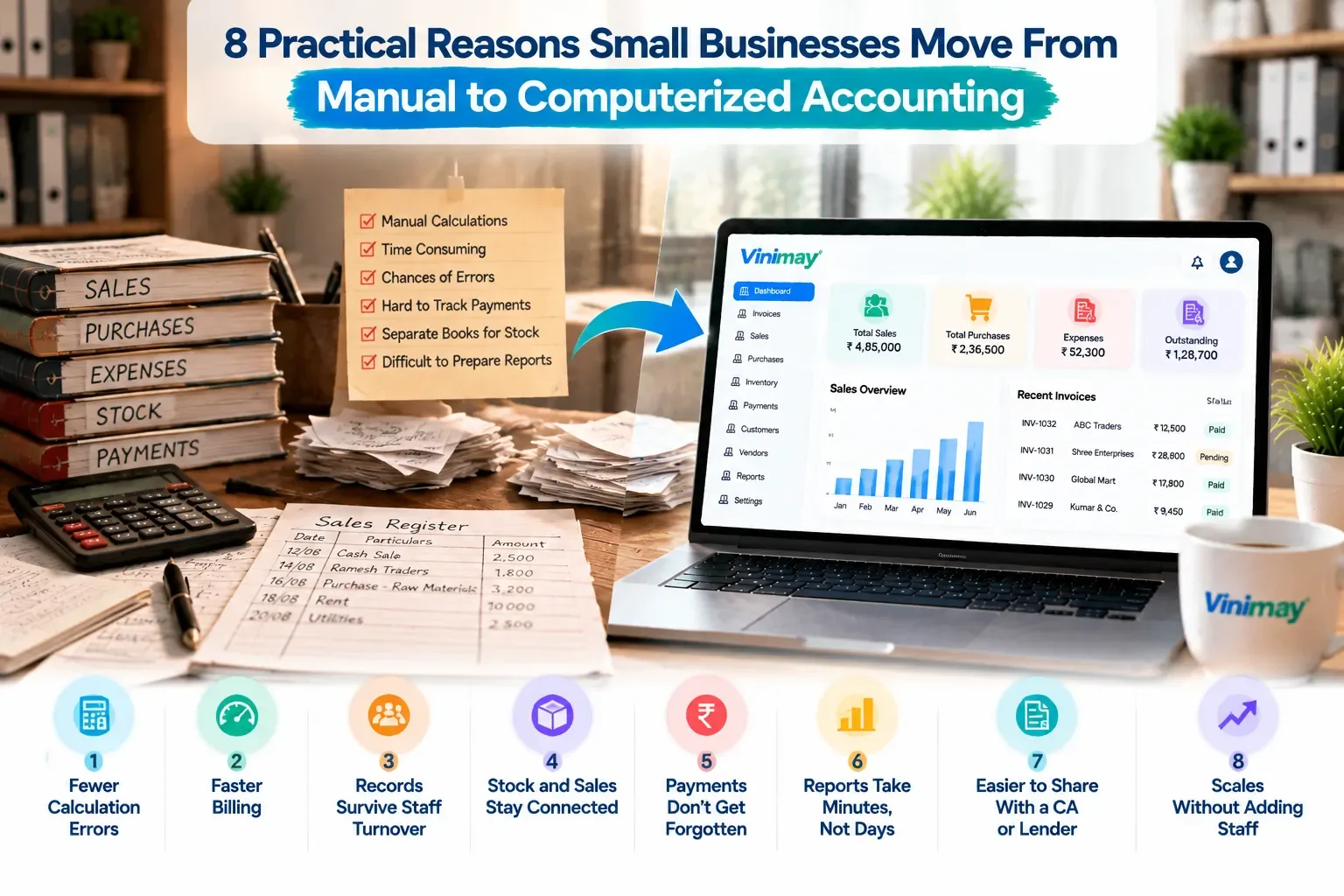
8 Practical Reasons Small Businesses Move From Manual to Computerized Accounting
A business owner rarely wakes up one day and decides to abandon their register overnight. The shift usually happens gradually—a missed payment here, a mismatched stock count there — until the pattern becomes impossible to ignore. Vinimay helps businesses manage GST invoicing, sales and purchase records, payment tracking, inventory and reports in one connected system. This guide walks through eight concrete reasons businesses make this move, with a clear picture of what actually changes at each step.
Why Do Businesses Move Away From Manual Accounting?
The short answer is that manual systems work fine at low volume and break down predictably as volume grows — more bills mean more chances for a missed entry, a wrong calculation, or a forgotten payment. Each reason below reflects a specific point where that breakdown tends to happen.
Reason 1: Fewer Calculation Errors
Every handwritten bill depends on someone adding tax and totals correctly, by hand, every single time. A computerized system calculates these automatically from the entered amount and rate, removing the arithmetic step where most manual mistakes happen. This matters more than it sounds — a single miscalculated GST amount on a B2B invoicecan affect a customer's input tax credit, not just your own records.
Reason 2: Faster Billing
Manual billing means writing out the same customer details, item descriptions and totals from scratch every time. In a computerized system, saved customer and product details are reused automatically, cutting the time spent per invoice significantly — which adds up across a busy counter or a month of regular billing.
Reason 3: Records Survive Staff Turnover
A notebook or register is only as reliable as the person who filled it in—if that staff member leaves, so does their memory of shorthand notes or informal tracking habits. Records kept in a system stay accessible and consistent regardless of who enters new data going forward.
Reason 4: Stock and Sales Stay Connected
In a manual setup, a sale is written in one book and stock is counted separately in another, and the two rarely stay in sync for long. A computerized system reduces stock automatically when a sale is recorded, so the two numbers move together instead of drifting apart over weeks.
Reason 5: Payments Don't Get Forgotten
Tracking who owes what, manually, depends entirely on someone remembering to check a separate ledger or notebook. A computerized system flags outstanding invoices automatically, so pending payments are visible without a manual cross-check every time.
Reason 6: Reports Take Minutes, Not Days
Producing a monthly sales or expense total by hand means going through every entry and adding it up — a task that eats into hours that could go toward running the business.In a connected system, the same report is generated instantly from entries already made for billing purposes.
Reason 7: Easier to Share With a CA or Lender
A CA reviewing handwritten books has to first reconstruct what happened before they can even start analysing it. Digital records can be shared directly, already organised by date, customer or category — saving both time and the risk of misreading someone's handwriting.
Reason 8: Scales Without Adding Staff
Manual accounting scales roughly one-to-one with volume — double the bills, and you often need double the hands to manage them. A computerized system absorbs growing volume with the same effort per entry, so the business can grow without proportionally growing its back-office headcount.
What Manual Accounting Still Gets Right
To be fair, manual accounting isn't without merit at very low volume—it requires no setup, no learning curve, and works when a business issues only a handful of bills a month. The case for switching gets stronger specifically as volume, staff count, or the need for reports and shared records increases — not as a blanket rule for every business at every stage.
Making This Shift With Vinimay
Vinimay is built around the exact friction points listed above — GST invoicing with automatic tax calculation, sales and purchase records that stay connected to inventory, payment tracking that flags outstanding amounts, and reports drawn directly from your existing entries. Moving from a register to Vinimay doesn't mean learning accounting theory; it means recording the same transactions you already track, in a system that carries the calculation and organisation forward for you.
To try this shift without commitment, Vinimay's free invoice tool lets you generate up to 5 GST invoices free and download them as PDF.
Conclusion
The shift from manual to computerized accounting rarely happens for one dramatic reason—it usually adds up from smaller, recurring friction points: a miscalculated tax amount, a forgotten payment, a stock count that doesn't match. Each of the eight reasons above reflects a specific, common breakdown point in manual systems, and a specific way computerized accounting closes that gap. Vinimay is built around these same points—GST invoicing,connected records, payment tracking and reports—making the shift a matter of recording what you already track, not learning something new.
Frequently Asked Questions
1. At what point should a business switch from manual to computerized accounting?
Typically once invoice volume, staff involvement, or the need for reports starts making manual tracking time-consuming or error-prone.
2. Is computerized accounting more accurate than manual bookkeeping?
Generally yes, mainly because it removes manual calculation and reduces inconsistent entry across multiple books or staff.
3. Does switching to computerized accounting require accounting knowledge?
No — most systems are built around everyday transactions like sales and payments, not accounting theory.
4. Can a very small business stay on manual accounting?
Yes, if volume is low and records don't need to be shared or reported on frequently.
5. How does computerized accounting help with GST compliance?
By applying tax fields consistently and reducing the chance of missed GSTINs or incorrect tax calculations.
6. Does Vinimay require installation to get started?
Vinimay's free invoice tool works without installation, letting you create up to 5 GST invoices free.
7. Will switching to software mean losing past manual records?
Not necessarily — opening balances and pending figures can typically be entered into the new system as a starting point.
8. Is computerized accounting only for larger businesses?
No, small businesses benefit too, particularly around GST accuracy, saved customer details and reduced manual entry.
9. Does computerized accounting eliminate the need for a CA?
No, but it makes sharing organised records with a CA faster and easier to review.
10. What's the biggest immediate benefit of switching?
Most businesses notice fewer calculation errors and faster billing first, before the reporting and reconciliation benefits become visible
Related Topics
Published by Team Vinimay
Our editorial and compliance specialists create practical guides, tax calculation rules, and operational strategies to empower Indian small business owners and accountants.