Learn how to complete financial year-end closing with sales, expenses, inventory, bank reconciliation, receivables, payables and CA review.
A
admin
Financial Insights & Compliance Desk
Share:
Financial year-end closing is an important process for every business because it brings together and verifies the financial records maintained throughout the year. As the financial year comes to an end, business owners need to close their books, organize data for their CA, and make sure that sales, purchases, expenses, inventory, receivables, payables, and other financial records are complete and accurate.
The process can become stressful when businesses wait until the last moment to review their records. Missing invoices, unrecorded expenses, unreconciled customer or supplier balances, and differences between physical and book inventory can make year-end closing more complicated and increase the possibility of errors. Pasted markdown
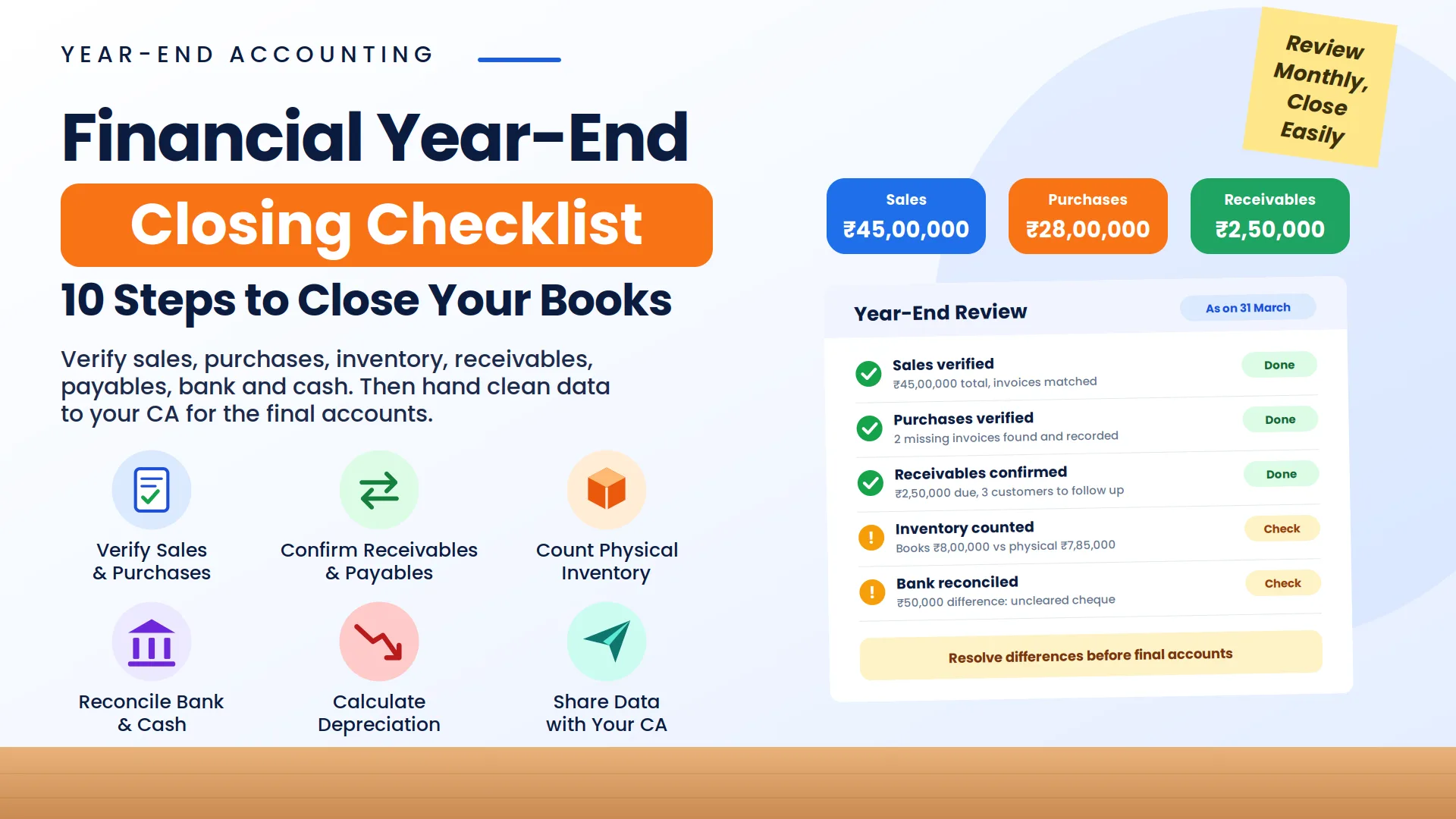
A proper financial year-end closing process involves verifying sales, purchases, and expenses, confirming receivables and payables, physically checking inventory, reconciling bank and cash balances, calculating depreciation, recording necessary adjustments, and organizing the final data for preparation of the Profit & Loss Statement and Balance Sheet. Pasted markdown
The best approach is not to wait until the end of the year. Businesses that maintain their records throughout the year can make year-end closing a final verification exercise instead of a large data-collection task.
Why Is Financial Year-End Closing Important?
Financial year-end closing is important for several reasons:
Complete and verified data is required for accurate tax filing.
It helps determine the business actual profitability and financial position.
It provides a reliable foundation for the next year's budgeting and planning.
Banks and investors may require accurate financial statements for loans or investment decisions.
Organized records make audit and CA review easier. Pasted markdown
A properly completed year-end closing also helps identify discrepancies before they affect financial statements or compliance work.
Financial Year-End Closing: Step-by-Step Process
1. Verify All Sales Transactions
Review all sales invoices recorded during the financial year.
Missing or incorrectly recorded sales can affect both revenue and tax reporting. Pasted markdown
2. Check All Purchase and Expense Records
Review every purchase invoice and expense entry recorded during the year.
Make sure that:
Purchase invoices are complete.
Business expenses have been recorded.
No major expense has been missed.
Expenses are properly categorized.
Supporting documents are available where required.
Unrecorded expenses can result in an incorrect calculation of business profit. Pasted markdown
3. Confirm Receivables
Review the outstanding balance of every customer.
Check:
Total amount receivable.
Overdue invoices.
Customer-wise outstanding balances.
Any disputed or incorrect balances.
If there is a difference between your records and the customer's records, investigate and resolve it before finalizing the books. Pasted markdown
4. Confirm Payables
Review the outstanding amount payable to every supplier.
Check:
Supplier-wise balances.
Unpaid purchase invoices.
Partial payments.
Overdue amounts.
Any disputed supplier balance.
Accurate payable balances are also important because they may become opening balances for the next financial year. Pasted markdown
5. Physically Verify Inventory
Count the actual physical stock available at year-end and compare it with the inventory shown in the books.
If there is a difference, identify the reason. It could be due to:
Damaged goods
Theft or loss
Unrecorded purchases
Unrecorded sales
Data-entry errors
Other stock movements
The physical inventory should be reviewed before finalizing the closing stock figure. Pasted markdown
6. Reconcile Bank and Cash Balances
Compare your accounting records with the bank statement.
Also verify the actual cash-in-hand balance.
Bank reconciliation can help identify:
Uncleared cheques
Bank charges
Missing transactions
Direct bank credits
Direct bank debits
Recording errors
Cash-in-hand should also be compared with the actual physical cash available. Pasted markdown
7. Calculate Depreciation
Review fixed assets such as:
Machinery
Equipment
Vehicles
Furniture
Other applicable assets
Applicable depreciation should be considered while finalizing the year's financial statements because it affects the reported profit. Pasted markdown
8. Record Provisions and Necessary Adjustments
Review whether any year-end adjustments are required.
These may include items such as:
Bad debts
Outstanding expenses
Other accounting adjustments
Relevant provisions
The applicable accounting and tax treatment should be reviewed with the CA before finalizing these entries. Pasted markdown
9. Prepare Financial Statements or Provide Data to Your CA
After completing the verification and reconciliation process, organize the final financial data.
This information can be used to prepare:
Profit & Loss Statement
Balance Sheet
Other required financial statements and schedules
Businesses that work with a CA can provide the verified and organized data to the CA for final preparation. Pasted markdown
10. Complete GST and Other Applicable Compliance Work
Review the GST records and other applicable compliance requirements for the financial year.
GST reconciliation and annual compliance should be completed in coordination with the CA or relevant professional, based on the business's applicable requirements. Pasted markdown
Financial Year-End Closing Checklist
Task
Status
Sales invoices complete and verified
✓
Purchase invoices complete and verified
✓
Expenses recorded category-wise
✓
Receivables confirmed
✓
Payables confirmed
✓
Physical inventory counted
✓
Bank statement reconciled
✓
Cash balance verified
✓
Depreciation calculated
✓
Data provided to CA
✓
This checklist can be used as a simple year-end review before the books are finalized. Pasted markdown
Practical Example of Financial Year-End Closing
Suppose a retail business reviews its accounts at the end of March.
Review Area
Finding
Sales Verification
₹45,00,000 total sales; invoices matched
Purchase Verification
₹28,00,000 purchases; 2 missing invoices identified and recorded
₹50,000 difference identified due to an uncleared cheque
The inventory difference and bank difference should be investigated before the final accounts are prepared. A systematic review like this helps identify discrepancies while there is still an opportunity to resolve them. Pasted markdown
Common Financial Year-End Closing Mistakes
Businesses commonly make the following mistakes:
Waiting until the last moment to close the books.
Not physically verifying inventory.
Skipping receivables and payables reconciliation.
Failing to record small cash expenses throughout the year.
Ignoring bank reconciliation.
Providing incomplete or unorganized data to the CA. Pasted markdown
These issues can make the year-end process unnecessarily difficult and may require additional time to identify and correct missing information.
Why Year-Round Record Keeping Makes Closing Easier
Financial year-end closing becomes much easier when the business maintains its records throughout the year.
If sales, expenses, receivables, payables, inventory, and bank transactions are regularly reviewed, year-end closing becomes primarily a verification and reconciliation exercise rather than a large data-compilation project.
Businesses that do not maintain their records regularly may spend significant time at year-end collecting invoices, checking balances, and reconstructing transactions. Pasted markdown
A weekly or monthly review can therefore reduce the workload that accumulates at the end of the financial year.
How Vinimay Helps With Financial Year-End Closing
Vinimay helps businesses keep their financial data organized throughout the year, making the year-end review process more structured.
Sales Management
Sales transactions can be maintained digitally throughout the year, making year-end sales verification easier.
Purchase Management
Purchase invoices can be maintained digitally, helping businesses keep purchase records organized.
Ledgers
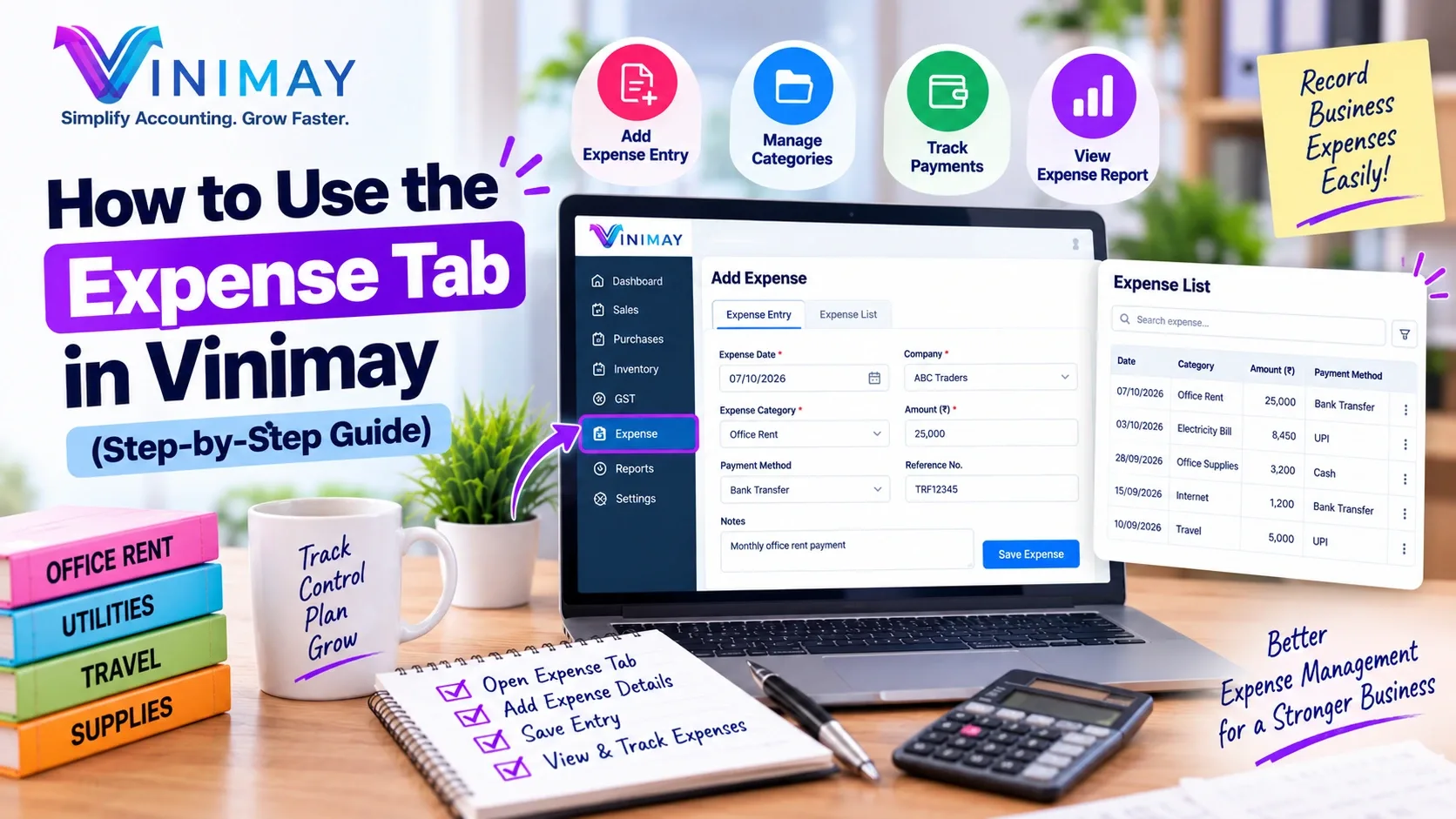
Expenses can be recorded systematically and categorized throughout the year instead of being compiled at year-end.
Customer & Vendor Management
Customer receivables and vendor payables can be tracked in an organized manner, helping businesses review outstanding balances.
Inventory Management
Digital stock records can be compared with physical inventory during the year-end verification process.
Reports
Vinimay's reporting workflow helps businesses review consolidated financial data, making it easier to organize information before sharing it with the CA. Pasted markdown
Vinimay helps organize business data, while formal financial statement preparation and tax filing should be completed with appropriate professional guidance from a CA.
Frequently Asked Questions (FAQs)
1. How do I complete financial year-end closing?
Start by verifying all sales, purchases, and expenses. Then confirm receivables and payables, physically verify inventory, reconcile bank and cash balances, review depreciation and adjustments, and organize the final data for financial statement preparation.
How Vinimay Helps: Vinimay keeps sales, expenses, inventory, and outstanding data organized throughout the year, making year-end verification easier. Pasted markdown
2. Is physical inventory counting necessary for year-end closing?
Physical inventory verification is an important part of year-end review because it helps identify differences between actual stock and book records.
How Vinimay Helps: Vinimay's inventory records provide a digital reference that can be compared with the physical stock count. Pasted markdown
3. Why is bank reconciliation important at year-end?
Bank reconciliation helps identify differences between the accounting records and the actual bank balance. It can reveal uncleared cheques, missing transactions, bank charges, or recording errors.
How Vinimay Helps: Vinimay allows businesses to maintain bank and cash transactions in an organized accounting workflow. Pasted markdown
4. Should financial year-end closing only be done at the end of the year?
Formal year-end closing takes place at the end of the financial year, but businesses should review and maintain their records throughout the year. Regular reviews reduce the amount of work required at year-end.
How Vinimay Helps: Vinimay helps businesses maintain financial information throughout the year, making the final closing process more manageable. Pasted markdown
5. What is depreciation and why is it important during year-end closing?
Depreciation represents the reduction in the value of applicable fixed assets over time. It is considered while preparing financial statements because it affects the reported profit.
How Vinimay Helps: Vinimay can help maintain organized records of asset-related purchases, while depreciation calculations can be handled with appropriate professional guidance. Pasted markdown
6. What should I do if there is a mismatch in receivables or payables?
First, check the relevant customer or supplier records and identify the reason for the difference. Confirm the balance with the concerned party and make the appropriate correction if required.
How Vinimay Helps: Vinimay's customer and vendor records help businesses review outstanding balances and identify discrepancies more easily. Pasted markdown
7. Can I complete year-end closing myself, or do I need a CA?
Basic data verification and reconciliation can be performed by the business, but professional assistance from a CA is advisable for formal financial statement preparation and applicable tax filing.
How Vinimay Helps: Vinimay keeps financial information organized so that the relevant data can be shared with the CA more efficiently. Pasted markdown
Conclusion
Financial year-end closing is more than a routine accounting formality. It is an important process for accurately capturing the business's performance, confirming its financial position, completing required compliance work, and preparing for the next financial year.
The process becomes much easier when businesses regularly maintain sales, purchases, expenses, receivables, payables, inventory, bank, and cash records throughout the year. Instead of trying to compile an entire year's information at the last moment, the business can focus on final verification and reconciliation.
An organized accounting workflow such as Vinimay helps businesses maintain their financial data systematically throughout the year, making year-end closing more structured and providing the CA with organized information for preparing the relevant financial statements.
Our editorial and compliance specialists create practical guides, tax calculation rules, and operational strategies to empower Indian small business owners and accountants.