AI tools today can genuinely take a set of transactions and generate something that looks like a financial report — formatted, organised, and readable. Whether that output is actually a correct financial report is a different question entirely, and the gap between "looks like a report" and "is a report you can rely on" is exactly where most of the confusion around this topic sits. The honest breakdown looks like this: AI is genuinely useful at summarising and formatting data it's given — turning a list of transactions into a readable sales summary, for instance. It's far less reliable at the judgement calls a proper financial reports requires — deciding how to categorise an ambiguous transaction, applying accounting standards correctly, or catching that a number looks wrong because it doesn't match the broader context of the business. An AI tool doesn't know your business the way an accountant reviewing your specific numbers does.
What AI Genuinely Does Well Here
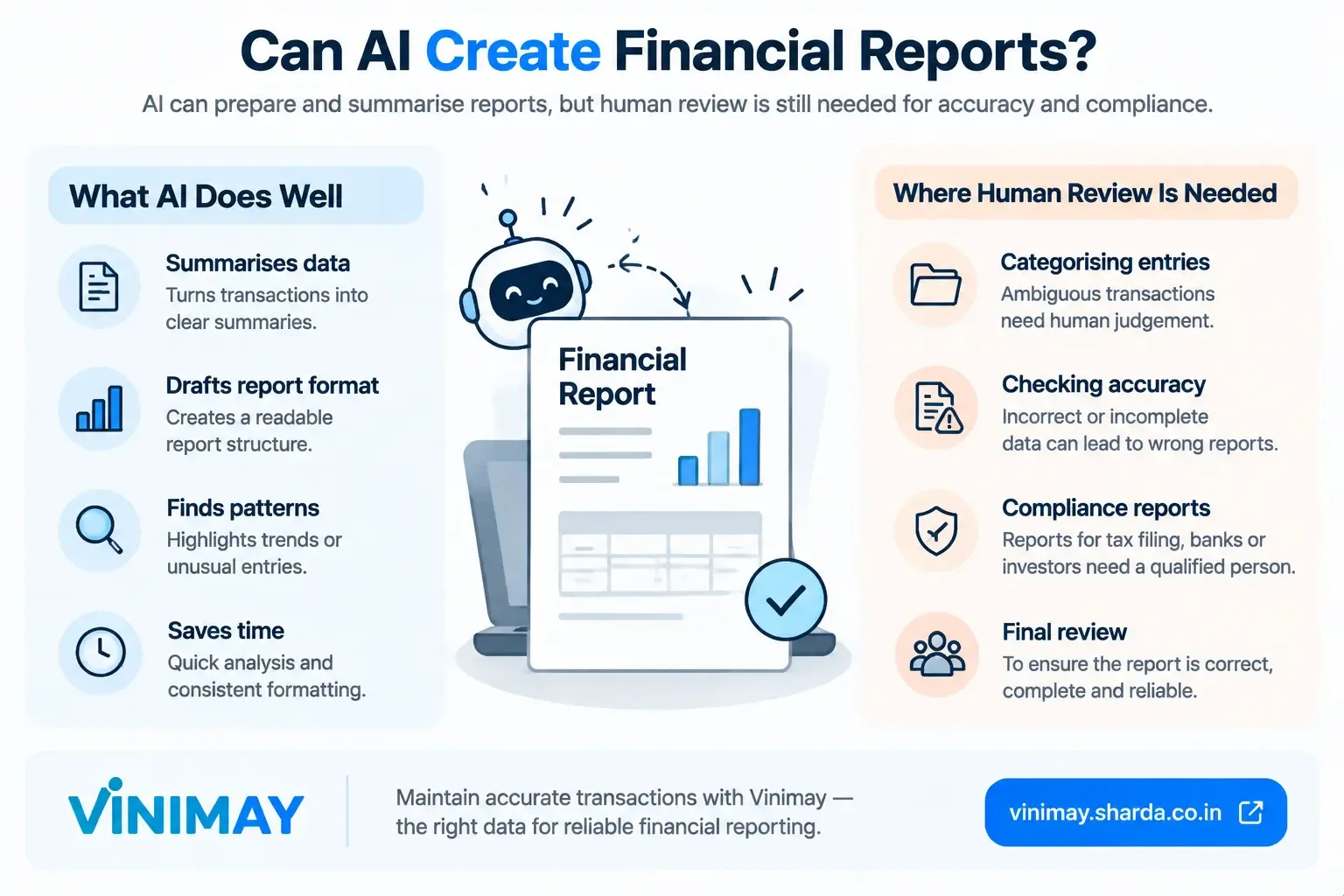
Data Summarisation: Quickly turns large volumes of transaction data into clear, readable summaries.
Report Drafting: Creates an initial report structure that a human can review, verify, and refine.
Pattern Detection: Identifies trends, unusual entries, or recurring patterns when the underlying data is clean and complete.
Faster Analysis: Helps reduce the time required to review and interpret large datasets.
Consistent Formatting: Can organise financial information into a standard report format for easier review.
Where AI Falls Short Without Human Review
Ambiguous transactions still need a human decision on how they should be categorised.
Data that's incomplete or wrong going in produces a confident-looking but wrong report coming out.
Compliance-sensitive reports (for filing, for a bank, for an investor) still need a qualified person checking them before they go anywhere important.
Where Vinimay Fits — and Doesn't
Vinimay's confirmed capabilities centre on recording GST-compliant invoices and transactions accurately — sales, purchases, receipts, payments — connected to customer and vendor accounts. This accurate underlying data is exactly what any reporting, AI-assisted or otherwise, depends on to be trustworthy in the first place. AI-generated financial statements or automated report drafting aren't part of Vinimay's currently confirmed feature set — if this is specifically what you're looking for, it's worth checking directly rather than assuming.
Conclusion
AI can genuinely help format and summarise financial data, but "creating a financial report" in the full sense still leans on human judgement for categorisation, accuracy checks, and compliance review. The most reliable approach right now treats AI as a drafting assistant working from accurate data, not a replacement for the review step.
Frequently Asked Questions
Q1. Can AI generate a profit & loss statement?
AI can help prepare or summarise a profit & loss statement when accurate sales, income, and expense data are available.
Q2. Can AI create a balance sheet?
Yes, AI can assist in preparing or analysing balance-sheet information when asset, liability, and equity records are properly maintained.
Q3. Can AI analyse cash flow?
AI can analyse recorded cash inflows and outflows and help identify patterns, changes, or unusual movements in cash flow.
Q4. Can AI create financial reports from Excel data?
Yes, AI can analyse structured Excel data and help organise it into financial summaries and reports, provided the data is complete and correctly formatted.
Q5. Can AI identify financial trends?
AI can compare financial data across different periods and highlight changes in sales, expenses, profit, cash flow, or other recorded metrics.
Q6. Can AI automatically correct accounting errors?
AI may identify potential inconsistencies or unusual entries, but accounting corrections should be reviewed before changes are made to financial records.
Q7. Can AI prepare reports for tax filing?
AI can help organise and summarise relevant financial information, but tax filings and compliance reports should be checked against applicable rules and, where necessary, reviewed by a qualified professional.
Q8. Can AI create financial reports automatically every month?
This depends on the accounting software and AI features available. Systems with automated reporting can generate recurring summaries using updated transaction data.
Q9. Is AI-generated financial information always accurate?
No. AI depends on the quality of the data and the rules or calculations used by the system. Financial reports should be reviewed for completeness and accuracy.
Q10. Can small businesses use AI for financial reporting?
Yes. Small businesses can use AI to summarise financial information, analyse trends, organise reports, and reduce manual reporting work, while maintaining appropriate review and accounting controls.
Related Topics
Published by Team Vinimay
Our editorial and compliance specialists create practical guides, tax calculation rules, and operational strategies to empower Indian small business owners and accountants.