Some accounting software does offer cash flow forecasting, projecting what your bank balance might look like in coming weeks based on expected invoices, payments due, and past patterns. This is a genuinely useful feature where available—but it's worth understanding what it actually is before relying on it: an educated projection based on patterns, not a guarantee.
A forecast is only as reliable as two things: how complete your historical data is and how predictable your business actually is. A business with steady, recurring customers and consistent payment timing is far easier to forecast accurately than one with irregular, one-off sales and unpredictable customer payment behavior. The same forecasting feature can feel remarkably accurate for one business and consistently off for another, purely based on how predictable the underlying pattern is.
What Is Cash Flow Forecasting?
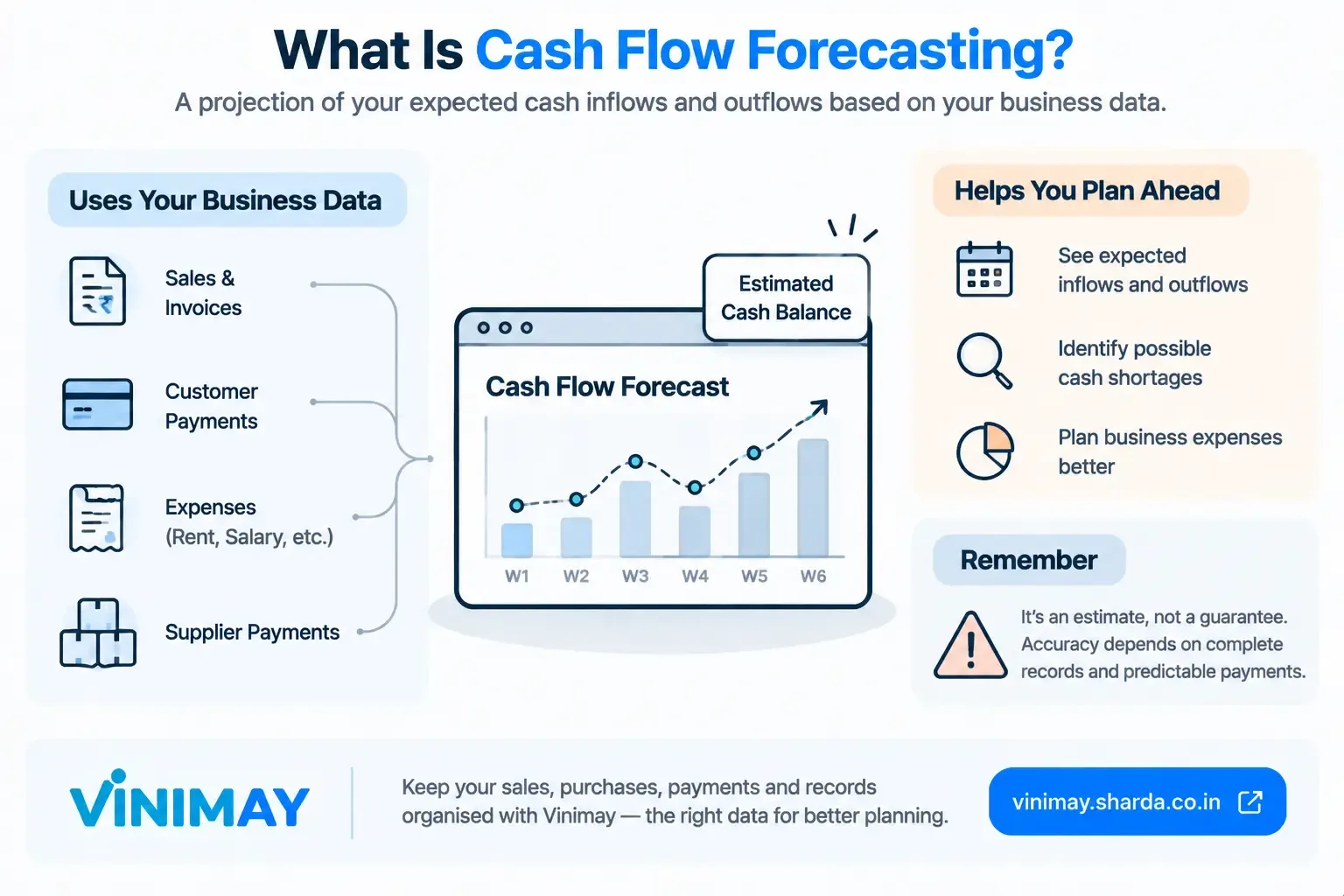
Cash flow forecasting is the process of estimating how much money a business is expected to receive and spend during a future period. It gives business owners a clearer understanding of expected cash inflows and cash outflows, helping them plan their finances and manage working capital more effectively.
Cash inflows may include sales receipts, customer payments, loans, investments, and other business income, while cash outflows can include supplier payments, salaries, rent, utilities, taxes, loan repayments, and operating expenses. By comparing expected inflows with planned outflows, businesses can identify periods when they may have excess cash or face a potential cash shortage.
Accounting software can make cash flow forecasting easier by keeping sales, expenses, invoices, receivables, payables, and payment records organized. Businesses can use historical transaction data and upcoming payment information to understand their expected cash position. However, a forecast is an estimate, so its accuracy depends on the quality of the financial data and assumptions used.
What Makes a Cash Flow Forecast Reliable
Complete transaction history. Gaps in recorded sales or purchases directly weaken the pattern a forecast is built on.
Consistent payment behavior. Customers who pay on a regular schedule are easier to project than ones who pay unpredictably.
Enough historical data. A forecast based on one month of records is far shakier than one based on a year of consistent patterns.
How Accounting Software Supports Cash Flow Forecasting
Accounting software can support cash flow forecasting by bringing sales, expenses, invoices, payments, receivables, and payables into organized financial records. Instead of relying entirely on manual calculations, businesses can use their recorded transaction data to understand their current cash position and estimate future cash movements.
Key ways accounting software supports cash flow forecasting include:
Tracking sales and customer payments: Businesses can monitor invoices issued, payments received, and outstanding amounts to estimate future cash inflows.
Monitoring expenses: Regular business expenses such as rent, salaries, utilities, and purchases can be recorded to estimate upcoming cash outflows.
Managing accounts receivable: Tracking pending and overdue customer payments helps businesses understand when money is expected to come into the business.
Managing accounts payable: Upcoming supplier bills and other payment obligations can be monitored to plan future cash requirements.
Using historical transaction data: Previous sales and expense records can help businesses identify patterns and make more informed cash flow estimates.
What a Forecast Can't Account For
A sudden, unexpected large order or expense that breaks the historical pattern.
A customer who has always paid on time suddenly is not paying.
External events—market shifts, seasonal changes not yet reflected in your data.
Where Vinimay Stands on This
Vinimay's confirmed scope covers recording sales, purchases, receipts, and payments accurately against connected customer and vendor accounts—this is the foundational data any cash flow forecast would need to be built on. Dedicated cash flow prediction or forecasting features aren't part of what's currently confirmed for Vinimay. If forecasting specifically is a requirement for your business, it's worth confirming this directly rather than assuming it's included, since Vinimay's verified strength currently lies in accurate transaction recording rather than predictive forecasting.
Conclusion
Cash flow forecasting in accounting software is a genuinely useful feature where it exists, but it's a projection based on patterns, not a guarantee—reliable for predictable businesses with complete records, shakier for irregular ones. Before trusting any forecast, check how complete your underlying data actually is, since that's what the projection is really built on.
FAQs
Q1. Can accounting software forecast future cash flow?
Some software can use existing financial data to estimate future cash inflows and outflows.
Q2. What data is used for cash-flow forecasting?
Forecasts may use sales, expenses, customer receivables, supplier payables, recurring payments, and historical transaction data.
Q3. Can software predict when customers will make payments?
Some systems can use outstanding invoices and payment history to help estimate expected collections, depending on their features.
Q4. Can accounting software forecast business expenses?
Recurring expenses and historical spending patterns can be used to estimate future outflows where the software supports forecasting.
Q5. Can cash-flow forecasting help small businesses?
Yes. It can help businesses understand expected cash availability and identify periods when upcoming payments may exceed expected collections.
Q6. Is an accounting software cash-flow forecast always accurate?
No. Forecasts depend on the quality of recorded data and assumptions about future sales, expenses, and payment timing. Unexpected events can change the actual cash position.
Q7. Can I create a cash-flow forecast from historical data?
Yes, historical sales, expenses, collections, and payments can provide useful information for estimating future cash movements.
Q8. Can accounting software show expected cash balances?
Some systems can estimate future balances by combining current cash, expected receipts, and expected payments.
Q9. Can cash-flow forecasting identify potential cash shortages?
A forecast can highlight periods where expected cash outflows may be higher than expected inflows, giving the business an opportunity to review upcoming obligations.
Q10. Do I still need to review a software-generated cash-flow forecast?
Yes. Businesses should review forecasts regularly and update them when sales expectations, customer payments, expenses, or other financial conditions change.
Related Topics
Published by Team Vinimay
Our editorial and compliance specialists create practical guides, tax calculation rules, and operational strategies to empower Indian small business owners and accountants.